- Published on
- Veemi Accounting
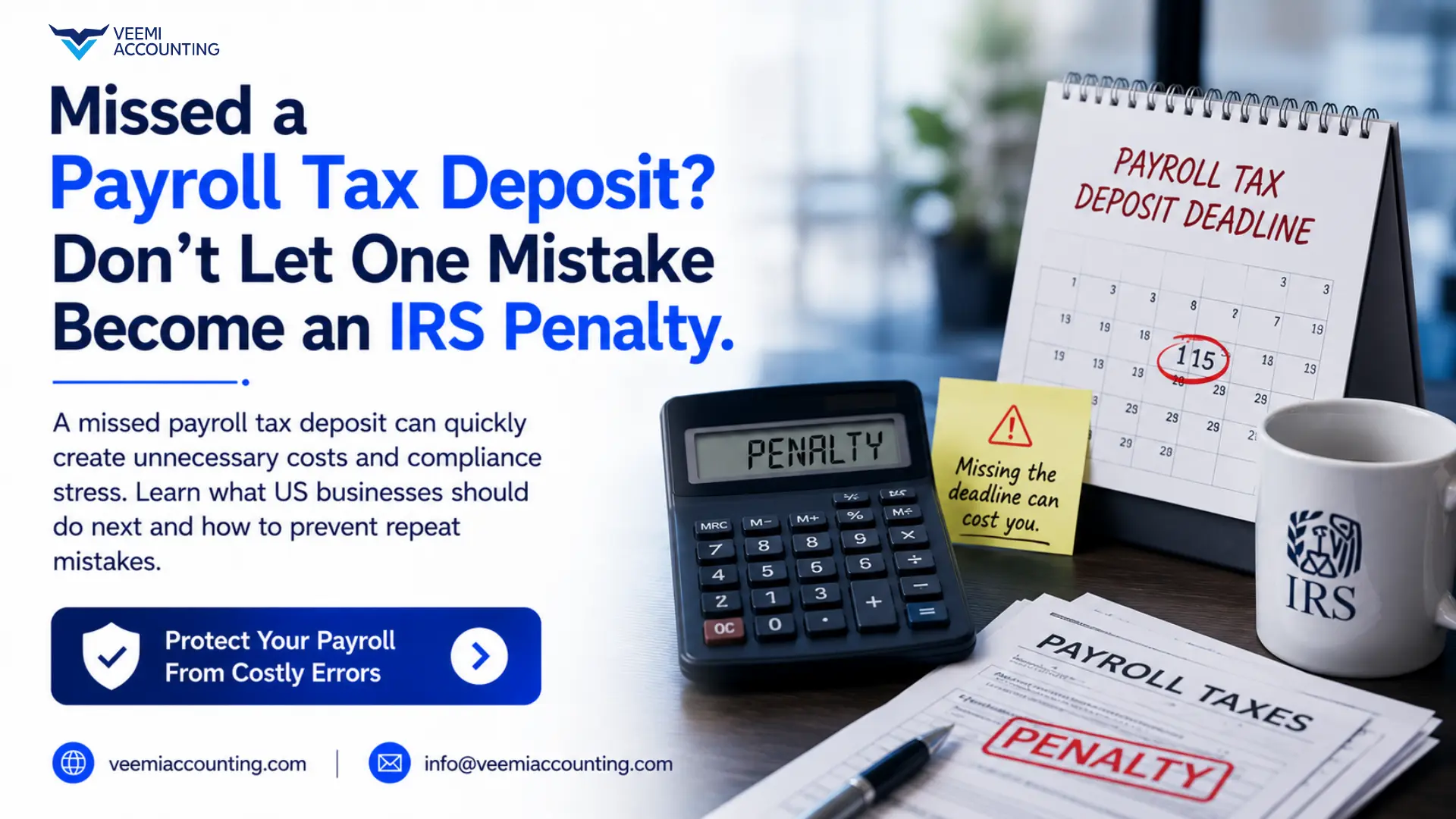
Missed a Payroll Tax Deposit Deadline? How US Businesses Avoid IRS Penalties
Payroll day is usually a good day.
Employees get paid. Another payroll cycle is completed. Everyone moves on to the next task.
Then someone realizes the payroll tax deposit wasn’t made.
Maybe the payment was scheduled for the wrong date. Maybe the person responsible was out of the office. Maybe the business changed payroll providers. Or maybe the money was available, but nobody actually submitted the deposit.
Suddenly, a routine payroll task has become an IRS compliance issue.
If you’ve missed a payroll tax deposit deadline, the first reaction is often panic:
“How much is the IRS going to charge us?”
“Did we just trigger a major penalty?”
“What should we do now?”
Take a breath.
A missed deposit should be addressed quickly, but panic doesn’t fix it.
The better approach is to determine which deposit was missed, how late it is, how much was involved, and what process needs to change so it doesn’t happen again.
For US businesses, payroll compliance isn’t just about filing Form 941.
The timing of payroll tax deposits matters too.
What Is a Payroll Tax Deposit Penalty?
US employers generally must deposit federal income tax withheld from employees along with employer and employee Social Security and Medicare taxes according to their required deposit schedule. Federal employment tax deposits generally must be made electronically.
When a required employment tax deposit isn’t made on time, the IRS may impose a Failure to Deposit penalty.
The penalty depends on how late the deposit is.
Generally, the IRS applies:
👉 2% for deposits 1-5 days late
👉 5% for deposits 6-15 days late
👉 10% for deposits 16 or more days late
👉 15% when the amount remains unpaid more than 10 days after the IRS’s first notice demanding payment
The IRS also explains that the applicable penalty rate is based on how late the deposit is rather than adding each percentage together.
👉 The longer a missed deposit remains unresolved, the more expensive the mistake can become.
Payroll Tax Deposits Are Not the Same as Form 941
This is where many business owners get confused.
You may think:
“We file Form 941 every quarter, so our payroll taxes are handled.”
Not necessarily.
Form 941 reports federal income tax withheld and Social Security and Medicare taxes for the quarter.
But employers generally have to deposit those taxes during the quarter according to their assigned deposit schedule.
So there are two separate responsibilities:
👉 Deposit payroll taxes when required.
👉 Report payroll taxes on the appropriate employment tax return.
A business can file Form 941 correctly and still have a payroll tax deposit problem.
That distinction is important.
How Often Do US Businesses Have to Deposit Payroll Taxes?
Your deposit schedule isn’t simply based on how often you run payroll.
For Form 941 employers, the IRS generally uses a monthly or semiweekly deposit schedule based on the applicable lookback-period tax liability.
Businesses with $50,000 or less in the relevant lookback period generally use the monthly schedule, while businesses above that threshold generally use the semiweekly schedule.
There is also an important rule for businesses that accumulate $100,000 or more in tax liability on any day during a deposit period.
A next-business-day deposit requirement can apply.
That’s why growing businesses shouldn’t assume that the deposit schedule they’ve always followed will remain appropriate forever.
Payroll changes.
Tax liabilities change.
Deposit requirements can change.
What Should You Do If You Missed a Payroll Tax Deposit?
Don’t wait for an IRS notice before investigating.
Start by identifying exactly what happened.
1. Identify the Missed Deposit
Find out:
👉 Which payroll created the liability
👉 Payroll date
👉 Amount that should have been deposited
👉 Original deposit deadline
👉 Whether the deposit has since been made
👉 Date it was actually paid
👉 Whether other deposits are outstanding
You need these facts before you can understand the potential penalty.
2. Make the Required Deposit Quickly
If the deposit hasn’t been made, don’t let the investigation become another reason to delay it.
Federal employment tax deposits generally need to be made electronically through an approved payment method.
👉 Don’t wait for the IRS to send a penalty notice before addressing the underlying tax deposit.
The sooner the required deposit is made, the sooner you can move on to determining what penalties or other issues need attention.
3. Reconcile Payroll Records With Your Accounting Records
Now compare the numbers.
Look at:
👉 Payroll reports
👉 Federal tax liabilities
👉 Bank transactions
👉 Payment confirmations
👉 Payroll liability accounts
👉 Form 941 reporting
You want to answer one question:
Does the amount your payroll system says you owe match what was actually deposited and reported?
If it doesn’t, you may have more than a late-payment problem.
You could also have a payroll calculation or reconciliation issue.
What If You Paid the IRS, But the Deposit Was Late?
Paying the correct amount eventually doesn’t automatically eliminate a Failure to Deposit penalty.
The IRS penalty is based on whether the required deposit was made on time, in the correct amount, and in the required manner.
However, penalty relief may be available in certain circumstances.
The IRS provides rules for reasonable-cause relief and other penalty-relief provisions, depending on the facts.
So don’t immediately assume:
“We’ll just pay the penalty.”
First determine what happened and whether relief could apply.
Why Payroll Deposit Errors Keep Happening
Most missed payroll deposits aren’t intentional.
They’re operational.
Someone assumed the payroll provider handled the payment.
A new employee took over payroll.
A deposit deadline wasn’t added to the calendar.
A payment approval was delayed.
The company switched payroll systems.
Or the business grew and the old process simply stopped working.
Sound familiar?
👉 If one person forgetting a deadline can create an IRS penalty, the process is probably too dependent on one person.
That’s the real issue many businesses need to address.
What Does a Stronger Payroll Tax Process Look Like?
You don’t necessarily need a larger payroll department.
You need clearer controls.
Before payroll:
👉 Confirm payroll calculations.
👉 Review federal withholding.
👉 Review Social Security and Medicare taxes.
👉 Confirm the applicable deposit schedule.
👉 Identify the deposit deadline.
After payroll:
👉 Schedule the required tax deposit.
👉 Save payment confirmation.
👉 Reconcile payroll liabilities.
👉 Verify the payment was processed correctly.
Regularly:
👉 Compare payroll records with accounting records.
👉 Review Form 941 against payroll reports.
👉 Investigate unexplained differences.
👉 Check upcoming deposit deadlines.
This turns payroll compliance from a memory exercise into a repeatable process.
Why Payroll Reconciliation Matters
Here’s where businesses often discover problems.
The payroll system says one number.
The accounting system says another.
The bank shows a third.
The IRS account shows something else.
That doesn’t necessarily mean something has gone seriously wrong.
But it does mean someone needs to reconcile the difference.
Regular payroll reconciliation can help identify:
👉 Missing deposits
👉 Duplicate payments
👉 Incorrect payroll liabilities
👉 Timing differences
👉 Incorrect tax calculations
👉 Unapplied payments
👉 Differences between payroll and accounting records
If you’re looking to strengthen this part of your payroll process, What Is Payroll Reconciliation and Why Does It Matter for US Businesses? explains how regular reconciliation can help US businesses identify payroll discrepancies before they become bigger compliance problems.
The earlier you identify these issues, the easier they usually are to correct.
Don’t Let One Missed Deposit Become a Pattern
One missed payroll tax deposit is frustrating.
Repeated missed deposits are a different problem.
If your business regularly discovers payroll liability differences, misses deposit deadlines, or relies entirely on one person to remember payroll obligations, you may have a process problem rather than an isolated mistake.
And missed deposits are only one type of payroll problem. Payroll Mistakes That Cost US Small Businesses Thousands Every Year looks at other common payroll errors that can create unexpected costs and compliance pressure for growing US businesses.
And that’s when the question needs to change.
Instead of asking:
“How do we avoid this penalty?”
ask:
“Why does our payroll process allow this to happen?”
That question can lead to a much better solution.
How US Businesses Can Prevent Future Payroll Tax Deposit Penalties
The answer isn’t another sticky note.
It’s a reliable operating rhythm.
👉 Know your deposit schedule.
👉 Track the tax liability from every payroll.
👉 Know the exact deposit deadline.
👉 Make deposits using the required electronic method.
👉 Keep payment confirmations.
👉 Reconcile payroll liabilities regularly.
👉 Review the IRS account.
👉 Don’t wait until quarterly filing to discover a deposit problem.
The IRS emphasizes depositing employment taxes when due, filing employment tax returns accurately and on time, and maintaining appropriate payroll records.
👉 Payroll tax compliance should be part of the payroll process, not something added after payroll is finished.
How Veemi Accounting Can Support US Businesses
For a growing US business, payroll administration can quickly become more complicated than simply running payroll.
Someone needs to monitor payroll liabilities.
Someone needs to track deposit deadlines.
Someone needs to reconcile the accounts.
Someone needs to verify payments.
Someone needs to investigate differences.
When those responsibilities are added to bookkeeping and daily operations, small mistakes become easier to make.
Veemi Accounting can support US businesses with bookkeeping, payroll-related accounting support, reconciliations, financial reporting, tax preparation support, and back-office accounting operations.
The objective isn’t simply to fix one missed payroll tax deposit.
It’s to help create a process where payroll liabilities are monitored consistently and discrepancies are identified earlier.
✅ More consistent payroll reconciliation.
✅ Better visibility into payroll liabilities.
✅ Less administrative pressure.
✅ More reliable accounting records.
✅ More time for business owners to focus on running the company.
For CPA firms, additional accounting capacity can also reduce repetitive back-office pressure while the firm retains client ownership, communication, branding, and quality control.
👉 The goal isn’t to replace professional expertise.
It’s to give that expertise stronger operational support.
Fix the Process Before the Penalty Repeats
Missing a payroll tax deposit deadline is stressful.
Especially when you’re already managing employees, customers, cash flow, vendors, and everything else involved in running a business.
But the biggest mistake isn’t always the late deposit.
It’s allowing the same process failure to happen again.
Start with the immediate problem:
👉 Identify the missed deposit.
👉 Confirm the amount.
👉 Make the required deposit.
👉 Reconcile the payroll records.
👉 Check the IRS account.
👉 Determine whether a penalty applies.
Then take the more important step:
👉 Fix the process that allowed the deadline to be missed.
Because the goal isn’t simply to avoid one payroll tax deposit penalty.
It’s to build a payroll process where deadlines are visible, responsibilities are clear, deposits are verified, and the next payroll doesn’t create another compliance surprise.
FAQs About Payroll Tax Deposit Penalties
The IRS Failure to Deposit penalty may apply when required employment tax deposits aren’t made on time, in the correct amount, or in the required manner.
The current penalty rates generally range from 2% to 15%, depending on how late the deposit is.
Not necessarily. Payroll tax deposits generally have their own deadlines, separate from the quarterly Form 941 filing deadline.
Employers generally follow either a monthly or semiweekly deposit schedule, based on the applicable IRS rules and lookback period.
Penalty relief may be available in certain circumstances, including qualifying reasonable-cause situations and other IRS relief provisions.