- Published on
- Veemi Accounting
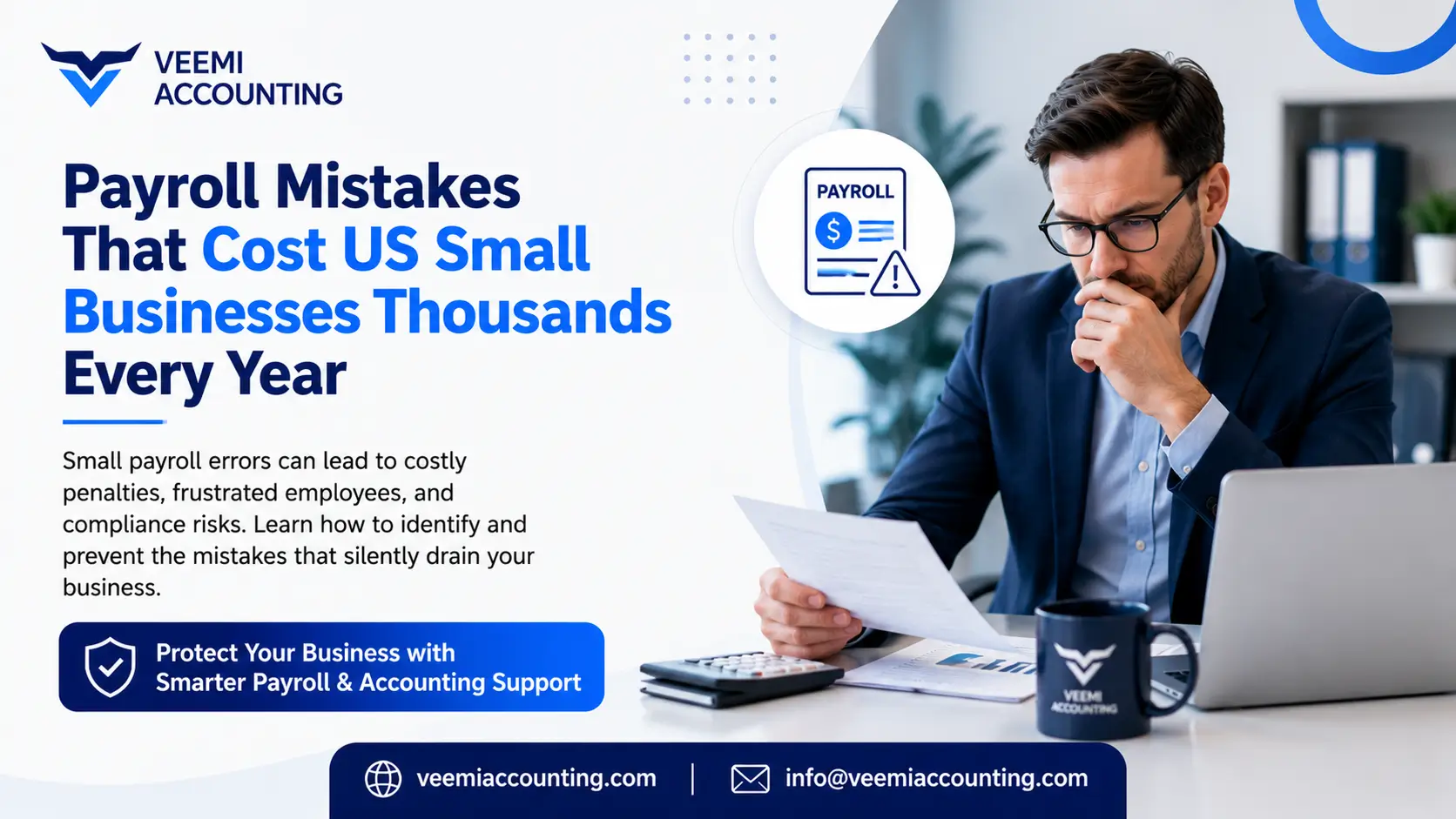
Payroll Mistakes That Cost US Small Businesses Thousands Every Year (And How to Avoid Them)
Running a small business often feels like balancing on a tightrope.
You’re focused on winning new customers, managing cash flow, supporting your employees, and making countless decisions every day. Payroll? It often becomes another task on an already overflowing to-do list.
Until something goes wrong.
An employee points out an incorrect paycheck.
A payroll tax deadline slips by unnoticed.
A government notice arrives in the mail.
Suddenly, what seemed like a routine administrative task becomes an expensive business problem.
The reality is that payroll mistakes US small businesses make aren’t usually caused by carelessness. They’re caused by growth, complexity, and the pressure of wearing too many hats.
The irony?
Many business owners spend months trying to increase profits while unknowingly losing thousands of dollars through preventable payroll errors.
The good news is that most of these mistakes are avoidable if you know where they typically happen.
Let’s explore the payroll pitfalls that quietly cost small businesses money every year and, more importantly, how to prevent them.
Why Payroll Becomes More Complicated as Your Business Grows
Payroll feels simple when you’re paying one or two employees.
You know everyone’s schedule.
You remember every salary adjustment.
You can manually review every paycheck.
Then your business starts growing.
You hire more employees.
Different pay rates enter the picture.
Some team members work overtime.
Others receive bonuses or commissions.
State payroll requirements begin to vary.
Suddenly, payroll is no longer just “paying people.”
It’s a compliance function.
It’s a tax function.
It’s a financial reporting function.
And every small error can ripple through multiple areas of the business.
Growth doesn’t create payroll problems. It exposes the weaknesses in payroll processes that were manageable when your business was smaller.
The Hidden Cost of Payroll Errors
When business owners think about payroll mistakes, they usually imagine paying someone the wrong amount.
That’s only part of the picture.
The bigger costs often remain invisible until months later.
👉 IRS penalties for late or incorrect payroll tax filings
👉 State compliance fines
👉 Employee dissatisfaction and declining trust
👉 Hours spent correcting payroll records
👉 Increased accounting costs
👉 Cash flow disruptions
👉 Time diverted from growing the business
The financial loss isn’t always the largest expense.
Sometimes, it’s the distraction.
Every hour spent fixing payroll errors is an hour not spent serving customers, improving operations, or generating revenue.
7 Payroll Mistakes US Small Businesses Commonly Make
1. Misclassifying Employees and Independent Contractors
This remains one of the most expensive payroll mistakes US small businesses continue to make.
Hiring independent contractors offers flexibility.
But not every worker legally qualifies as a contractor.
Misclassification can result in:
⚠️ Back payroll taxes
⚠️ Interest charges
⚠️ Employee benefit liabilities
⚠️ Government penalties
Many business owners don’t intentionally misclassify workers.
They simply assume that issuing a 1099 instead of a W-2 solves the problem.
Unfortunately, payroll compliance doesn’t work that way.
The way the work is performed often matters more than the agreement you’ve signed.
2. Missing Payroll Tax Deadlines
Payroll taxes operate on strict schedules.
Unlike many business tasks, deadlines aren’t flexible.
One missed filing can quickly trigger penalties that continue accumulating over time.
This often happens because payroll is treated as an administrative task rather than a compliance responsibility.
Busy owners postpone it.
Unexpected issues arise.
Deadlines pass.
The cost?
Sometimes hundreds of dollars.
Sometimes thousands.
The frustrating part is that these penalties are entirely avoidable with proper payroll systems.
3. Incorrect Employee Classification for Overtime
Many business owners assume that salaried employees automatically qualify as exempt from overtime.
They don’t.
Federal and state labor laws establish specific criteria.
An employee’s salary alone doesn’t determine overtime eligibility.
This mistake frequently appears when businesses grow quickly and promote employees into supervisory roles without reviewing compliance requirements.
⚠️ Unpaid overtime claims
⚠️ Wage disputes
⚠️ Legal expenses
⚠️ Back-pay obligations
One classification decision can become an expensive legal issue years later.
4. Payroll Records That Don’t Tell the Full Story
Payroll isn’t just about paying employees.
It’s also about documenting what happened.
Accurate records protect businesses during audits, disputes, and compliance reviews.
Unfortunately, many small businesses rely on scattered spreadsheets, handwritten notes, or outdated systems.
Months later, they struggle to answer simple questions.
When was overtime approved?
Who authorized the pay increase?
Why was this deduction made?
Without reliable records, even accurate payroll becomes difficult to prove.
Payroll doesn’t exist in isolation. In many cases, recurring payroll issues are actually symptoms of larger bookkeeping problems. If your financial records aren’t accurate or up to date, payroll errors become much harder to identify and fix. Learn how poor bookkeeping is costing US small businesses thousands and why strong bookkeeping practices create the foundation for accurate payroll and financial reporting.
5. Forgetting About State-Specific Payroll Rules
Many small businesses assume federal payroll regulations are enough.
They’re not.
State payroll requirements can vary significantly.
Depending on where employees work, businesses may face different rules regarding:
👉 Paid leave
👉 State payroll taxes
👉 Minimum wage
👉 Overtime calculations
👉 Final paycheck requirements
Businesses operating remotely across multiple states often discover these differences only after receiving compliance notices.
By then, correcting the mistake becomes much more expensive.
6. Relying Too Heavily on Manual Payroll Processes
Spreadsheets are useful.
Until they aren’t.
Manual payroll systems work reasonably well when a business has just a few employees.
But growth introduces more variables.
Salary adjustments.
Bonuses.
Benefits deductions.
Tax updates.
Employee reimbursements.
One incorrect formula can affect every paycheck.
The risk isn’t simply human error.
It’s the cumulative effect of repeating that error month after month before anyone notices.
The longer payroll mistakes remain hidden, the more expensive they become to correct.
7. Treating Payroll as an Administrative Task Instead of a Strategic Function
This may be the most overlooked payroll mistake of all.
Many owners believe payroll is simply about paying employees on time.
In reality, payroll influences:
👉 Cash flow planning
👉 Financial reporting
👉 Employee satisfaction
👉 Regulatory compliance
👉 Tax planning
👉 Business forecasting
Businesses that view payroll strategically tend to experience fewer surprises because payroll becomes integrated with accounting and financial management, not isolated from it.
That’s an important shift.
Because the goal isn’t just accurate payroll.
It’s operational stability.
The Warning Signs Your Payroll Process Needs Attention
Most payroll issues don’t appear overnight.
They build gradually.
Small inconsistencies become recurring problems.
Minor delays become stressful monthly routines.
Ask yourself:
👉 Are payroll corrections becoming more frequent?
👉 Do tax notices occasionally arrive unexpectedly?
👉 Is payroll taking longer every month?
👉 Are employees asking about paycheck discrepancies?
👉 Does payroll depend heavily on one person remembering every detail?
If you answered yes to even one or two of these questions, your payroll process may already be creating unnecessary business risk.
And that’s where many small businesses find themselves.
Not because they lack capable people.
But because growth has outpaced the systems supporting it.
How to Build a Payroll Process That Grows With Your Business
One of the biggest misconceptions about payroll is that it’s something you “figure out later.”
But later has a way of arriving sooner than expected.
A new employee joins.
A contractor transitions to a full-time role.
Your business expands into another state.
Suddenly, the payroll process that worked six months ago starts showing cracks.
The businesses that avoid costly payroll problems aren’t necessarily the ones with the largest finance teams. They’re the ones that build payroll systems designed to support growth, not just today’s headcount.
Here are a few practical ways to strengthen your payroll operations before small issues become expensive ones.
👉 Standardize your payroll process.
Document every step, from collecting employee information to approving payroll and filing taxes. A clear process reduces dependency on one individual and makes payroll more consistent.
👉 Review employee classifications regularly.
Roles evolve as businesses grow. An employee who was correctly classified a year ago may no longer meet the same criteria today. Periodic reviews help reduce compliance risks.
👉 Keep payroll records organized and accessible.
Accurate documentation isn’t just about staying organized. It protects your business during audits, employee disputes, and tax reviews.
👉 Connect payroll with your accounting system.
Payroll shouldn’t operate in isolation. Integrating payroll with your bookkeeping and financial reporting provides better visibility into labor costs, cash flow, and profitability.
👉 Don’t wait until tax season to identify problems.
Regular payroll reviews make it easier to catch discrepancies early, when they’re still simple, and inexpensive, to fix.
The objective isn’t to create a more complicated payroll process. It’s to create one that’s dependable, scalable, and resilient as your business grows.
Payroll Is More Than Paying Employees, It’s About Protecting Your Business
Every growing business eventually reaches a turning point.
In the beginning, the owner can personally oversee every payroll run.
As the team expands, that approach becomes harder to sustain.
The challenge isn’t that payroll suddenly becomes impossible.
The challenge is that the cost of even a small mistake increases with every new employee, every additional state, and every reporting requirement.
A single payroll error may seem manageable.
Repeated payroll errors quietly chip away at profitability.
Late tax filings create avoidable penalties.
Incorrect classifications expose businesses to compliance risks.
Inaccurate records consume valuable time during audits.
Perhaps most importantly, payroll mistakes affect the people who make your business successful.
Employees expect to be paid accurately and on time. When payroll becomes inconsistent, confidence in the business can suffer, even if the mistake was unintentional.
Strong payroll processes don’t just protect compliance. They strengthen trust, improve operational efficiency, and give business owners one less thing to worry about.
As payroll, cash flow, and financial reporting become more complex, many growing businesses realize they need strategic financial guidance, not necessarily a full-time finance executive. Understanding when a growing business needs a Fractional CFO can help you build stronger financial processes before operational challenges begin affecting profitability.
Growing Businesses Need Systems, Not More Stress
Many entrepreneurs assume that growing a business means working harder.
In reality, sustainable growth comes from building better systems.
Payroll is one of those systems.
When it’s reliable, it fades into the background and quietly supports the business.
When it isn’t, it demands attention at the worst possible times.
The most successful small businesses don’t eliminate complexity.
They build processes that handle complexity without creating chaos.
That’s why payroll deserves the same strategic attention as sales, operations, and customer service.
Because protecting your margins isn’t only about increasing revenue.
It’s also about preventing unnecessary losses.
And many of those losses begin with payroll.
How Veemi Accounting Helps Businesses Build Payroll Confidence
As businesses grow, payroll often becomes more than just another administrative responsibility.
It becomes part of a much larger operational challenge.
You’re managing hiring, bookkeeping, tax deadlines, financial reporting, and day-to-day business decisions, all while trying to ensure every employee is paid accurately and on time.
That’s where having the right accounting partner can make a meaningful difference.
At Veemi Accounting, we work with growing businesses and CPA firms that need dependable back-office support without increasing internal complexity.
Rather than replacing your existing team, we work as an extension of it.
👉 We help streamline bookkeeping and accounting processes so payroll data flows accurately into your financial records.
👉 We provide accounting support that helps reduce reconciliation issues caused by payroll errors.
👉 Our tax preparation support helps businesses stay better prepared for payroll tax reporting and compliance.
👉 For firms looking to expand their capacity, our white-label accounting services allow them to serve more clients while maintaining complete ownership of client relationships, branding, communication, and quality control.
👉 Businesses seeking stronger financial oversight can also benefit from our Fractional CFO services, providing strategic insights into labor costs, cash flow planning, profitability, and financial decision-making.
✅ The outcome is greater operational stability.
✅ Better financial visibility.
✅ More capacity to focus on growing the business instead of constantly fixing administrative issues.
Payroll works best when it’s supported by accurate accounting, organized financial processes, and proactive planning, not last-minute corrections.
If you’re looking to strengthen your financial operations or build a more scalable back-office function, a strategic conversation can help identify where improvements can be made.
Payroll Mistakes US Small Businesses Frequently Ask About
Some of the most common payroll mistakes US small businesses make include misclassifying workers, missing payroll tax deadlines, calculating overtime incorrectly, maintaining incomplete payroll records, overlooking state-specific payroll regulations, and relying too heavily on manual payroll processes. While these issues often begin as small oversights, they can lead to penalties, compliance risks, and employee dissatisfaction if left unresolved.
Payroll errors can result in IRS penalties, state fines, interest charges, back-pay obligations, legal expenses, and additional accounting costs. Beyond the direct financial impact, business owners also lose valuable time correcting mistakes, responding to compliance notices, and resolving employee concerns.
It’s a good practice to review payroll processes at least once a year or whenever significant business changes occur, such as hiring more employees, expanding into new states, introducing new compensation structures, or updating employee benefits. Regular reviews help identify risks before they become costly problems.
Payroll software significantly reduces manual errors, but it doesn’t eliminate every risk. Businesses still need accurate employee data, correct worker classifications, timely approvals, and ongoing compliance oversight. Technology works best when combined with strong internal processes and professional financial guidance.
If payroll is consuming excessive time, compliance requirements are becoming difficult to manage, or payroll errors are occurring more frequently, it may be time to seek external support. Outsourcing payroll or accounting functions can improve accuracy, reduce administrative workload, and allow business owners to focus on growth.