- Published on
- Veemi Accounting
CFO-Level Financial Metrics Every Founder Should Track
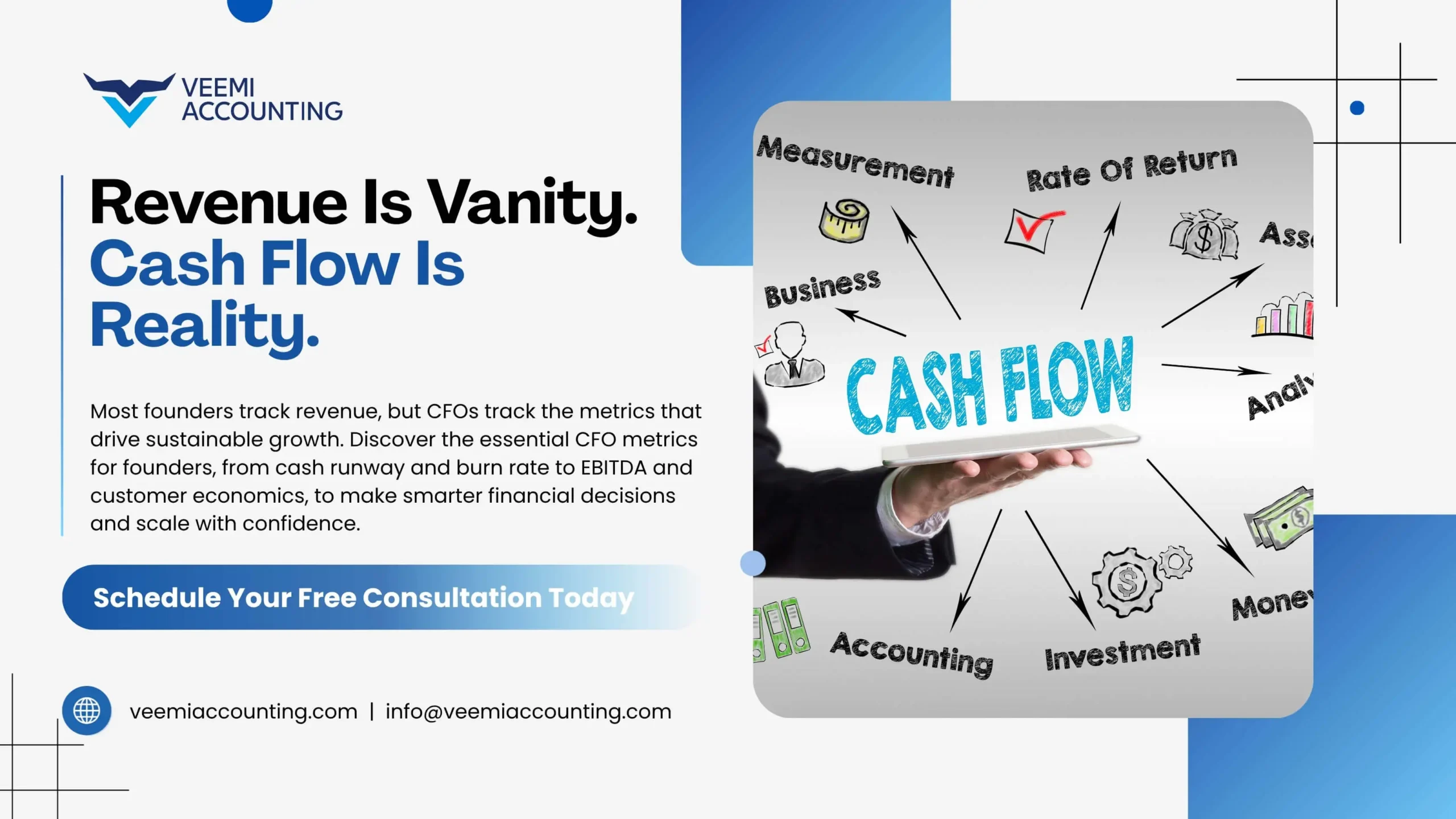
Most founders track revenue religiously. They celebrate new sales, monitor growth trends, and focus heavily on top-line performance. While revenue is important, it only tells part of the story.
The businesses that scale successfully don’t just track how much money they are bringing in; they understand how efficiently they are generating, managing, and deploying that money. This is where CFO-level financial thinking comes into play.
Many startups and small businesses fail not because demand disappears, but because they lose visibility into critical financial indicators that reveal cash risks, profitability challenges, and operational inefficiencies before they become major problems.
However, most founders are not financial experts, and they should not have to be. That is why many growing businesses rely on outsourced financial leadership, such as Veemi Accounting’s Fractional CFO Services, to gain strategic financial insights without the cost of a full-time executive.
In this guide, we will break down the essential CFO metrics every founder should track and explain what each one means in practical business terms.
Why Founders Need to Think Like a CFO
Tracking financial metrics effectively starts with accurate and timely reporting. Without reliable financial reports, founders often make decisions based on incomplete information. As discussed in our guide on Why Financial Reporting Matters More Than Just Filing Taxes, financial reporting serves as the foundation for strategic planning, cash flow management, and long-term growth initiatives.
Ignoring these metrics can create serious consequences:
👉Unexpected cash shortages
👉Overhiring during growth periods
👉Poor pricing decisions
👉Unprofitable customer acquisition
👉Reduced investor confidence
👉Lower company valuations
Founders who understand financial KPIs gain the ability to make proactive decisions rather than reacting to financial problems after they occur.
The Core CFO Metrics for Founders
1. Cash Runway
Cash runway measures how long your business can continue operating before running out of cash.
Formula
Cash Runway = Cash Balance ÷ Monthly Net Burn Rate
Why It Matters
Cash runway is often considered the most important startup survival metric. It tells founders exactly how much time they have to reach profitability, secure funding, or improve revenue.
For example:
👉Cash balance: $600,000
👉Monthly burn: $50,000
Runway = 12 months
Benchmark
Most investors prefer startups to maintain at least 12–18 months of runway.
Warning Sign
Less than six months of runway often signals an urgent need for corrective action.
How to Extend Runway
👉Improve gross margins
👉Accelerate collections
👉Delay non-essential spending
👉Optimize hiring plans
👉Increase recurring revenue
2. Burn Rate (Gross & Net)
What It Is
Burn rate measures how quickly a company spends cash.
Gross Burn Rate
Total monthly operating expenses.
Formula
Gross Burn = Total Monthly Expenses
Net Burn Rate
Cash is lost each month after accounting for revenue.
Formula
Net Burn = Monthly Expenses – Monthly Revenue
Why It Matters
Burn rate determines how quickly the runway decreases.
A startup spending $100,000 monthly but generating $70,000 in revenue has a net burn of only $30,000.
Healthy Burn Rates
👉Pre-seed: Higher burn acceptable if growth is strong
👉Seed/Series A: Burn should align with measurable milestones
👉Growth-stage: Greater focus on efficiency and profitability
Warning Sign
Rapidly increasing burn without corresponding growth.
3. Monthly Recurring Revenue (MRR) & Annual Recurring Revenue (ARR)
What They Are
MRR and ARR measure predictable subscription revenue.
Formulas
MRR = Total Monthly Subscription Revenue
ARR = MRR × 12
Why They Matter
These metrics provide visibility into future revenue and are heavily used in SaaS valuations.
Investors often value recurring revenue businesses more highly because earnings are predictable.
Example
MRR = $50,000
ARR = $600,000
Key Metric
MRR Growth Rate
Formula:
(Current MRR – Previous MRR) ÷ Previous MRR × 100
Benchmark
Many investors seek consistent monthly growth rates above 10% during early stages.
4. Gross Profit Margin
What It Is
Gross margin measures how much revenue remains after delivering products or services.
Formula
Gross Profit Margin = (Revenue – Cost of Goods Sold) ÷ Revenue × 100
Why It Matters
Revenue alone can be misleading.
Two companies generating $1 million annually may have dramatically different profitability levels.
Warning Sign
Declining margins despite increasing revenue.
5. Customer Acquisition Cost (CAC)
What It Is
CAC measures the cost of acquiring a new customer.
Formula
CAC = Sales & Marketing Costs ÷ New Customers Acquired
Why It Matters
Founders often celebrate customer growth without understanding acquisition economics.
If acquiring customers costs more than the value they generate, growth becomes unsustainable.
Common CAC Mistakes
👉Excluding salaries
👉Ignoring software costs
👉Omitting agency fees
👉Excluding sales commissions
Benchmark
CAC should be recoverable within a reasonable payback period.
6. EBITDA
What It Is
EBITDA stands for:
Earnings Before Interest, Taxes, Depreciation, and Amortization
Why It Matters
Investors and acquirers use EBITDA to evaluate operating performance independently of financing and accounting decisions.
It provides a standardized view of profitability.
Benefits
👉Useful for business valuation
👉Simplifies company comparisons
👉Highlights operational efficiency
When EBITDA Can Mislead
EBITDA ignores:
👉Debt obligations
👉Capital expenditures
👉Working capital requirements
For this reason, it should never be analyzed in isolation.
8. Working Capital Ratio
What It Is
The working capital ratio measures short-term liquidity.
Formula
Working Capital Ratio = Current Assets ÷ Current Liabilities
Why It Matters
It indicates whether a business can meet short-term obligations.
Benchmark
👉Above 1.5 = Healthy
👉Around 1.0 = Caution
👉Below 1.0 = Potential liquidity concern
Warning Sign
Persistent ratios below 1.0 may indicate upcoming cash flow stress.
Metrics That Matter by Business Stage
Financial priorities evolve as businesses grow.
Pre-Revenue / Early Stage
Focus on:
👉Cash Runway
👉Burn Rate
👉CAC
The primary goal is survival and validating product-market fit while preserving capital.
Growth Stage
Focus on:
👉MRR
👉ARR
👉LTV: CAC Ratio
👉Gross Margin
At this stage, founders must ensure growth is efficient and scalable.
Scale / Fundraising Stage
Focus on:
👉EBITDA
👉Operating Cash Flow
👉Working Capital
Investors increasingly evaluate operational discipline and profitability pathways.
Mature / Exit-Ready Stage
Focus on:
👉All core metrics
👉DSO
👉Net Profit Margin
👉EBITDA Trends
Acquirers want comprehensive financial visibility and predictable performance.
How to Build a Simple CFO Dashboard as a Founder
KPI tracking should not be limited to fundraising rounds or year-end reviews. Establishing a regular cadence for reviewing business performance helps founders identify opportunities and risks early. For additional guidance, read Why April Is the Best Time to Review Your Business KPIs, where we explain how periodic KPI reviews support smarter business decisions and stronger financial performance.
You don’t need a full-time CFO to begin tracking financial performance.
A simple dashboard can provide tremendous visibility.
Recommended Tools
👉QuickBooks Online
👉Xero
👉Google Sheets
👉Microsoft Excel
👉Financial reporting platforms
Review Cadence
Weekly
👉Cash position
👉Revenue trends
Monthly
👉KPI dashboard review
👉Budget vs actual analysis
Quarterly
👉Strategic planning
👉Investor reporting
👉Forecast updates
Founders preparing for funding rounds should also establish board-ready reporting processes.
Businesses often accelerate this process through Fractional CFO Services and Financial Planning & Analysis (FP&A) support to improve forecasting accuracy and strategic decision-making.
When to Bring in a Fractional CFO
Many founders reach a point where spreadsheets and basic bookkeeping are no longer enough.
Common signs include:
👉Rapid growth
👉Fundraising preparation
👉Cash flow uncertainty
👉Complex forecasting needs
A Fractional CFO provides executive-level financial leadership without the significant cost of hiring a full-time CFO.
Benefits include:
👉Financial forecasting
👉KPI tracking
👉Fundraising support
👉Cash flow management
For growing businesses, the cost-benefit equation often makes fractional CFO services the most practical solution.
Veemi Accounting’s Fractional CFO Services help founders gain financial clarity, improve decision-making, and build scalable financial systems.
Turn Financial Data Into Better Business Decisions
Founders who consistently track the right financial metrics gain a significant advantage over those who rely solely on revenue reports. Understanding your cash runway, burn rate, profitability, customer acquisition efficiency, and cash flow health gives you the clarity needed to make smarter decisions, scale sustainably, and confidently navigate growth opportunities.
Whether you are preparing for fundraising, improving cash flow, planning expansion, or simply seeking greater visibility into your company’s financial performance, tracking these CFO metrics for founders can help you move from reactive decision-making to proactive growth management.
Ready to Gain CFO-Level Financial Clarity?
If you are looking for expert guidance on financial reporting, forecasting, cash flow management, or strategic planning, Veemi Accounting can help. Our Fractional CFO team supports founders and business owners across the USA, Canada, Australia, and the UK with actionable financial insights that drive growth.
Schedule your free 30-minute consultation today and discover how CFO-level financial guidance can help your business scale with confidence.
👉 Book Your Strategy Call:
Schedule a Free Consultation
No obligation. Just practical financial insights tailored to your business goals.
FAQs
Cash-related metrics should be reviewed weekly, while full KPI dashboards should typically be reviewed monthly and strategically assessed quarterly.
A full-time CFO is a permanent executive, while a fractional CFO provides similar strategic expertise on a part-time or outsourced basis at a lower cost.
Absolutely. Even small businesses can improve cash flow, profitability, and decision-making by tracking key financial indicators
Veemi Accounting provides bookkeeping, FP&A, strategic reporting, forecasting, and fractional CFO services that help founders gain financial clarity and make data-driven decisions.