- Published on
- Veemi Accounting
T4 Filing Mistakes Canada: 10 Common Errors Employers Make (and How to Avoid Them)
For many Canadian employers, year-end payroll reporting is one of the most demanding compliance responsibilities of the year. Between calculating employee earnings, verifying payroll deductions, preparing tax slips, and meeting strict filing deadlines, even a small oversight can result in costly penalties and unnecessary stress.
T4 filing mistakes in Canada can cost employers time, money, and increased scrutiny from the Canada Revenue Agency (CRA). Incorrect employee information, inaccurate payroll amounts, missed taxable benefits, or late submissions often trigger penalties that could have been avoided with proper preparation.
The challenge becomes even greater for growing businesses managing multiple employees, bonuses, benefits, and changing payroll regulations. Manual payroll processes, disconnected accounting systems, and last-minute reconciliations only increase the risk of errors.
Why Accurate T4 Filing Matters
A T4 slip summarizes an employee’s annual employment income and deductions, making it one of the most important tax documents issued each year.
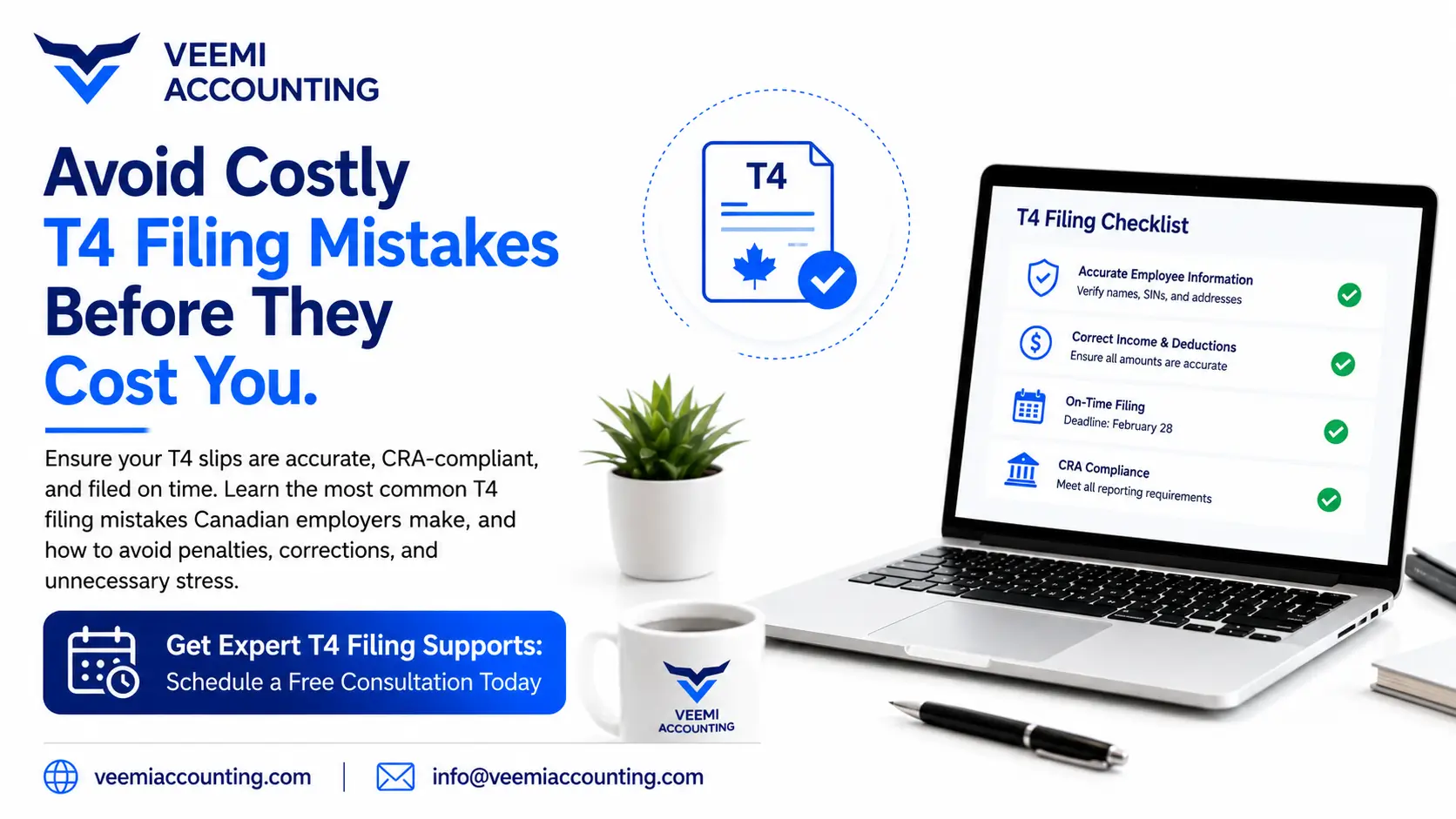
Every employer must provide T4 slips to employees and submit corresponding information returns to the CRA by the last day of February following the tax year. Missing this deadline or submitting inaccurate information can lead to financial penalties and administrative complications.
Accurate T4 filing matters because it:
👉 Ensures employees can file their personal income taxes correctly and on time.
👉 Helps businesses remain compliant with CRA payroll regulations.
👉 Prevents penalties, interest charges, and correction notices.
👉 Reduces the likelihood of payroll audits.
👉 Maintains trust between employers and employees.
Even seemingly minor inaccuracies can require amended filings, additional administrative work, and unnecessary communication with employees and the CRA.
10 Common T4 Filing Mistakes Canadian Employers Make
1. Missing or Incorrect Social Insurance Number (SIN)
One of the simplest yet most common payroll mistakes is recording an incorrect or incomplete Social Insurance Number.
Errors often occur because:
👉 Employee information was not updated.
👉 Manual data entry mistakes.
👉 New hires provided incorrect documentation.
An incorrect SIN can delay employee tax processing and may result in CRA requests for corrected information. Employers should always verify employee identification during onboarding and before year-end filing.
2. Incorrect Employment Income (Box 14) Reporting
Box 14 represents total employment income earned during the year.
Mistakes happen when employers:
👉 Omit bonuses.
👉 Misclassify taxable allowances.
👉 Forget retroactive pay adjustments.
👉 Include amounts belonging to another tax year.
Because Box 14 is the foundation for several other calculations, inaccuracies often create a chain reaction affecting tax deductions and employee returns.
3. Errors in CPP and EI Deductions (Boxes 16–18)
Canada Pension Plan (CPP) and Employment Insurance (EI) deductions must accurately reflect payroll records.
Common causes include:
👉 Incorrect contribution calculations.
👉 Mid-year payroll adjustments.
👉 Software configuration issues.
👉 Manual overrides.
Incorrect deduction amounts may require amended filings and create discrepancies between payroll records and CRA remittances.
Employers should reconcile payroll deductions against monthly remittance records before generating T4 slips.
4. Forgetting to Report Taxable Benefits
Taxable benefits are frequently overlooked during T4 preparation.
Examples include:
👉 Company vehicles
👉 Personal use of employer assets
👉 Group insurance premiums
👉 Gift cards exceeding CRA exemptions
👉 Housing or accommodation benefits
👉 Low-interest loans
When these benefits are excluded, employee taxable income becomes understated, potentially resulting in reassessments and penalties.
Maintaining a year-round record of employee benefits significantly reduces this risk.
5. Misreporting Pension Adjustments (Box 52)
Employers offering registered pension plans must correctly report Pension Adjustments (PAs).
Errors often result from:
👉 Miscommunication between HR and payroll.
👉 Incorrect pension calculations.
👉 Delayed contribution reporting.
Since Pension Adjustments affect employees’ RRSP contribution limits, mistakes may create complications for their personal tax planning.
6. Filing Late or Missing the CRA Deadline
Many businesses underestimate how much preparation T4 filing requires.
Last-minute payroll reconciliations, missing employee information, or staffing shortages often push submissions beyond the filing deadline.
Late filing penalties increase based on:
👉 Number of information slips filed
👉 Length of delay
👉 Previous filing history
Preparing payroll several weeks before the deadline helps eliminate unnecessary pressure.
7. Not Issuing Amended T4 Slips When Errors Are Found
Discovering an error after filing doesn’t mean it should be ignored.
Some employers mistakenly assume small discrepancies are insignificant.
However, failing to submit amended T4 slips can:
👉 Delay employee tax refunds.
👉 Trigger CRA inquiries.
👉 Create payroll inconsistencies in future years.
Correcting mistakes promptly demonstrates good compliance practices and minimizes further complications.
8. Using the Wrong Employer Business Number
Every T4 submission must include the correct CRA payroll account number.
Businesses operating multiple entities or payroll accounts sometimes accidentally use:
👉 An inactive payroll account
👉 Another subsidiary’s account
👉 Incorrect business registration information
These errors can delay processing and require additional communication with the CRA.
9. Mismatched Payroll and Accounting Records
Payroll data should always reconcile with accounting records before T4 slips are prepared.
Common discrepancies arise when:
👉 Journal entries are incomplete.
👉 Payroll adjustments aren’t recorded.
👉 Bonus accruals differ from actual payments.
👉 Manual accounting entries are missed.
Payroll reconciliation helps identify inconsistencies before they become reporting errors.
10. Manual Spreadsheet Errors
Businesses relying heavily on spreadsheets face significantly greater risk of human error.
Typical issues include:
👉 Formula mistakes
👉 Duplicate employee entries
👉 Incorrect copy-and-paste values
👉 Outdated payroll templates
👉 Missing payroll updates
As businesses grow, spreadsheet-based payroll becomes increasingly difficult to manage accurately.
Modern payroll software and outsourced payroll support greatly reduce these risks.
Consequences of T4 Filing Errors
Even minor payroll reporting mistakes can have significant consequences.
CRA Penalties and Interest
Late or inaccurate filings may result in monetary penalties that increase depending on the severity and frequency of the error.
Repeated non-compliance can attract closer CRA attention.
Employee Frustration
Employees depend on accurate T4 slips to complete their personal tax returns.
Incorrect information can delay refunds, require amended personal returns, and reduce confidence in the employer’s payroll processes.
Increased Audit Risk
Consistent payroll discrepancies may increase the likelihood of CRA reviews or payroll audits.
While not every mistake triggers an audit, recurring issues often prompt further examination.
How to Avoid T4 Filing Mistakes
Preventing payroll errors requires proactive planning throughout the year, not just during tax season.
Reconcile Payroll Before Filing
Compare payroll reports with accounting records, CRA remittances, and year-end summaries to identify discrepancies early.
Use Certified Payroll Software
Reliable payroll systems automate calculations, validate employee information, and reduce manual errors.
Verify Employee Information
Review employee names, addresses, SINs, payroll account numbers, and tax forms before preparing T4 slips.
Why Outsourcing T4 Filing Makes Sense
As payroll regulations evolve and businesses grow, managing year-end reporting internally becomes increasingly complex.
Outsourcing T4 preparation to experienced accounting professionals offers several advantages:
👉 Reduced risk of filing errors
👉 Timely CRA compliance
👉 Accurate payroll reconciliations
👉 Professional review before submission
👉 Improved documentation and audit readiness
👉 Less administrative workload for internal teams
For businesses operating across provinces or CPA firms managing multiple Canadian clients, outsourcing also provides additional flexibility during busy tax seasons.
Many growing businesses and CPA firms are reducing compliance risks by partnering with experienced offshore accounting professionals who handle payroll reporting, reconciliations, and year-end filings efficiently. Learn why more firms are embracing this model in our article, Why Canadian CPA Firms Are Turning to Offshore Accounting Teams.
Get Your T4 Filing Right the First Time, Without the Last-Minute Rush
Year-end payroll reporting doesn’t have to be stressful. By avoiding the most common T4 filing mistakes in Canada, businesses can stay compliant with CRA requirements, prevent costly penalties, and provide employees with accurate tax information on time.
From reconciling payroll records and reporting taxable benefits correctly to meeting filing deadlines, a proactive approach can save significant time, money, and administrative effort. Whether you are a small business, a growing company, or a CPA firm managing multiple clients, having experienced payroll professionals by your side makes the entire T4 filing process smoother and more reliable.
While accurate T4 filing is essential for payroll compliance, it’s only one aspect of maintaining a healthy financial operation. Businesses that stay on top of year-end reporting are also better positioned to improve budgeting, cash flow, and long-term tax planning. Read our guide on Beyond T2 Filing: Financial Planning Opportunities for Canadian Businesses to learn how strong compliance can support smarter financial decision-making throughout the year.
Need expert support with your year-end payroll and T4 filings? Schedule a free consultation with Veemi Accounting to ensure your T4 slips are accurate, compliant, and submitted on time, so you can focus on running your business with confidence.
FAQs
If you identify an error after submitting your T4 information return, you should file an amended T4 slip as soon as possible rather than waiting until the next tax year. Promptly correcting mistakes helps minimize confusion for employees, ensures accurate CRA records, and may reduce the likelihood of further compliance issues. Keep documentation explaining the correction for your payroll records.
Only taxable benefits provided to an employee during the tax year must be reported on their T4 slip. These may include personal use of a company vehicle, employer-paid life insurance premiums, housing benefits, parking benefits, and certain gifts or awards that exceed CRA exemptions. Maintaining a year-round record of taxable benefits helps prevent omissions during T4 preparation.
A thorough payroll reconciliation involves comparing year-end payroll registers with employee earnings, CRA remittance records, general ledger accounts, taxable benefit schedules, and payroll tax deductions. Any discrepancies should be investigated and resolved before generating T4 slips to reduce the need for amended filings and improve reporting accuracy.
While certified payroll software significantly reduces manual calculations and data entry errors, it cannot prevent mistakes caused by inaccurate employee information, incorrectly configured payroll settings, or missing taxable benefits. Employers should still perform year-end reviews and reconciliations to verify that all information reported on T4 slips is complete and accurate.