- Published on
- Veemi Accounting
Multi-State Payroll Compliance: What US Businesses With Remote Teams Must Know
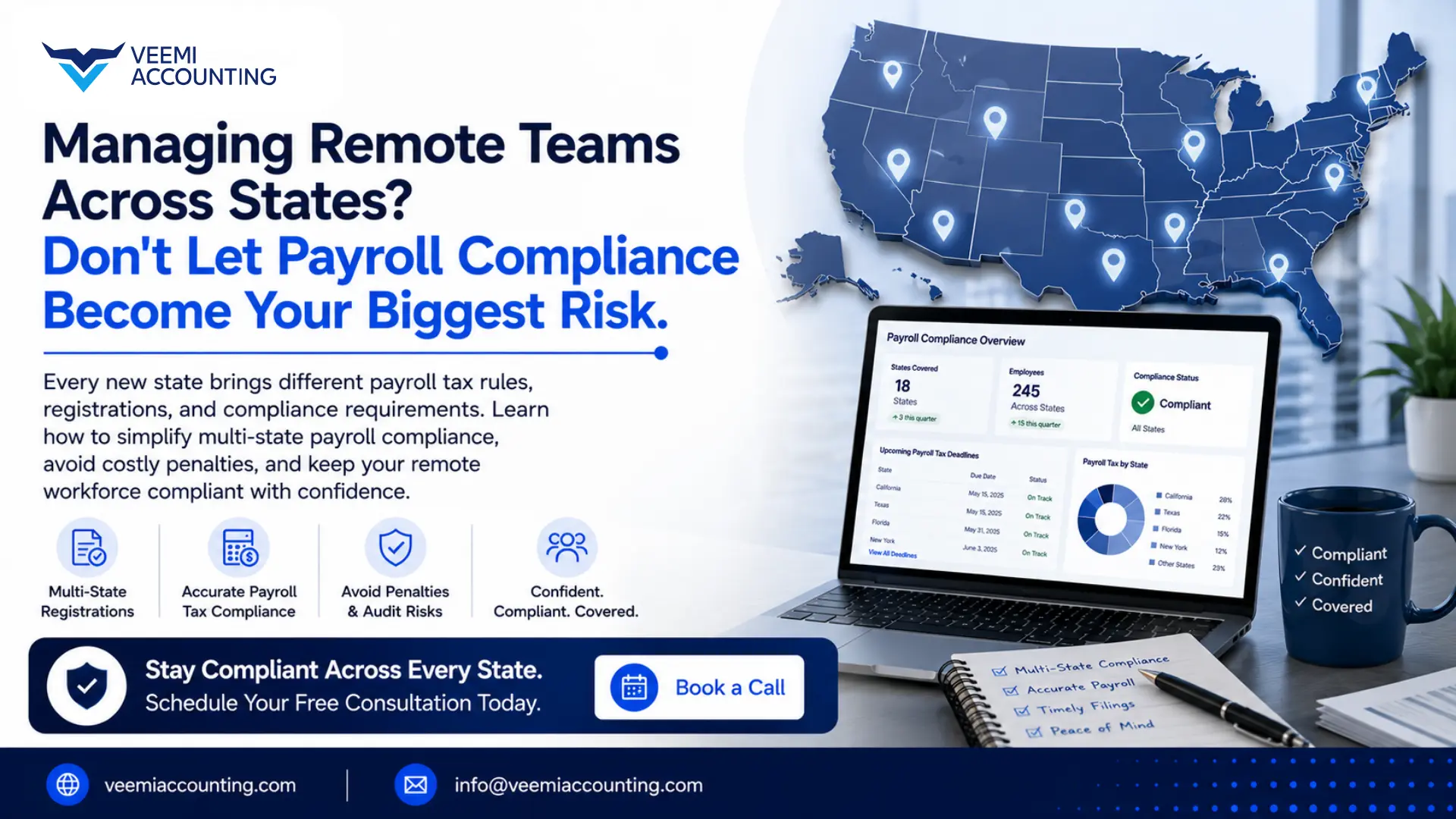
Remote and hybrid work have permanently changed how US businesses operate. Today, employees can live in different cities, or even different states, while working for the same company. While this flexibility has improved hiring opportunities and employee satisfaction, it has also introduced a significant payroll challenge: multi-state payroll compliance.
For employers with distributed teams, payroll is no longer a simple matter of withholding federal taxes and paying employees on time. Different states have unique tax laws, unemployment insurance requirements, new-hire reporting rules, and workers compensation regulations. Missing even one requirement can lead to penalties, audits, and administrative headaches.
What Is Multi-State Payroll Compliance?
Multi-state payroll compliance refers to the process of correctly withholding, remitting, and reporting payroll taxes and employment-related obligations when employees work or live in states different from their employer’s primary business location.
When a company hires employees across multiple states, it may be required to:
👉 Register as an employer in additional states
👉 Withhold the correct state income taxes
👉 Pay state unemployment insurance (SUI)
👉 File payroll tax returns in multiple jurisdictions
👉 Comply with local payroll tax requirements
👉 Meet state-specific labor laws
Unlike federal payroll taxes, state payroll regulations vary considerably. What is required in California may be completely different from the rules in Texas, Florida, or New York.
Why It Matters More in 2026
Remote work is no longer a temporary arrangement. Many organizations now recruit talent nationwide, allowing employees to relocate without requiring office attendance. As a result, state tax authorities have increased their focus on employers with out-of-state workers, making compliance more important than ever.
Reciprocity States vs. Non-Reciprocity States
Some neighboring states have reciprocity agreements, allowing employees who live in one state and work in another to pay income tax only in their state of residence. This simplifies payroll withholding.
Examples include:
👉 Pennsylvania and New Jersey
👉 Maryland and Virginia
👉 Indiana and Kentucky
However, most states do not have reciprocity agreements. Employers must carefully determine which state’s withholding rules apply based on the employee’s work location, residency, and applicable tax laws.
Why Multi-State Payroll Has Become a Bigger Issue for US Businesses
Several workplace trends have made payroll compliance significantly more complex.
Remote and Hybrid Work Have Expanded Nationwide
Companies no longer hire only within commuting distance. A small business headquartered in Texas might now employ developers in Colorado, accountants in Illinois, and customer support representatives in Florida.
Each additional state introduces new payroll responsibilities.
Employees Relocate Without Informing HR
A surprisingly common compliance issue occurs when employees move to another state without notifying Human Resources or Payroll.
Even a single employee relocation can trigger requirements such as:
👉 State payroll registration
👉 Updated tax withholding
👉 New unemployment insurance obligations
👉 Workers compensation adjustments
If employers continue withholding taxes using the previous state’s rules, they may become non-compliant.
Increased State Tax Audits
Many state revenue departments are strengthening enforcement efforts to recover unpaid payroll taxes.
Audits often focus on:
👉 State withholding accuracy
👉 Employer registrations
👉 Unemployment insurance payments
👉 Worker classification
👉 Local payroll taxes
Businesses that expand remote hiring without updating payroll processes face greater audit exposure.
Key Compliance Requirements Employers Must Track
Managing payroll across multiple states requires close attention to several compliance areas.
State Income Tax Withholding
Every state establishes its own income tax withholding requirements.
Generally, withholding depends on:
👉 Where the employee performs work
👉 Employee residency
👉 State reciprocity agreements
👉 Temporary versus permanent work arrangements
Some states require withholding based primarily on the work location, while others consider residency rules.
Payroll teams must ensure every employee has accurate state withholding documentation.
State Unemployment Insurance (SUI) Registration
State Unemployment Insurance (SUI) is paid to the state where employment is covered.
Before processing payroll in a new state, employers generally need to:
👉 Register with the state’s unemployment agency
👉 Obtain employer account numbers
👉 File unemployment reports
👉 Pay applicable SUI taxes
Each state has unique wage bases and tax rates, making ongoing monitoring essential.
Workers Compensation Requirements
Workers’ compensation rules differ by state.
Employers may need to:
👉 Purchase state-approved insurance
👉 Update existing policies
👉 Report payroll by state
👉 Maintain separate coverage requirements
Failure to secure proper workers’ compensation coverage can expose businesses to substantial legal and financial risks.
Common Multi-State Payroll Mistakes Businesses Make
Even experienced payroll teams can make costly mistakes when managing distributed workforces.
Not Tracking Employee Relocations
When employees relocate without updating company records, payroll tax withholding quickly becomes inaccurate.
Organizations should require employees to promptly report address changes.
Applying Home-State Tax Rules Incorrectly
Some employers assume all employees follow headquarters payroll rules.
In reality, payroll obligations often depend on the employee’s work state rather than the employer’s location.
Missing State-Specific New-Hire Reporting Deadlines
Every state has its own deadlines for reporting newly hired employees.
Missing these deadlines can lead to compliance issues and monetary penalties.
Ignoring Local Tax Jurisdictions
Businesses often focus on federal and state taxes while overlooking city and municipal payroll obligations.
Local taxes can create unexpected compliance risks.
Failing to Register Before Running Payroll
Running payroll before registering with the appropriate state tax authorities can delay filings and trigger penalties.
Registration should occur before employees begin working in a new jurisdiction whenever possible.
Step-by-Step Compliance Checklist for Remote-Team Employers
A structured payroll compliance process helps reduce risk and maintain consistency.
1. Identify Every State Where Employees Live or Work
Maintain an updated list of employee work locations, including remote, hybrid, and temporary assignments.
2. Register in Every Applicable State
Complete employer registrations for:
👉 State withholding tax
👉 State unemployment insurance
👉 Other required employer accounts
3. Configure Payroll Systems Correctly
Ensure payroll software reflects:
👉 Correct tax rates
👉 State-specific deductions
👉 Local taxes
👉 Reciprocity rules
4. Track Reciprocity Agreements
Determine whether employees qualify for reciprocal withholding arrangements and collect any required exemption forms.
5. File New-Hire Reports
Submit new-hire reports according to each state’s reporting requirements and deadlines.
6. Reconcile Payroll Quarterly
Conduct regular payroll reconciliations across all states to identify discrepancies before year-end reporting.
Penalties and Risks of Non-Compliance
Ignoring multi-state payroll compliance can become expensive very quickly.
Potential consequences include:
Back Taxes
States may assess unpaid withholding taxes, unemployment taxes, and other employer obligations.
Interest and Financial Penalties
Late filings and incorrect payments often accumulate interest and additional penalties.
Payroll Audits
State tax agencies increasingly coordinate payroll audits, especially for businesses with remote workforces.
Audits consume valuable management time and often uncover additional compliance issues.
How Technology and Outsourcing Simplify Multi-State Payroll
Managing payroll across multiple jurisdictions manually is becoming increasingly difficult.
Modern payroll technology and outsourced payroll specialists help businesses stay compliant while reducing administrative workloads.
Multi-State Payroll Software
Modern payroll platforms can:
👉 Calculate state-specific withholding automatically
👉 Apply reciprocity rules
👉 Track employee work locations
👉 Generate state tax reports
👉 Manage local payroll taxes
👉 Maintain payroll records
Automation significantly reduces manual errors.
While managing payroll across multiple states adds complexity, many businesses still struggle with avoidable payroll errors even within a single state. Understanding these common mistakes can help strengthen your payroll processes and reduce compliance risks. Read our guide on Payroll Mistakes That Cost US Small Businesses Thousands Every Year to learn how to identify and prevent costly payroll errors.
Benefits of Outsourced Payroll and Accounting Support
Working with an experienced outsourced accounting and payroll partner offers additional advantages, including:
👉 Multi-state payroll expertise
👉 Ongoing monitoring of changing tax regulations
👉 Accurate payroll processing
👉 Timely payroll tax filings
👉 Assistance during payroll audits
👉 Reduced compliance risk
For growing businesses with distributed teams, outsourcing payroll compliance allows internal staff to focus on strategic priorities instead of navigating constantly changing state regulations.
At Veemi Accounting, our payroll and accounting professionals help businesses manage complex multi-state payroll requirements with accurate processing, regulatory compliance, and proactive support tailored to remote workforces.
Build a Multi-State Payroll Strategy Before Compliance Becomes a Costly Problem
As your remote workforce expands, multi-state payroll compliance becomes more than an administrative task; it becomes a critical part of protecting your business from tax penalties, payroll errors, and state audits. Staying compliant means keeping up with changing state regulations, registering in the right jurisdictions, applying accurate tax withholding, and continuously monitoring employee work locations.
Instead of managing these complexities alone, partner with professionals who understand the ever-changing payroll landscape. Veemi Accounting provides expert outsourced payroll and accounting services to help US businesses confidently manage multi-state payroll, maintain compliance, and reduce administrative burden.
Schedule Your Free Payroll Compliance Consultation
Whether you are hiring your first out-of-state employee or managing a growing remote workforce across multiple states, our experts are here to help you streamline payroll and stay compliant.
Maintaining multi-state payroll compliance doesn’t end after each payroll run. Regular payroll reconciliation ensures that tax withholdings, employee wages, deductions, and employer liabilities remain accurate across every state where your team operates. Learn more in our guide, What Is Payroll Reconciliation and Why Does It Matter for US Businesses?, to strengthen your payroll accuracy and stay audit-ready.
👉 Schedule a Free Consultation
Let Veemi Accounting simplify your multi-state payroll compliance, so you can focus on growing your business with confidence.
FAQs
It can. Some states have short-term presence thresholds, while others may require employers to begin withholding payroll taxes as soon as an employee performs work within the state. Even temporary remote work may trigger withholding, unemployment insurance, or employer registration requirements depending on the state’s laws. Employers should review state-specific nexus rules before approving extended out-of-state remote work.
A handful of states, including New York, apply the “Convenience of the Employer” rule in certain situations. Under this rule, if an employee works remotely for personal convenience rather than business necessity, their wages may still be subject to tax in the employer’s state. Businesses with remote employees should determine whether this rule applies to avoid incorrect withholding and potential tax disputes.
Yes. In many cases, hiring a remote employee can establish business nexus in another state, potentially creating obligations beyond payroll taxes. Depending on the employee’s role and the state’s regulations, the employer may also need to consider registration for corporate income tax, franchise tax, or sales and use tax. Payroll compliance should be evaluated alongside broader state tax obligations.
Employers should retain accurate employee work location records, residency information, state withholding forms, reciprocity exemption certificates (where applicable), payroll tax filings, unemployment insurance registrations, and documentation of employee address changes. Maintaining detailed records helps demonstrate compliance during state payroll or tax audits.