- Published on
- Veemi Accounting
- Last Modified
What Generative AI Means for the Future of Accounting in the USA
The accounting profession in the United States is experiencing one of its biggest transformations in decades. Rising compliance requirements, increasing client expectations, talent shortages, and tighter reporting deadlines have forced accounting firms and finance teams to rethink how they work. Manual bookkeeping, repetitive reconciliations, document reviews, and tax preparation consume valuable time that professionals could otherwise spend advising clients and supporting business growth.
This is where generative AI accounting USA firms are increasingly adopting comes into the picture.
Generative AI refers to artificial intelligence systems capable of understanding data, generating human-like text, summarizing financial information, analyzing documents, and assisting professionals with complex tasks. Unlike traditional automation that follows predefined rules, generative AI can interpret context, provide recommendations, and create meaningful outputs.
Rather than replacing accountants, generative AI is reshaping the profession by automating repetitive work while allowing professionals to focus on strategic advisory services, financial planning, compliance oversight, and client relationships.
What Is Generative AI in the Context of Accounting?
Generative AI refers to advanced AI systems that can generate written content, summarize financial documents, analyze transactions, answer accounting questions, and assist professionals using natural language.
Examples include:
👉 AI-powered accounting assistants
👉 Large Language Models (LLMs)
👉 AI document intelligence tools
👉 Financial reporting copilots
👉 Intelligent tax research assistants
Instead of simply executing repetitive instructions, these systems understand context, recognize patterns, and help accountants work more efficiently.
How Is It Different from Traditional Automation?
Traditional automation (RPA) works through predefined workflows.
For example:
👉 Import bank transactions
👉 Send invoices automatically
👉 Match payments
👉 Process payroll
These systems perform exactly what they are programmed to do.
Generative AI goes much further.
It can:
👉 Draft financial reports
👉 Explain accounting variances
👉 Summarize tax regulations
👉 Answer accounting questions
👉 Generate client communications
👉 Review contracts
👉 Analyze financial statements
Instead of replacing automation, generative AI enhances it by adding reasoning, language understanding, and contextual assistance.
Why It Matters Specifically for US Accounting
Accounting in the United States involves far more than bookkeeping.
Professionals must navigate:
👉 GAAP compliance
👉 IRS regulations
👉 State tax laws
👉 Multi-state payroll requirements
👉 Industry-specific reporting
👉 Financial statement disclosures
Because regulations are extensive and documentation requirements continue growing, AI has become a valuable productivity tool that helps professionals process information faster while maintaining quality.
Key Ways Generative AI Is Changing Accounting in the USA
Automated Bookkeeping & Transaction Categorization
Bookkeeping remains one of the most time-consuming accounting functions.
Generative AI can assist by:
👉 Categorizing expenses
👉 Matching invoices
👉 Suggesting journal entries
👉 Identifying duplicate transactions
👉 Learning historical accounting patterns
👉 Assisting with bank reconciliations
Rather than manually reviewing thousands of transactions, accountants review AI-generated suggestions and approve them.
This significantly reduces processing time while improving consistency.
While generative AI is transforming broader accounting functions, its impact is especially visible in day-to-day bookkeeping. Learn how automation is streamlining transaction categorization, reconciliations, and financial recordkeeping in our guide on How AI Is Changing Bookkeeping for US Small Businesses in 2026.
AI-Assisted Tax Preparation & Research
Tax compliance requires reviewing large volumes of regulations, client records, deductions, and filing requirements.
Generative AI helps by:
👉 Summarizing IRS guidance
👉 Researching tax questions
👉 Drafting tax memos
👉 Organizing supporting documentation
👉 Highlighting potential deductions
👉 Preparing first drafts of client responses
Professionals still validate all outputs before submission, but AI dramatically reduces research time.
Financial Reporting & Narrative Generation
Preparing financial reports often involves writing management commentary alongside the numbers.
Generative AI can automatically draft:
👉 Monthly financial summaries
👉 Budget variance explanations
👉 Cash flow commentary
👉 Management Discussion & Analysis (MD&A)
👉 Executive summaries
👉 KPI explanations
Instead of writing reports from scratch, finance teams review and refine AI-generated drafts.
This speeds reporting while maintaining professional quality.
Fraud Detection & Anomaly Flagging
AI excels at recognizing unusual patterns within large datasets.
It can identify:
👉 Duplicate invoices
👉 Suspicious vendor payments
👉 Unusual expense patterns
👉 Abnormal journal entries
👉 Potential payroll fraud
👉 Revenue inconsistencies
While AI does not determine fraud on its own, it helps accountants focus investigations where risks are highest.
Audit Support & Documentation Review
Audits require reviewing large volumes of documentation.
Generative AI assists by:
👉 Summarizing contracts
👉 Reviewing supporting documents
👉 Identifying missing records
👉 Comparing financial statements
👉 Organizing audit evidence
👉 Highlighting inconsistencies
Auditors remain responsible for professional judgment, but AI significantly reduces manual review work.
Benefits for US Accounting Firms and Businesses
Faster Turnaround During Tax Season
Tax season creates enormous workloads for accounting firms.
Generative AI accelerates:
👉 Document review
👉 Client communication
👉 Financial analysis
👉 Report drafting
👉 Tax research
This helps firms meet deadlines without sacrificing quality.
Better Financial Insights
Instead of spending hours compiling reports, finance teams can focus on interpreting results.
AI helps generate:
👉 Trend analysis
👉 Forecast summaries
👉 Budget comparisons
👉 Profitability insights
👉 Business recommendations
Businesses receive more actionable financial intelligence, enabling better decision-making.
Beyond automating accounting tasks, AI can also help businesses make smarter financial decisions through predictive analytics and forecasting. Explore practical strategies in our article on How to Use AI Tools for Cash Flow Forecasting in Your Business to see how AI supports better cash flow management and financial planning.
Risks and Challenges to Watch
Despite its advantages, generative AI is not without risks.
Data Security and Confidentiality
Accounting firms handle highly sensitive financial information.
Before implementing AI, firms must ensure:
👉 Strong encryption
👉 Secure cloud infrastructure
👉 Controlled user access
👉 Compliance with privacy regulations
👉 Responsible data handling policies
Protecting client information remains a top priority.
Regulatory Uncertainty
AI regulation continues evolving.
Accounting firms must monitor:
👉 IRS guidance
👉 Professional standards
👉 State Board of Accountancy expectations
👉 Data governance requirements
As AI adoption grows, regulatory frameworks are likely to become more detailed.
Human Oversight Remains Essential
AI is an assistant, not a licensed CPA.
Professional judgment remains critical for:
👉 Tax planning
👉 Financial statement preparation
👉 Audit conclusions
👉 Regulatory interpretation
👉 Client advisory
The most successful firms use AI as a copilot while keeping experienced accountants responsible for final decisions.
What This Means for CPAs and Accounting Professionals
The role of accountants is evolving rather than disappearing.
As AI handles repetitive tasks, professionals can focus on:
👉 Business advisory
👉 Financial strategy
👉 Risk management
👉 Tax planning
👉 Client relationships
👉 Decision support
Future accountants will increasingly combine technical accounting knowledge with technology skills.
Important capabilities include:
👉 AI tool literacy
👉 Prompt engineering basics
👉 Reviewing AI-generated outputs
👉 Critical thinking
👉 Data interpretation
👉 Ethical AI usage
How Businesses Can Prepare
Organizations don’t need to overhaul their accounting operations overnight.
Instead, they should adopt AI strategically.
Choose AI-Enabled Service Providers Carefully
Evaluate providers based on:
👉 Security certifications
👉 Data privacy policies
👉 Human review processes
👉 Compliance expertise
👉 Industry experience
Start with Low-Risk Use Cases
Begin AI implementation in areas like:
👉 Bookkeeping
👉 Document processing
👉 Bank reconciliations
👉 Financial reporting
👉 Internal summaries
These functions typically deliver quick efficiency gains with manageable risk.
Keep CPA Oversight for Compliance
Tax filings, audits, and financial reporting should always include professional oversight.
AI should support, not replace, qualified accountants.
The Future Outlook (Next 2-3 Years)
Generative AI adoption in accounting is expected to accelerate rapidly over the next few years.
We are likely to see:
👉 Deeper AI integration within QuickBooks, Xero, and ERP platforms
👉 More AI-assisted audit procedures
👉 Real-time financial reporting and dashboards
👉 Automated financial analysis and forecasting
👉 Smarter compliance monitoring
👉 Increased use of AI copilots across accounting workflows
However, the future will not belong to AI alone.
The greatest value will come from combining automation with professional expertise, ethical judgment, and trusted client relationships.
Accounting firms that embrace this balanced approach will be better positioned to improve efficiency, scale operations, and deliver higher-value advisory services.
Transform Your Accounting Operations with AI, Backed by Human Expertise
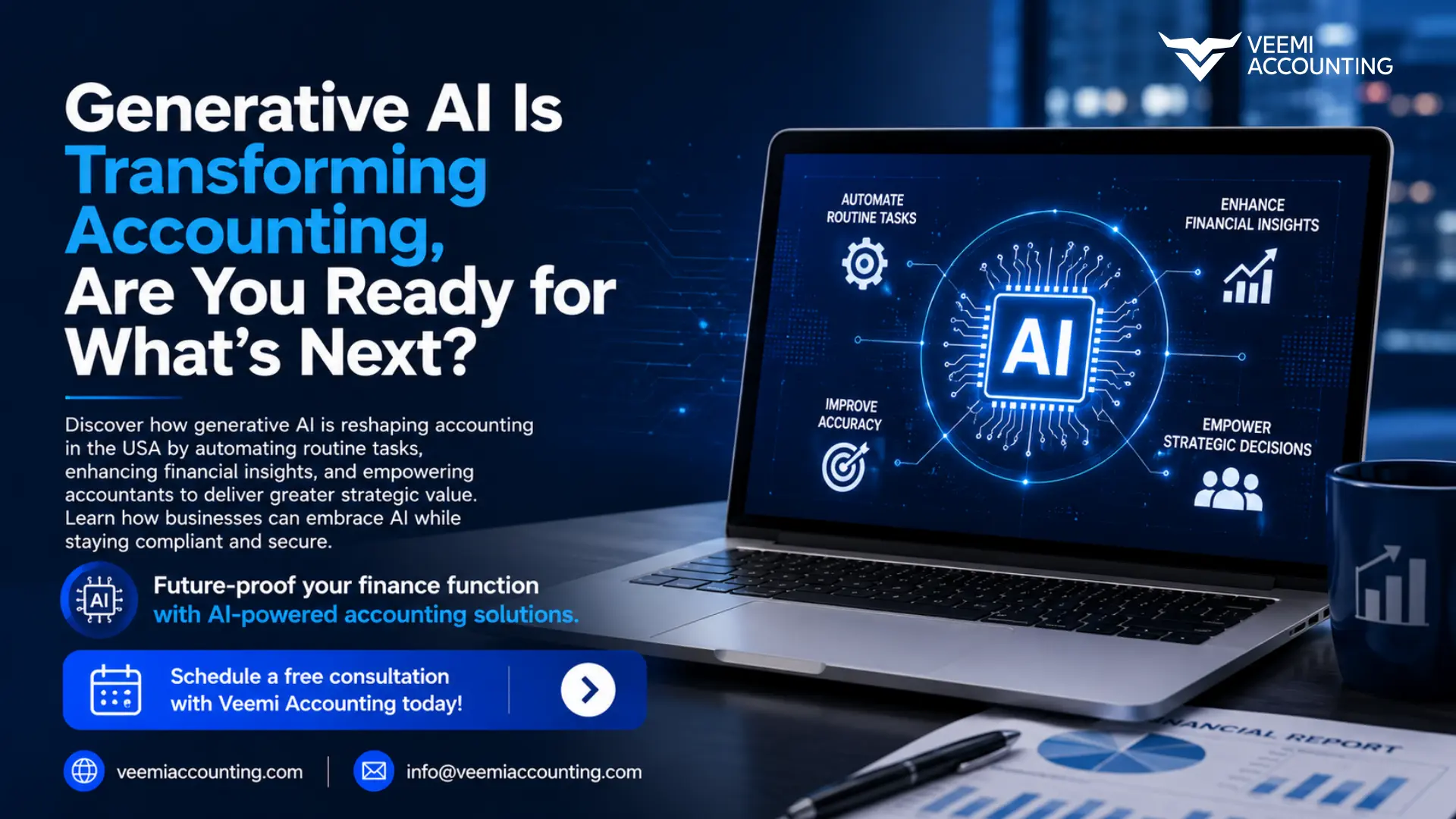
Generative AI is redefining the future of accounting in the USA by automating routine tasks, accelerating financial workflows, and enabling accounting professionals to focus on higher-value advisory services. However, the true competitive advantage does not come from AI alone; it comes from combining intelligent automation with experienced human oversight.
Businesses that embrace this balanced approach can improve efficiency, enhance financial accuracy, strengthen compliance, and make faster, data-driven decisions without sacrificing quality or trust.
Whether you are looking to streamline bookkeeping, simplify tax preparation, improve financial reporting, or scale your accounting operations, partnering with the right accounting experts can help you maximize the benefits of AI while staying compliant with evolving regulations.
Ready to Future-Proof Your Accounting?
At Veemi Accounting, we combine AI-powered efficiency with experienced accounting professionals to deliver accurate, secure, and compliant accounting solutions tailored to your business needs. Let us help you reduce manual work, improve financial visibility, and free your team to focus on growth.
FAQs
Generative AI can assist by organizing financial data, summarizing accounting standards, and drafting reports or tax-related documentation. However, it does not guarantee GAAP or IRS compliance on its own. Businesses should always have qualified accounting professionals or CPAs review AI-generated work before filing tax returns or issuing financial statements.
While AI is effective for bookkeeping, transaction categorization, document summarization, and report drafting, businesses should avoid relying on it alone for tax planning, audit opinions, financial statement sign-offs, complex revenue recognition, or regulatory compliance decisions. These tasks require professional judgment and expertise.
Accounting firms should use AI platforms that offer enterprise-grade security, encryption, strict access controls, and clear data privacy policies. It is also important to establish internal governance, limit the sharing of sensitive financial information with public AI tools, and ensure all AI-assisted work is reviewed by authorized professionals.
In most cases, no. Instead, AI is making outsourced accounting providers more efficient by automating repetitive processes while experienced accountants handle compliance, financial analysis, and client advisory. Businesses can benefit from faster turnaround times and improved service quality without replacing human expertise.
Ask how the provider integrates AI into its workflows, what security measures protect your financial data, who reviews AI-generated outputs, and how they ensure compliance with US accounting standards. A trustworthy accounting partner should be transparent about where AI is used and where human oversight remains essential.