- Published on
- Veemi Accounting
Got a CRA Notice of Reassessment? What It Means for Canadian Businesses and What to Do Next
You open your CRA account expecting another routine notification.
Instead, you see it:
Notice of Reassessment.
Your first thought is probably not, “Interesting. I wonder what changed.”
It’s more likely:
“How much do I owe?”
“Did we make a mistake?”
“Is the CRA auditing us?”
“What am I supposed to do now?”
If you’ve received a CRA notice of reassessment, don’t panic, but don’t ignore it either.
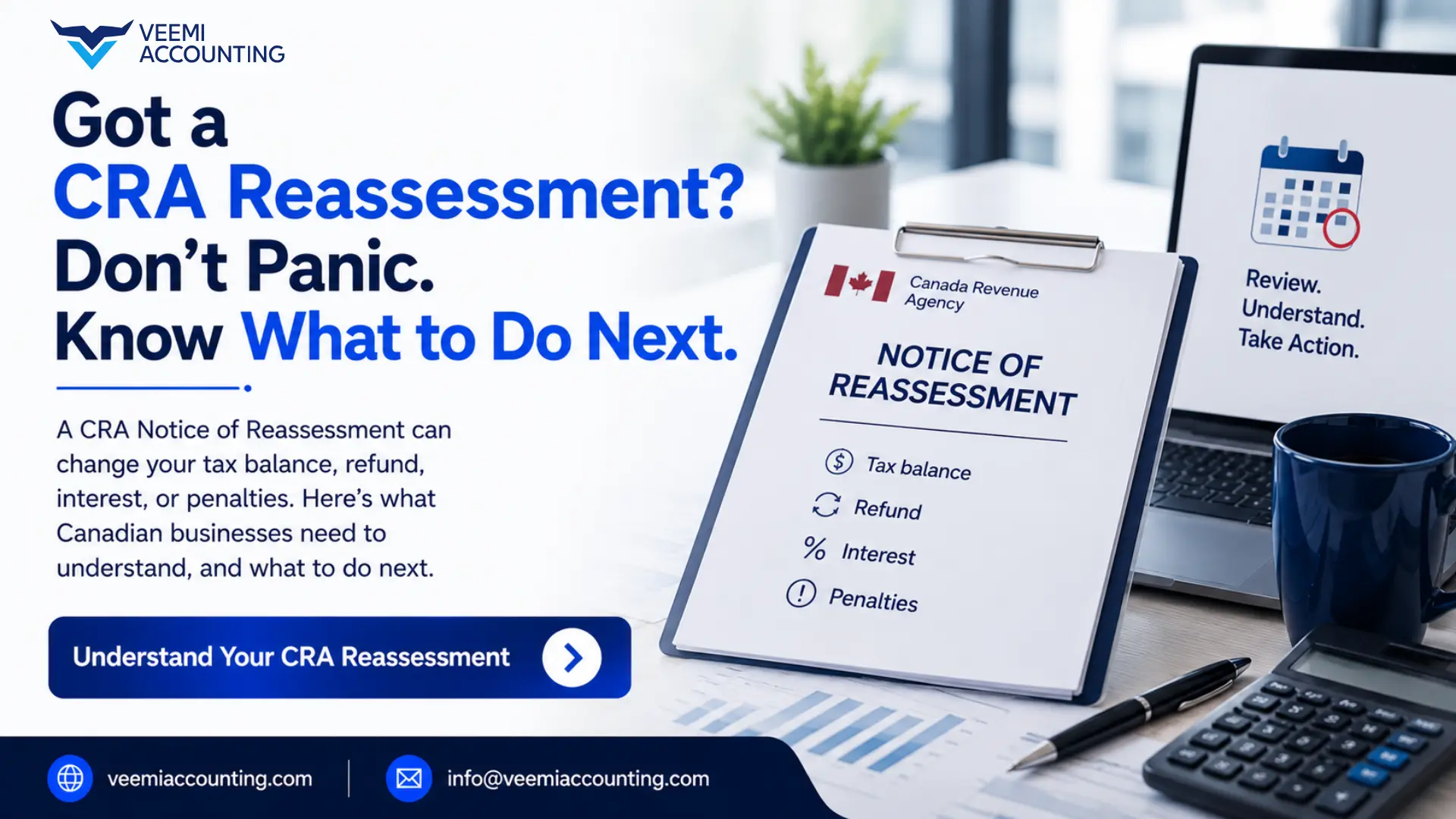
A reassessment means the Canada Revenue Agency has changed something from a previously assessed return. For corporations, the CRA can reassess a T2 return to correct errors, update information, or reflect changes identified during its review. A reassessment can change the tax you owe, including interest and penalties, or change the refund you were expecting.
The important part is understanding why the reassessment happened and what your next step should be.
Because sometimes the CRA has identified a genuine error.
Sometimes you’ve provided information that changed the original assessment.
And sometimes you may have valid reasons to disagree with the reassessment.
Let’s break down what Canadian business owners need to know.
What Is a CRA Notice of Reassessment?
A Notice of Reassessment, or NOR, is an updated assessment issued after the CRA changes the assessment of a previously filed tax return.
Think of it this way.
You filed your business tax return.
The CRA assessed it.
Later, something changes.
That change could come from information the CRA reviewed, an adjustment to your return, or information you or your representative provided.
The CRA then issues a new assessment showing the updated result.
That new notice may show:
👉 Additional tax owing
👉 Additional interest
👉 Additional penalties
👉 A reduced refund
👉 A larger refund
👉 Or a different tax position than the original assessment
So receiving a reassessment does not automatically mean you’ve done something wrong.
But it does mean something has changed.
And you need to understand what.
Is a CRA Notice of Reassessment the Same as an Audit?
Not necessarily.
This is one of the first things business owners worry about.
“Does a reassessment mean we’re being audited?”
Not automatically.
The CRA can reassess a return as part of its normal assessment processes. For corporations, the CRA explains that it can review information provided on a T2 return and reassess it to correct errors, update information, or reflect changes identified by the CRA.
An audit is a more specific review process.
So don’t immediately assume:
CRA reassessment = CRA audit.
Instead, start with a much more useful question:
What exactly did the CRA change?
That’s where the notice becomes important.
Why Might the CRA Reassess a Business Tax Return?
There isn’t one single reason.
A reassessment can happen because the CRA identified an issue or received information that changes the return.
For example:
👉 A business expense may have been adjusted.
👉 Income reported by a third party may not match the return.
👉 A tax credit or deduction may have been changed.
👉 Information provided after the original filing may have changed the assessment.
👉 The CRA may have identified an error in the original return.
👉 A requested adjustment may have changed the tax calculation.
The key is not to guess.
Read the reassessment carefully.
Look for the explanation of what changed and compare the new numbers with the original return.
What Should You Do When You Receive a CRA Notice of Reassessment?
The worst possible response is to put the notice aside because you don’t have time to deal with it.
That is understandable.
It’s also risky.
CRA correspondence can contain deadlines, amounts owing, and information that affects your options.
Instead, slow down and work through the notice systematically.
Step 1: Read the Notice Carefully
Start with the basics.
👉 Date of the notice
👉 Tax year involved
👉 Original assessment
👉 Reassessed amount
👉 New balance or refund
👉 Interest or penalties
👉 Explanation of the adjustment
Don’t just look at the final number.
The reason behind the number is usually much more important.
The CRA itself advises businesses to compare a notice of assessment with their copy of the corporation’s return and contact the CRA if clarification is needed.
Step 2: Compare It With Your Original Tax Return
Pull out the return that was originally filed.
Then compare it with the reassessment.
Look for the specific line items that changed.
For example:
👉 Did taxable income change?
👉 Was an expense reduced?
👉 Was a credit removed?
👉 Did the CRA change a deduction?
👉 Was additional income included?
👉 Did the change affect another tax calculation?
This is where accurate bookkeeping becomes incredibly valuable.
If your records are organized, you can trace the number back to the underlying transaction.
If your records are messy, you may spend hours simply trying to figure out where the CRA’s number came from.
Don’t Start by Assuming the CRA Is Wrong
This is an emotional reaction many business owners have.
“We filed everything correctly. The CRA must have made a mistake.”
Maybe.
But you won’t know until you’ve reviewed the details.
The better approach is neutral.
👉 Don’t defend the original return before understanding the reassessment.
First establish:
What did the CRA change?
Then:
Why did they change it?
Then:
Do our records support the original filing?
That sequence makes the conversation much more productive.
What If the Reassessment Is Correct?
Sometimes the CRA has identified a genuine issue.
Maybe an expense wasn’t deductible as originally reported.
Maybe income was missed.
Maybe supporting documentation wasn’t sufficient.
Maybe a calculation was simply wrong.
If the reassessment is correct, the next step is usually to understand the amount owing and deal with it rather than spending time fighting an adjustment you cannot support.
But there’s another important question:
Why did the error happen?
Because paying the additional tax fixes the immediate problem.
It doesn’t necessarily fix the process that caused it.
If the issue came from incomplete bookkeeping, poor documentation, incorrect categorization, or a weak review process, the business should address that before the next tax filing.
What If You Disagree With the CRA Reassessment?
This is where things become more important.
If you believe the CRA misunderstood the facts or applied the tax rules incorrectly, you generally have the right to formally object to the reassessment.
For corporations, the CRA states that the deadline to file an objection is 90 days from the date of the notice of assessment or reassessment.
That’s not a deadline you want sitting unnoticed in your inbox.
If you disagree, you need to build your position with evidence.
That can include:
👉 Accounting records
👉 Invoices
👉 Contracts
👉 Bank statements
👉 Supporting schedules
👉 Tax calculations
👉 Correspondence
👉 Other relevant documentation
The CRA says a formal objection should explain why you disagree and include relevant facts and supporting documents.
👉 Don’t object simply because the new tax bill is higher.
Object because you have facts, records, and tax reasoning that support your position.
What Happens If You Miss the 90-Day Objection Deadline?
This is where procrastination can become expensive.
If a corporation misses the normal objection deadline, the CRA allows an application for an extension in certain circumstances. The CRA indicates that an extension may be available when the taxpayer attempted to resolve the issue with the CRA or was prevented from objecting by circumstances beyond their control.
But don’t treat that extension as a backup plan.
The safer approach is simple:
Put the objection deadline on your calendar as soon as the reassessment arrives.
Then work backward.
You don’t want to reach day 85 and realize you still haven’t gathered the documentation.
What If You Agree With the Reassessment but Can’t Pay?
This is another situation that causes business owners to freeze.
You receive a reassessment.
The amount owing is larger than expected.
Cash flow is already tight.
So you don’t know whether to pay immediately, investigate further, or simply wait.
Start by confirming the amount and understanding the consequences of the reassessment.
If the amount is correct but your business cannot pay immediately, look into the CRA’s available payment and relief options rather than ignoring the balance.
The CRA also has taxpayer-relief provisions that may allow certain penalties or interest to be cancelled or waived in qualifying circumstances.
The important thing is to separate two questions:
👉 Is the reassessment correct?
👉 If it is correct, how will the business handle the amount owing?
Those are different problems.
Why Accurate Bookkeeping Matters When CRA Reassesses Your Business
This is where a reassessment often reveals something bigger.
A business owner may think:
“Our accountant filed the return, so we’re done.”
But tax filing is the end of a process, not the beginning.
The CRA’s reassessment may force you to go back through months of transactions.
Now you need to find the invoice.
Find the bank transaction.
Find the expense documentation.
Check how it was categorized.
Confirm what was reported.
And suddenly, a tax issue becomes a bookkeeping investigation.
That’s why clean records matter long before the CRA sends a notice.
Accurate bookkeeping gives you something extremely valuable:
the ability to explain your numbers.
If your business wants to strengthen the financial process behind its tax reporting, How Canadian Businesses Can Improve Monthly Reporting Accuracy is a useful next step. Regular monthly reporting can make it easier to identify discrepancies before they become bigger problems during tax filing or a CRA review.
What a CRA Reassessment Can Teach You About Your Business
Here’s the part many business owners miss.
A reassessment isn’t only a tax event.
It can be a diagnostic signal.
Maybe your expense documentation wasn’t strong enough.
Maybe your bookkeeping categories weren’t consistent.
Maybe your financial records were updated months after the transactions happened.
Maybe nobody reviewed unusual entries before the tax return was prepared.
Maybe the business relied too heavily on estimates.
👉 The question shouldn’t only be:
“How do we respond to this CRA notice?”
It should also be:
“What does this notice tell us about the way our financial process is working?”
That second question can prevent the next problem.
How to Prepare for a CRA Reassessment
You can’t control whether the CRA ever reviews or reassesses a return.
You can control how prepared your business is to respond.
A stronger process includes:
👉 Keeping supporting documents organized.
👉 Reconciling bank and credit-card accounts regularly.
👉 Reviewing unusual transactions.
👉 Maintaining clear expense documentation.
👉 Keeping tax-related records accessible.
👉 Reviewing financial statements before tax filing.
👉 Comparing filed tax returns with the underlying accounting records.
👉 Keeping CRA correspondence organized.
The goal isn’t to create paperwork for the sake of paperwork.
It’s to make your business easier to defend when someone asks:
“Where did this number come from?”
When a CRA Reassessment Becomes an Operational Problem
One reassessment can be manageable.
But repeated reassessments can point to something deeper.
If your business repeatedly struggles with:
👉 Missing documentation
👉 Incorrect expense categorization
👉 Unreconciled accounts
👉 Tax adjustments
👉 Payroll discrepancies
👉 GST/HST issues
then the issue may not be tax preparation alone.
Your underlying accounting process may need attention.
And as a business grows, accurate bookkeeping becomes only one part of the picture. Why Bookkeeping Alone Is Not Enough for Business Growth explains why growing businesses eventually need financial information that supports better decisions, not simply records that are accurate enough for tax filing.
And that’s where many growing businesses eventually reach an uncomfortable realization.
The problem is no longer simply:
“Who can file our taxes?”
It’s:
“Do we have reliable financial information throughout the year?”
How Veemi Accounting Can Help Canadian Businesses
For a growing Canadian business, dealing with a CRA notice of reassessment can quickly consume management time.
Someone needs to find the records.
Someone needs to reconcile the numbers.
Someone needs to understand what changed.
Someone needs to organize supporting documentation.
And someone needs to make sure the underlying bookkeeping is accurate.
Veemi Accounting can support businesses with bookkeeping, reconciliations, financial reporting, tax preparation support, and back-office accounting operations.
The objective isn’t simply to react when the CRA sends a notice.
It’s to build cleaner financial processes throughout the year so that tax filings are supported by organized, reliable records.
✅ Better bookkeeping visibility.
✅ More organized supporting documentation.
✅ More consistent reconciliations.
✅ Less time spent searching for historical transactions.
✅ Stronger financial information for tax and business decisions.
👉 The goal is not to make a CRA reassessment impossible.
It’s to make your business better prepared when one happens.
Don’t Let the Notice Sit in Your Inbox
A CRA notice of reassessment can feel intimidating.
Especially when you’re already running a business.
But the notice itself is not the problem.
Uncertainty is.
You don’t know what changed.
You don’t know whether the CRA is correct.
You don’t know whether you need to object.
And you don’t know what the reassessment means for your cash flow.
Start by slowing down.
Read the notice.
Compare it with the original return.
Identify exactly what changed.
Gather the supporting records.
Then decide what action makes sense.
If you disagree, don’t miss the applicable objection deadline.
If the reassessment is correct, deal with the balance and investigate why the original return was different.
And if the reassessment exposed weaknesses in your bookkeeping, don’t wait until next tax season to fix them.
👉 The goal isn’t simply to respond to one CRA notice.
It’s to build a financial process where your business can explain its numbers with confidence.
FAQs About a CRA Notice of Reassessment
A CRA Notice of Reassessment is an updated assessment issued after the CRA changes the assessment of a previously filed tax return. For corporations, the reassessment can change the amount of tax, interest, penalties, or refund.
Not necessarily. The CRA can reassess a corporate return as part of its assessment processes to correct errors, update information, or reflect changes identified by the CRA.
For corporations, the CRA generally allows 90 days from the date of the notice of assessment or reassessment to file a formal objection.
First, identify exactly what changed and compare the reassessment with your original return and accounting records. If you disagree with the CRA’s position, you can generally file a formal objection and provide the facts and supporting documents that explain your position.
First confirm the balance and determine whether the reassessment is final and correct. If you cannot pay the amount immediately, explore the CRA’s payment options rather than ignoring the balance. Depending on your circumstances, taxpayer-relief provisions may also be relevant.
Yes. A reassessment can increase or decrease the amount of tax payable or change the refund that was originally calculated.