- Published on
- Veemi Accounting
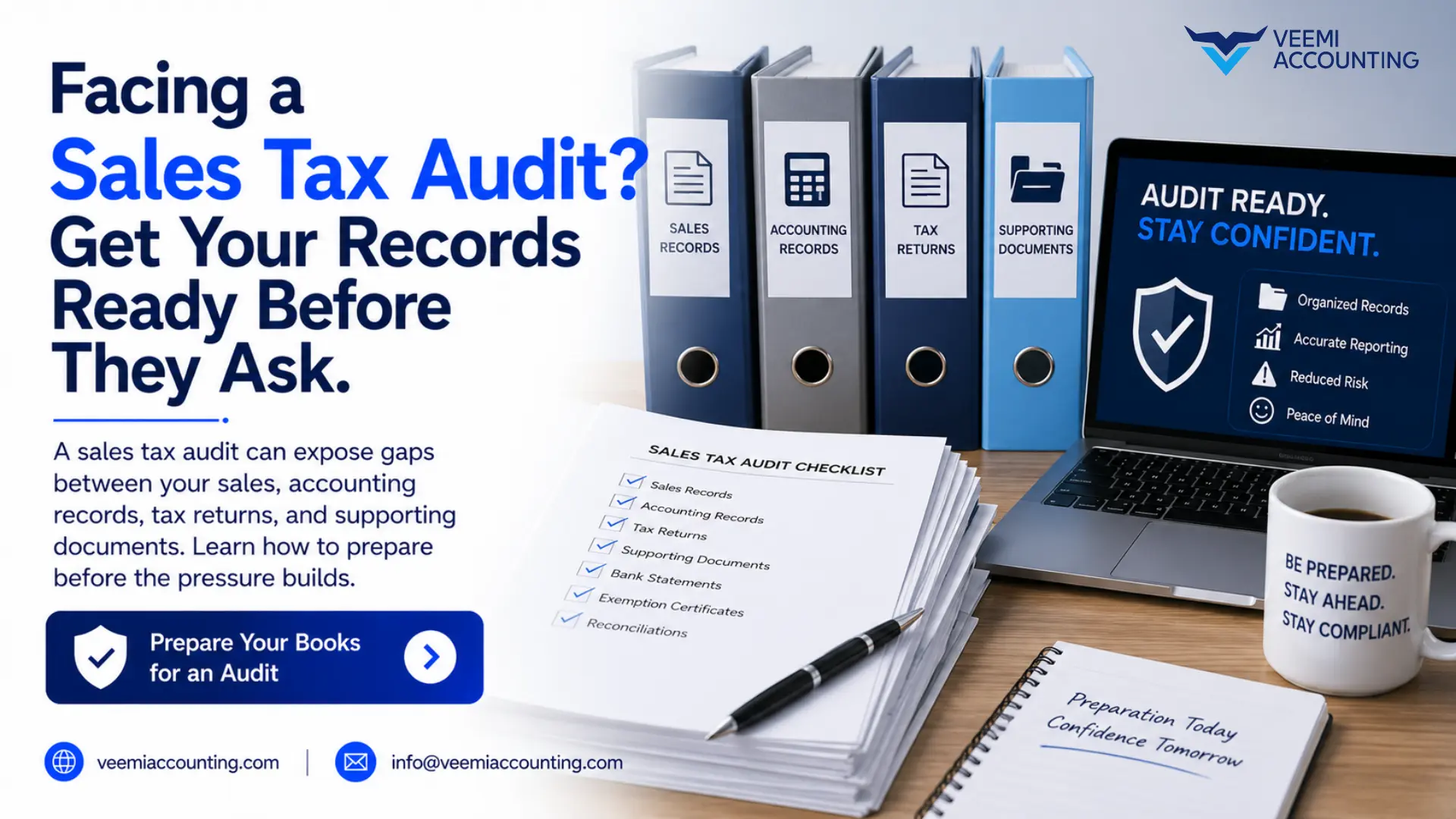
Facing a Sales Tax Audit? How US Businesses Get Their Records Ready
You open your email and see a notice from your state tax authority.
Sales tax audit.
Your first thought probably isn’t, “Great, let’s review our records.”
It’s more likely:
“What are they going to ask for?”
“Are our sales tax returns accurate?”
“What if our bookkeeping doesn’t match?”
“How far back will they look?”
“How much could this cost us?”
For a small business owner, a sales tax audit can feel overwhelming because sales tax isn’t usually something you think about every day.
You sell.
You collect tax where required.
You file returns.
You pay what you owe.
Then an auditor asks you to explain transactions from months—or even years—ago.
That’s when the quality of your records suddenly matters.
And here’s the uncomfortable part:
Sales tax audit preparation is much easier when your records were organized before the audit started.
The good news is that you don’t need to panic.
You need to get organized, understand what the auditor is asking for, and make sure your sales, tax collected, exemptions, returns, and payments can be traced back to the underlying transactions.
What Is a Sales Tax Audit?
A sales tax audit is a review by a state or local tax authority to determine whether a business has correctly handled its sales tax obligations.
The exact rules, audit periods, documentation requirements, and procedures vary by state.
That’s important because there isn’t one universal US sales tax system.
Your business may have obligations in one state—or several.
And each jurisdiction can have different rules around taxable products and services, exemptions, filing requirements, and documentation.
👉 The first mistake businesses make is treating sales tax as one nationwide process.
Your bookkeeping needs to reflect the states and jurisdictions where you actually have obligations.
Why Do Businesses Get Selected for a Sales Tax Audit?
Receiving an audit notice doesn’t automatically mean you’ve done something wrong.
A tax authority may select a business for various reasons, including routine compliance activity, discrepancies in reported information, unusual filing patterns, or other factors.
The important thing is not to spend the first week trying to guess:
“Why us?”
Instead ask:
“What exactly are they reviewing?”
Your audit notice should tell you what authority is conducting the audit, the periods involved, and what information they want.
Read that notice carefully before gathering hundreds of unrelated documents.
What Records Might a Sales Tax Auditor Want?
This is where businesses often discover whether their bookkeeping system is actually organized.
Depending on the state and scope of the audit, you may need records supporting:
👉 Sales transactions
👉 Invoices
👉 Customer information
👉 Sales tax collected
👉 Exempt sales
👉 Resale certificates or exemption documentation
👉 Returns and refunds
👉 General ledger accounts
👉 Bank records
👉 Payment processor reports
👉 Sales tax returns
👉 Tax payments
👉 Point-of-sale reports
👉 Ecommerce platform reports
👉 Supporting accounting records
The IRS also emphasizes that business records should clearly support income, expenses, and transactions, and that supporting documents such as invoices, receipts, deposit records, and sales documentation should be maintained in an orderly manner.
While a state sales tax audit is separate from a federal income tax audit, the underlying lesson is similar:
If you can’t trace a number back to supporting records, defending that number becomes much harder.
The Problem Isn’t Always the Sales Tax Return
Here’s where things get interesting.
A business owner may think:
“Our sales tax returns were filed on time. So we’re fine.”
But an audit doesn’t necessarily stop at the return.
The auditor may want to understand how the reported numbers were calculated.
Imagine your return says:
Taxable sales: $500,000
The auditor may ask:
“Show me how you arrived at that $500,000.”
Now you need to connect:
Sales system > invoices > tax treatment > exemptions > accounting records > sales tax return.
If those numbers don’t connect cleanly, the audit can become much more difficult.
This is also why How Poor Bookkeeping Delays Tax Filing for US Businesses is relevant for growing businesses. When financial records aren’t consistently reconciled, problems can surface not only during tax filing but also when a tax authority asks you to explain your numbers.
👉 A sales tax return is only as defensible as the records behind it.
Start With the Audit Notice
Before doing anything else, identify the scope of the audit.
Look for:
👉 Tax authority conducting the audit
👉 Tax periods under review
👉 Filing types involved
👉 Specific records requested
👉 Response deadline
👉 Contact information
👉 Instructions for submitting documents
Don’t assume you need to send everything your business has ever recorded.
Give the auditor what has been requested and organize it in a way that makes the review easier.
For federal IRS audits, the IRS similarly instructs taxpayers to organize requested records by year and type and include transaction summaries; it also advises sending copies rather than original records.
The specific requirements of a state sales tax audit can differ, so follow the instructions in your state notice.
Reconcile Your Sales Before the Auditor Does
This is one of the most important steps in sales tax audit preparation.
Don’t wait for the auditor to discover differences between your systems.
Do it yourself first.
Compare your:
👉 Ecommerce platform
👉 Point-of-sale system
👉 Accounting software
👉 Payment processor
👉 Bank deposits
👉 Sales tax returns
You aren’t necessarily expecting every system to show the exact same number.
You’re looking for a logical reconciliation.
For example, your ecommerce platform might show gross sales.
Your accounting system may show revenue after certain adjustments.
Your bank may show net deposits after payment-processing fees.
Your sales tax return may use taxable sales rather than total gross sales.
Those differences can be legitimate.
But you need to be able to explain them.
Separate Gross Sales From Taxable Sales
This is another common source of confusion.
A business may generate $1 million in total sales.
That doesn’t automatically mean $1 million was subject to the same sales tax treatment.
Your records may include:
👉 Taxable sales
👉 Non-taxable sales
👉 Exempt sales
👉 Resale transactions
👉 Returns
👉 Discounts
👉 Shipping or delivery charges
👉 Sales into different jurisdictions
The exact treatment depends on applicable state and local rules.
This is why your accounting system shouldn’t simply have one giant “Sales” number with no supporting detail.
👉 The more complicated your sales footprint becomes, the more important sales-tax-ready reporting becomes.
Don’t Forget Exemption Documentation
Exempt transactions can create particular problems during an audit.
Maybe you sold to a reseller.
Maybe the customer qualified for an exemption.
Maybe the transaction was treated differently under the applicable state rules.
Whatever the reason, your business may need documentation supporting that treatment.
And this is where memory isn’t enough.
“That customer is always tax-exempt.”
Isn’t documentation.
“We’ve been doing it this way for years.”
Isn’t documentation.
The strength of an exemption position depends on the applicable rules and supporting records.
⚠️ If your business routinely makes exempt or resale sales, your process for collecting and retaining the required documentation should be established before an audit—not during one.
Check Your Sales Tax Returns Against Your Books
Now compare each filed return with the underlying accounting records.
Look for:
👉 Gross sales
👉 Taxable sales
👉 Exempt sales
👉 Sales tax collected
👉 Credits or adjustments
👉 Returns
👉 Tax payments
👉 Filing dates
If you find a discrepancy, don’t immediately change historical records just to make the numbers match.
First understand why they differ.
Was it:
👉 A timing difference?
👉 A refund?
👉 An accounting adjustment?
👉 A filing correction?
👉 A transaction that was recorded differently?
👉 A genuine error?
That distinction matters.
What If You Find an Error Before the Auditor Does?
This is one of the most uncomfortable moments in audit preparation.
You discover that a previous return may not have been correct.
Now you’re thinking:
“Should we fix it before the auditor finds it?”
Don’t guess.
The appropriate correction process can depend on the state, tax period, type of error, and circumstances.
Before making changes, document what you found and consider discussing the issue with a qualified state and local tax professional.
👉 The goal isn’t to make the books look perfect before the auditor arrives.
The goal is to understand what actually happened and respond accurately.
Why Multi-State Businesses Face More Complexity
A business selling in multiple states can have an entirely different level of sales tax complexity.
Imagine an ecommerce business selling products nationwide.
Now there may be:
👉 Multiple state registrations
👉 Different filing frequencies
👉 Different tax rates
👉 Different taxable products
👉 Different exemption rules
👉 Different local jurisdictions
👉 Different filing systems
👉 Different documentation requirements
The bookkeeping problem isn’t simply calculating tax.
It’s keeping track of which rules apply to which transactions.
That’s why a sales tax process that worked when the business sold in one state can start breaking down when the business expands.
Growth creates tax complexity.
Don’t Let Your Payment Processor Become Your Sales Tax System
Payment processors are useful.
But they’re not necessarily a substitute for your accounting and sales tax records.
Your processor may show:
👉 Gross transaction volume
👉 Processing fees
👉 Refunds
👉 Chargebacks
👉 Net deposits
Your sales tax reporting may require a different view of those transactions.
So don’t simply export a payment processor report and assume you’ve completed your audit preparation.
The auditor may need to understand how your sales transactions connect to the tax reported.
Build an Audit File Before You Need One
Here’s a practical idea that can save significant stress later.
Create a recurring sales tax documentation package.
For each filing period, maintain:
👉 Sales reports
👉 Taxable and exempt sales detail
👉 Exemption documentation
👉 Sales tax return
👉 Payment confirmation
👉 Reconciliation between books and return
👉 Supporting transaction reports
Then organize those records by filing period and jurisdiction.
Now imagine receiving an audit notice.
Instead of starting from scratch, you already have a trail.
That’s a very different experience.
The right bookkeeping process can make this easier to maintain consistently. If you’re deciding how much of your accounting workflow should be automated, Automated Bookkeeping vs Manual Bookkeeping: Which Is Right for Your US Business? explores the trade-offs between automation and human review.
The Bigger Lesson: Sales Tax Compliance Is an Operations Problem
Sales tax is often treated as a tax department problem.
But for a small business, it touches almost everything.
Sales systems.
Accounting.
Customer information.
Ecommerce.
Invoices.
Payments.
Returns.
Product classification.
Exemption documentation.
And financial reporting.
That’s why recurring sales tax issues are often symptoms of a broader process problem.
If your business can’t easily answer:
“How did we calculate this sales tax return?”
you may have a bookkeeping problem hiding underneath a tax problem.
When Should a US Business Get Help With Sales Tax Records?
You don’t necessarily need outside support because you’ve received one audit notice.
But the complexity can become difficult to manage when:
👉 You sell in multiple states.
👉 Your business uses several sales channels.
👉 Your ecommerce and accounting systems don’t reconcile cleanly.
👉 You have significant exempt or resale sales.
👉 Sales tax returns require manual calculations.
👉 You regularly discover differences after filing.
👉 Your team spends hours reconstructing historical transactions.
👉 You don’t have a clear recordkeeping process.
At that point, the question becomes:
How much time and risk is your current process creating?
How Veemi Accounting Can Support US Businesses
Sales tax audit preparation can become extremely time-consuming when the underlying bookkeeping isn’t organized.
Someone has to pull sales reports.
Someone has to reconcile payment processors.
Someone has to match transactions with accounting records.
Someone has to locate supporting documentation.
Someone has to investigate discrepancies.
And the business owner still has to run the company.
Veemi Accounting can support US businesses with bookkeeping, reconciliations, financial reporting, tax preparation support, and back-office accounting operations.
The goal isn’t to promise that an audit will never happen.
It’s to help create financial records that are organized, consistent, and easier to review when questions arise.
✅ Better-organized transaction records.
✅ More consistent monthly reconciliations.
✅ Clearer financial reporting.
✅ Less time spent searching for historical information.
✅ More capacity for business owners to focus on running the company.
👉 Good bookkeeping doesn’t eliminate compliance risk.
It gives you a much stronger position when you need to explain your numbers.
Don’t Wait Until the Auditor Is Asking Questions
A sales tax audit is stressful because it forces you to look backward.
You have to explain transactions that happened months or years ago.
You have to find documents.
You have to reconcile numbers.
You have to remember why something was treated a certain way.
But good sales tax audit preparation changes the experience.
Instead of scrambling to reconstruct the past, you’re organizing records that already exist.
👉 Start with the audit notice.
👉 Understand exactly what’s being requested.
👉 Reconcile your sales.
👉 Review taxable and exempt transactions.
👉 Match your books to filed returns.
👉 Organize supporting documentation.
👉 Investigate discrepancies before submitting records.
Then take the bigger lesson seriously.
👉 Your sales tax records shouldn’t only make sense when an auditor asks for them. They should make sense to you every month.
Because the real goal isn’t simply getting through one audit.
It’s building a bookkeeping process that makes your business easier to understand, easier to manage, and better prepared for whatever comes next.
FAQs About Sales Tax Audit Preparation
Sales tax audit preparation is the process of organizing and reviewing the financial records, sales data, tax returns, exemptions, payments, and supporting documentation that may be needed during a state or local sales tax audit.
The exact requirements vary by jurisdiction and audit scope, but businesses may need sales records, invoices, exemption documentation, accounting records, sales tax returns, payment records, and transaction reports.
Yes. Comparing your sales systems, accounting records, payment processors, and filed sales tax returns can help you identify discrepancies and understand them before responding to an auditor.
Don’t automatically alter historical records or file corrections without understanding the issue. Document the discrepancy and consider getting appropriate state and local tax advice about the correction process.
Record-retention requirements vary by jurisdiction and type of record. Businesses should follow the applicable state and local requirements and retain records long enough to support their filings and tax positions.
Organized bookkeeping can make it easier to trace reported sales, tax amounts, payments, and adjustments back to supporting records. It can also reduce the time spent reconstructing historical transactions.