- Published on
- Veemi Accounting
Payroll Remittance Errors With CRA in Canada? How to Fix Them Before Penalties Add Up
Payroll day usually feels like a win.
Your employees get paid. Salaries go out. Another pay period is done.
Then you look at your CRA payroll account and notice something doesn’t match.
Maybe the remittance was late.
Maybe the amount sent to the CRA was lower than it should have been.
Maybe CPP or EI was calculated incorrectly.
Or maybe the payment was made, but it was applied to the wrong account.
And suddenly, something that looked like a small payroll mistake starts feeling much bigger.
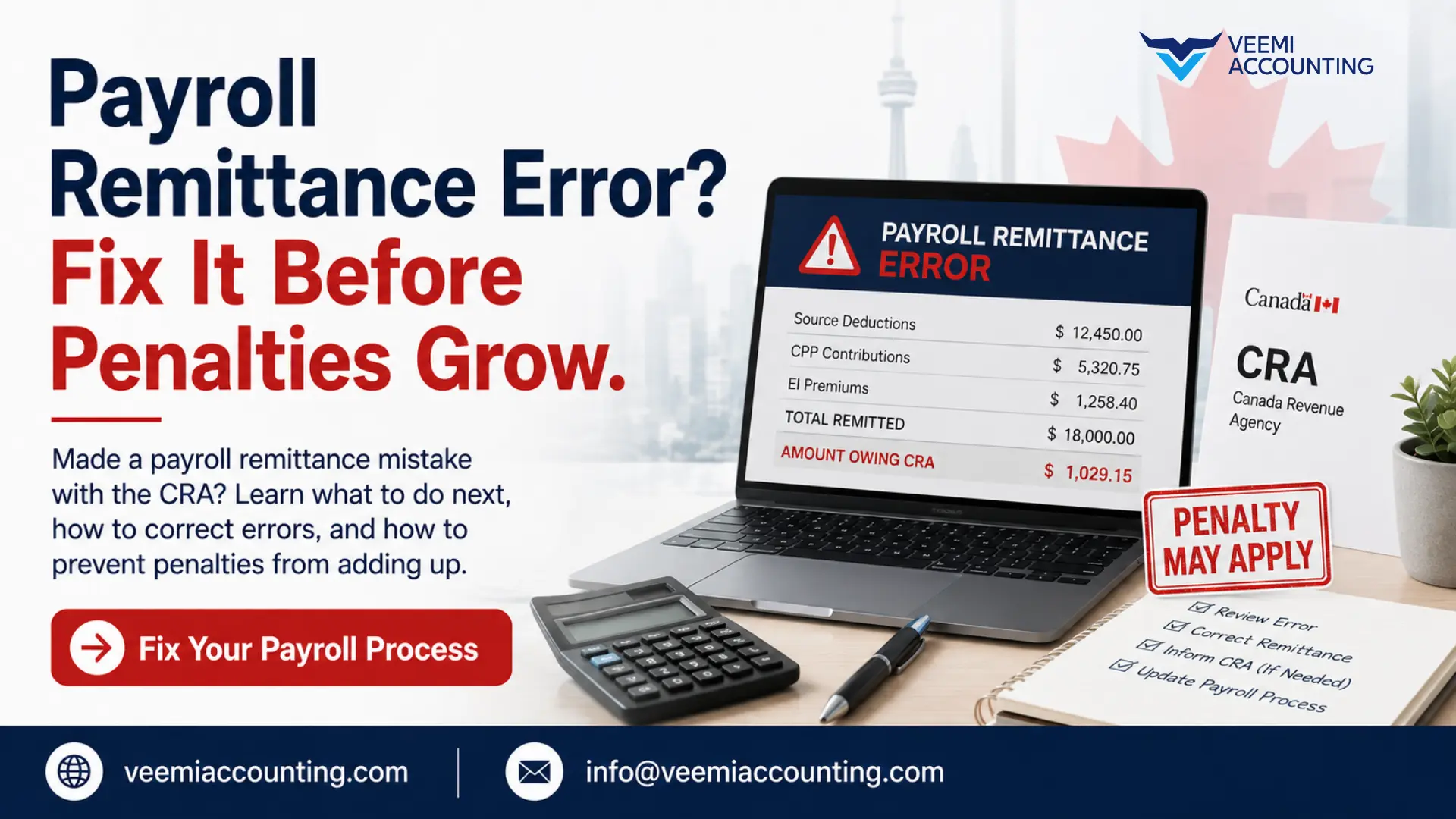
If you’re dealing with a CRA payroll remittance penalty, the worst response is usually to ignore it and hope the account corrects itself.
It rarely does.
The better approach is to understand what went wrong, correct it quickly, and identify why the error happened in the first place.
Because payroll mistakes aren’t just accounting mistakes.
They affect employees, cash flow, CRA compliance, and the financial stability of the business.
What Is a CRA Payroll Remittance Penalty?
Canadian employers generally have to deduct amounts such as income tax, CPP contributions, and EI premiums from employee payments and remit those amounts to the CRA according to their assigned remitter schedule.
When an employer deducts payroll amounts but doesn’t remit them on time, or doesn’t remit them at all, the CRA may apply a penalty and interest.
And this is where the situation can become expensive surprisingly quickly.
The CRA’s current penalty structure for late payroll remittances is:
👉 3% when the amount is 1-3 days late
👉 5% when it is 4-5 days late
👉 7% when it is 6-7 days late
👉 10% when it is more than 7 days late or no amount is remitted
👉 20% for a second or subsequent assessed failure in a calendar year when the failure was made knowingly or through gross negligence.
Interest can also apply from the day the payment was due and is compounded daily.
👉 The important lesson is simple: a payroll remittance error becomes more expensive the longer it remains unresolved.
What Counts as a Payroll Remittance Error?
Not every payroll problem looks the same.
You might have:
👉 Remitted the correct amount, but after the deadline.
👉 Remitted less than you were required to remit.
👉 Calculated CPP or EI incorrectly.
👉 Failed to deduct the required income tax.
👉 Used the wrong remitting frequency or payment method.
👉 Made the payment but had it incorrectly allocated to your CRA payroll account.
👉 Discovered an error after T4s or other information returns were already filed.
Each situation can require a different correction.
That’s why the first step isn’t automatically “pay more.”
It’s find the error.
How a Small Payroll Error Turns Into a Bigger Problem
Consider a growing business with 12 employees.
Payroll used to be simple.
The owner reviewed everything personally. There were only a few employees, one payroll cycle, and relatively straightforward compensation.
Then the company grew.
New employees joined.
Someone received a bonus.
Another employee changed their status.
A benefit was added.
Payroll software was updated.
And the person handling payroll was suddenly trying to manage everything while also doing bookkeeping and administrative work.
The business didn’t become careless.
The payroll process simply became more complicated than the old system could comfortably handle.
👉 This is why recurring payroll errors are often a process problem, not an employee problem.
What Should You Do If You Discover a CRA Payroll Remittance Error?
The longer you wait, the harder it becomes to reconstruct what happened.
Start with the basics.
Step 1: Compare Payroll Records With the CRA Account
Pull your payroll reports, payment confirmations, remittance records, and CRA account information.
Then compare them.
Look for:
👉 Payroll amounts calculated internally
👉 CPP and EI deductions
👉 Income tax deductions
👉 Employer contributions
👉 Amounts actually remitted
👉 Remittance due dates
👉 CRA account balances
👉 Any previous outstanding amounts
The CRA allows businesses to view payroll account statements and transactions through its online services.
This step is important because the amount you think you paid and the amount CRA actually received or applied to your account aren’t always the same thing.
Step 2: Determine Whether You Under-Remitted or Over-Remitted
This distinction matters.
If you under-remitted, the CRA says you must remit the required amount immediately, and a penalty and interest may apply.
If you over-remitted, the correction process is different.
So don’t simply send another payment before understanding the account.
👉 Know what the CRA believes you owe before trying to fix the balance.
This can prevent one accounting error from creating another.
Step 3: Correct the Payroll Calculation
Now go back to the payroll records.
Was the problem caused by:
👉 An incorrect CPP calculation?
👉 An EI error?
👉 Incorrect income tax withholding?
👉 A taxable benefit that wasn’t handled properly?
👉 A salary or bonus entered incorrectly?
👉 A payroll setup issue?
The CRA provides specific processes for correcting payroll deduction errors, both before and after information returns have been filed.
For example, if you discover that CPP or EI was under-deducted during the current year, there are rules around recovering the employee portion from later payments, including limits on how far back the amount can be recovered.
That’s why payroll corrections shouldn’t be treated as simply changing a number in your accounting software.
Step 4: Check Whether T4s Are Affected
This is where a payroll error can become more complicated.
Suppose you discover an incorrect deduction after the year-end payroll information has already been prepared.
Now you’re not only dealing with the CRA payroll account.
You may also need to consider whether an employee’s T4 information needs to be corrected.
The CRA provides processes for amending, cancelling, adding, or replacing slips when information reported on them is incorrect.
If you’re regularly dealing with payroll corrections, it’s worth understanding the common year-end issues covered in T4 Filing Mistakes Canadian Employers Keep Making.
👉 The goal isn’t simply to fix today’s payroll balance.
It’s to make sure the correction doesn’t create a second problem at year-end.
What If the Payroll Remittance Was Just Late?
Sometimes the numbers are completely correct.
The payment was simply missed.
Maybe the payroll administrator was away.
Maybe the payment approval wasn’t completed.
Maybe a bank issue delayed the transaction.
Maybe someone misunderstood the remittance deadline.
Even when the payroll calculation is correct, a late remittance can still result in penalties and interest.
So ask yourself:
“Was this genuinely a one-time mistake, or could the same thing happen next month?”
That question matters more than it sounds.
If the answer is “it could happen again,” you don’t just have a payment problem.
You have a process problem.
Why Payroll Remittance Errors Keep Happening
The problem is often surprisingly predictable.
Payroll responsibilities are unclear.
Deadlines live in someone’s personal calendar.
Payroll and bookkeeping systems don’t fully reconcile.
CRA payments aren’t reviewed after submission.
No one performs a monthly payroll reconciliation.
And everyone assumes someone else checked it.
This is where a proper payroll reconciliation process becomes valuable.
A reconciliation doesn’t simply ask, “Did we pay payroll?”
It asks:
👉 Does payroll expense agree with the accounting records?
👉 Do payroll liabilities agree with what should have been remitted?
👉 Do CRA payments match the amounts submitted?
👉 Are CPP, EI, and income tax balances reasonable?
👉 Are unusual differences investigated?
👉 Good reconciliation catches problems while they’re still small.
How to Prevent Another CRA Payroll Remittance Penalty
You don’t necessarily need a bigger accounting department.
You need a more reliable process.
During every payroll cycle:
👉 Review payroll calculations.
👉 Confirm deductions.
👉 Confirm the remittance amount.
👉 Track the CRA due date.
👉 Keep payment confirmations.
After the payment:
👉 Verify that the payment was received.
👉 Check the CRA payroll account.
👉 Reconcile the payroll liability accounts.
👉 Investigate unexpected differences.
The CRA recommends confirming remittance payments and viewing account transactions through its online services.
That extra review may feel unnecessary when everything looks right.
But that’s exactly when it is easiest to do.
The Bigger Business Lesson Behind Payroll Errors
Payroll is one of those business functions where “almost right” isn’t good enough.
Employees expect to be paid correctly.
The CRA expects deductions and remittances to be handled correctly.
And your financial statements need to reflect the real liability.
As your business grows, payroll complexity grows with it.
More employees.
More compensation structures.
More benefits.
More payroll cycles.
More compliance requirements.
The question eventually becomes:
How much payroll complexity can your current team realistically manage without creating avoidable risk?
That doesn’t automatically mean hiring another full-time employee.
It means looking honestly at where the process is breaking down.
How Veemi Accounting Can Help
For a small business, payroll remittance problems can consume far more management attention than they should.
👉 Someone has to check the calculations.
👉 Someone has to reconcile payroll.
👉 Someone has to monitor CRA balances.
👉 Someone has to investigate differences.
👉 Someone has to correct errors when something goes wrong.
And when those responsibilities sit on top of an already overloaded bookkeeping or administrative role, small mistakes become easier to make.
Veemi Accounting can support businesses with bookkeeping, payroll-related accounting support, reconciliations, financial reporting, tax preparation support, and broader back-office operations.
The objective isn’t simply to correct one CRA payroll remittance error.
It’s to help create a process where payroll liabilities are monitored consistently, discrepancies are identified earlier, and compliance doesn’t depend on one person remembering every deadline.
For CPA firms, the same capacity challenge can appear at scale.
Client payroll records may arrive late. Reconciliations may need additional review. Payroll-related corrections can consume valuable team time.
Veemi Accounting can work as an extension of the CPA firm’s team through white-label accounting and back-office support while the CPA firm retains client ownership, communication, branding, and quality control.
✅ Additional capacity when workloads increase.
✅ More consistent reconciliation workflows.
✅ Less repetitive administrative pressure.
✅ More room for CPA teams to focus on advisory and higher-value client work.
👉 The goal isn’t to replace the firm’s expertise.
It’s to give that expertise more operational support.
If payroll remittance issues are becoming a recurring source of pressure, it may be time to look beyond the individual mistake and strengthen the process behind it.
👉 Schedule a Consultation Call
Fix the Error Before It Becomes a Pattern
A payroll remittance error is stressful.
But the biggest mistake is assuming that paying the penalty, or correcting the balance, is the end of the problem.
If the same process remains in place, the same error can happen again.
Maybe next time the payment is eight days late.
Maybe the amount is larger.
Maybe the problem isn’t discovered until T4 preparation.
That’s when a small administrative mistake becomes an expensive operational problem.
So start with the immediate issue.
👉 Confirm what went wrong.
👉 Reconcile the payroll records.
👉 Correct the CRA account.
👉 Pay any outstanding amount.
👉 Review whether penalties or interest apply.
Then take the more important step:
👉 Fix the process that allowed the error to happen.
Because the goal isn’t simply to avoid one CRA payroll remittance penalty.
It’s to build a payroll process that makes the next one much less likely.
FAQs About CRA Payroll Remittance Penalties
The CRA may charge a penalty when an employer deducts payroll amounts but remits them late or fails to remit them. The penalty can range from 3% to 10% depending on how late the payment is, with higher penalties possible in certain repeated or gross-negligence situations.
The penalty increases based on how late the remittance is. The CRA currently applies 3% for 1-3 days late, 5% for 4-5 days, 7% for 6-7 days, and 10% when the payment is more than seven days late or not remitted.
If you discover that you paid the CRA less than required, the CRA says you must remit the required amount immediately. A penalty and interest may apply.
Yes. The CRA provides procedures for correcting deduction errors and amending payroll information returns after filing. The appropriate correction depends on the type and timing of the error.
Regular payroll reconciliation, clear ownership of CRA deadlines, accurate payroll records, payment verification, and consistent review of CRA account balances can reduce the risk of recurring errors.