- Published on
- Veemi Accounting
AI Cash Flow Forecasting for Small Business: A Practical Guide
Cash flow is the lifeblood of every business. Yet, many small business owners find themselves struggling with cash shortages, not because they aren’t profitable, but because they lack visibility into future cash movements. Invoices get paid late, unexpected expenses arise, and seasonal fluctuations can quickly disrupt financial stability.
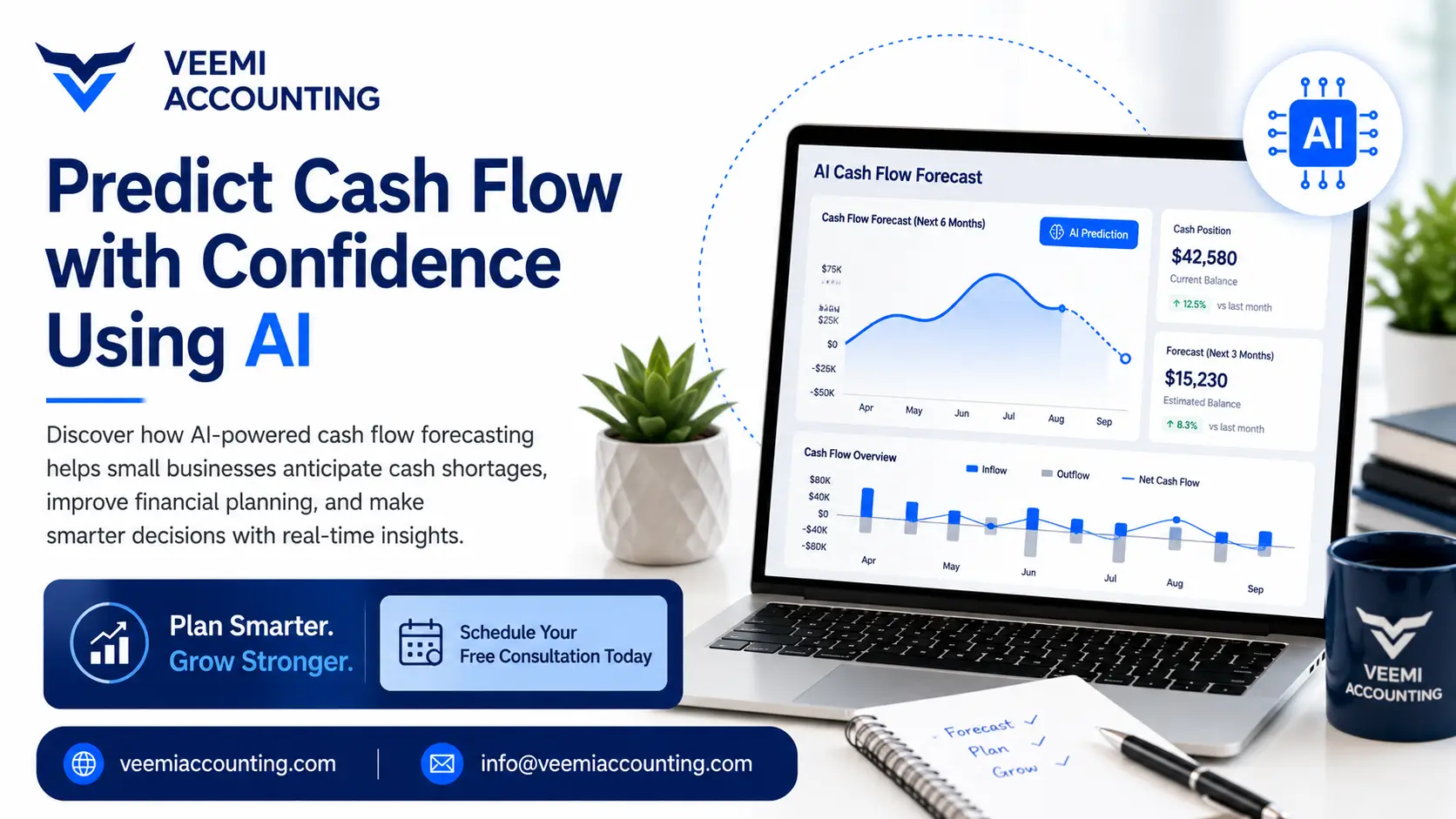
This is where AI cash flow forecasting for small businesses is transforming financial management. Instead of relying on spreadsheets, assumptions, or outdated reports, artificial intelligence helps businesses predict future cash positions using real-time financial data and historical trends. The result? Better financial decisions, fewer surprises, and greater confidence in planning for growth.
In this guide, we will explain how AI-powered cash flow forecasting works, its benefits, the best practices for implementation, and how combining AI with expert financial guidance can help your business stay financially healthy.
What Is AI Cash Flow Forecasting?
AI cash flow forecasting uses artificial intelligence and machine learning to estimate your future cash inflows and outflows. Rather than manually updating spreadsheets or making educated guesses, AI analyzes financial data continuously and identifies patterns that humans may overlook.
Traditional forecasting often depends on:
👉 Historical spreadsheets
👉 Manual calculations
👉 Static assumptions
👉 Monthly or quarterly updates
AI-powered forecasting goes much further by analyzing:
👉 Historical revenue and expenses
👉 Customer payment behavior
👉 Vendor payment schedules
👉 Seasonal sales trends
👉 Bank transactions
👉 Outstanding invoices
👉 Economic and business trends (where supported)
The software then generates predictions about your future cash position and continuously updates those forecasts as new financial information becomes available.
For small businesses operating with limited working capital, these insights can make the difference between proactive planning and reacting to cash shortages.
Why Small Businesses Need AI-Powered Forecasting
Small businesses often operate with tighter margins than larger organizations. A delayed customer payment or unexpected expense can significantly impact operations.
Unfortunately, many businesses still manage cash flow manually, creating several challenges.
Manual Forecasting Takes Time
Business owners already wear multiple hats. Spending hours updating spreadsheets every week reduces the time available for growing the business.
AI automates much of this process by collecting financial data and generating updated forecasts automatically.
Human Errors Affect Accuracy
Manual calculations increase the likelihood of:
👉 Formula mistakes
👉 Missing transactions
👉 Incorrect assumptions
👉 Outdated information
AI minimizes these errors by pulling data directly from integrated financial systems.
Most Small Businesses Don’t Have Finance Teams
Large corporations often employ financial analysts dedicated to forecasting. Smaller companies rarely have that luxury.
AI allows small businesses to access sophisticated forecasting capabilities without building an in-house finance department.
AI Identifies Hidden Patterns
Artificial intelligence excels at recognizing trends such as:
👉 Customers who consistently pay invoices late
👉 Seasonal revenue fluctuations
👉 Recurring expense increases
👉 Inventory purchasing patterns
👉 Cash shortages likely to occur months ahead
These insights help businesses make informed decisions before problems develop.
While AI helps predict future cash positions, understanding why businesses experience cash shortages despite strong profits is equally important. Read our guide on Why Your Business Can Be Profitable But Still Run Out of Cash to learn the key differences between profitability and cash flow, and how to avoid common financial pitfalls.
Key Benefits of Using AI Tools for Cash Flow Forecasting
Improved Forecast Accuracy
AI evaluates thousands of historical data points simultaneously, producing more reliable forecasts than manual methods alone.
While no prediction is perfect, AI significantly reduces guesswork.
Early Warning of Cash Flow Problems
Rather than discovering a cash shortage when it’s too late, AI can alert you weeks or months in advance.
This allows businesses to:
👉 Accelerate collections
👉 Delay discretionary spending
👉 Arrange financing
👉 Adjust purchasing decisions
Proactive planning reduces financial stress.
Better Scenario Planning
One of AI’s biggest advantages is “what-if” analysis.
For example:
👉 What happens if a major customer pays 30 days late?
👉 Can the business afford to hire another employee?
👉 Will purchasing new equipment create a cash shortage?
👉 What happens if sales decline by 15%?
AI models multiple scenarios quickly, helping owners make informed strategic decisions.
Significant Time Savings
Instead of manually gathering reports from multiple systems, AI automates:
👉 Data collection
👉 Forecast calculations
👉 Report generation
👉 Dashboard updates
Business owners spend less time creating reports and more time acting on insights.
Smarter Business Decisions
Reliable cash flow forecasts improve decisions around:
👉 Hiring employees
👉 Purchasing inventory
👉 Business expansion
👉 Equipment investments
👉 Loan applications
👉 Marketing budgets
Knowing future cash availability reduces unnecessary financial risk.
How AI Cash Flow Forecasting Tools Work
Although different software platforms use different technologies, most AI forecasting tools follow a similar process.
Step 1: Connect Financial Data
The software integrates with your financial ecosystem, including:
👉 Accounting software
👉 Business bank accounts
👉 Payroll systems
👉 Invoicing software
👉 Expense management tools
This creates a centralized financial picture.
Step 2: Analyze Historical Trends
AI reviews months or years of financial activity to identify patterns such as:
👉 Revenue cycles
👉 Expense timing
👉 Customer payment behavior
👉 Vendor payment schedules
👉 Seasonal fluctuations
The more historical data available, the stronger the forecasting model becomes.
Step 3: Generate Cash Flow Predictions
Using predictive analytics, AI estimates the future:
👉 Cash inflows
👉 Cash outflows
👉 Available cash balances
👉 Potential shortfalls
👉 Surplus cash
Forecasts are often available daily, weekly, monthly, or quarterly.
Step 4: Provide Alerts and Dashboards
Most AI tools notify users when:
👉 Cash balances fall below thresholds
👉 Large expenses are approaching
👉 Customer payments are overdue
👉 Forecast assumptions change significantly
Interactive dashboards make financial performance easier to understand.
Step 5: Continuously Learn
Unlike static spreadsheets, AI models improve over time.
As new transactions occur, predictions become increasingly accurate because the software continuously updates its understanding of your business patterns.
Popular AI Tools for Cash Flow Forecasting
Many accounting platforms now include AI-powered forecasting capabilities or integrate with specialized forecasting software.
Some common categories include:
Accounting Software with AI Features
Modern accounting solutions increasingly offer:
👉 Automated forecasting
👉 Cash flow dashboards
👉 Intelligent financial insights
👉 Predictive analytics
Many integrate seamlessly with bookkeeping workflows.
Standalone Forecasting Platforms
Dedicated forecasting tools typically provide:
👉 Advanced scenario planning
👉 Multi-business forecasting
👉 Custom dashboards
👉 Driver-based forecasting
👉 Budget comparisons
These platforms often suit growing businesses with more complex financial needs.
Forecasting Tools That Integrate with Existing Systems
Many businesses already use accounting software such as QuickBooks or Xero. Numerous AI forecasting applications connect directly with these systems, eliminating duplicate data entry.
When evaluating software, consider:
👉 Integration capabilities
👉 Ease of implementation
👉 Forecast accuracy
👉 Security standards
👉 Scalability
👉 Customer support
👉 Total cost of ownership
Remember that the “best” tool depends on your business size, complexity, and financial goals.
How to Get Started with AI Cash Flow Forecasting
Successful implementation begins with quality financial data.
Organize Your Financial Records
AI performs best when the data is accurate.
Before implementing forecasting software:
👉 Reconcile bank accounts
👉 Categorize expenses correctly
👉 Update outstanding invoices
👉 Remove duplicate records
Clean data produces better predictions.
Connect Your Accounting Systems
Integrate your:
👉 Accounting software
👉 Bank accounts
👉 Payroll
👉 Billing systems
Automated data synchronization keeps forecasts current.
Start with Short-Term Forecasts
Rather than forecasting several years immediately, begin with:
👉 30-day forecasts
👉 60-day forecasts
👉 90-day forecasts
Short-term predictions tend to be more accurate and actionable.
Review Forecasts Regularly
AI should support decision-making, not replace it.
Schedule regular reviews to compare:
👉 Forecasted cash flow
👉 Actual results
👉 Changes in assumptions
Continuous monitoring improves planning accuracy.
Work with Financial Professionals
AI provides predictions.
Experienced accountants provide interpretation.
A finance professional can:
👉 Validate AI forecasts
👉 Identify unusual trends
👉 Recommend strategic actions
👉 Improve forecasting assumptions
The combination of AI and expert guidance delivers the greatest value.
Common Mistakes to Avoid
Even the best AI forecasting software has limitations.
Avoid these common mistakes.
Treating AI as a Replacement for Human Judgment
AI identifies trends but cannot fully understand:
👉 Industry disruptions
👉 Regulatory changes
👉 Competitive pressures
👉 One-time business events
Human oversight remains essential.
Feeding Poor Data into the System
Incomplete or inaccurate financial records produce unreliable forecasts.
The principle remains true:
Better data leads to better predictions.
Reliable forecasts start with accurate financial records. Explore Automated Bookkeeping vs Manual Bookkeeping: Which Is Right for Your US Business? to learn how modern bookkeeping practices improve data quality and support more accurate AI-powered cash flow forecasting.
Ignoring External Factors
Economic conditions, supplier issues, or unexpected market changes can significantly affect cash flow.
Review forecasts alongside real-world business developments.
Setting and Forgetting
Forecasting is not a one-time activity.
Update assumptions regularly and review forecasts whenever significant business events occur.
Turn Cash Flow Predictions into Confident Business Decisions
Artificial intelligence is changing the way businesses manage their finances, making AI cash flow forecasting for small business more accessible, accurate, and practical than ever before. By replacing guesswork with data-driven insights, AI helps business owners anticipate cash shortages, improve planning, and make smarter financial decisions with confidence.
However, technology is only part of the equation. The greatest value comes from combining AI-powered forecasting with experienced financial professionals who can interpret the data, validate assumptions, and provide strategic guidance tailored to your business goals.
At Veemi Accounting, we help businesses leverage the power of AI alongside expert bookkeeping, accounting, and Fractional CFO services to create reliable cash flow strategies that support sustainable growth.
Ready to take control of your cash flow? Schedule a free consultation with our experts to discover how AI-powered forecasting and professional financial guidance can help your business plan ahead with confidence.
FAQs
Yes. AI can significantly improve forecasting accuracy by analyzing historical transactions, payment patterns, and financial trends. However, its accuracy depends heavily on the quality of the financial data being used and should always be reviewed alongside human expertise.
AI enhances traditional forecasting rather than replacing it. It automates calculations, identifies trends, and improves accuracy, while business owners and financial professionals provide strategic judgment and context.
No. Most modern AI forecasting solutions are designed for business owners and include user-friendly dashboards, automated reports, and visual insights. Working with an accountant can help you maximize their value.
Many AI-powered forecasting features are included within modern accounting platforms, while standalone solutions vary in pricing based on business size and functionality. The cost is often outweighed by the time savings and improved financial decision-making.