- Published on
- Veemi Accounting
Passive Income Pushing You Past the Small Business Deduction Limit? What CCPC Owners Should Know
Your accountant calls in March about last year’s T2. The business had a strong year, but the tax bill is thousands higher than you expected.
The reason isn’t your sales. It’s the investment portfolio sitting inside your corporation. This post explains how passive income reduces your small business deduction, what it costs, and how to see it coming a year ahead.
How Passive Income Quietly Shrinks Your $500,000 Small Business Limit
A Canadian-controlled private corporation (CCPC) pays a reduced federal rate of 9% on its first $500,000 (CAD) of active business income. Income above that limit is taxed at the general federal rate of 15%. That gap is the small business deduction (SBD).
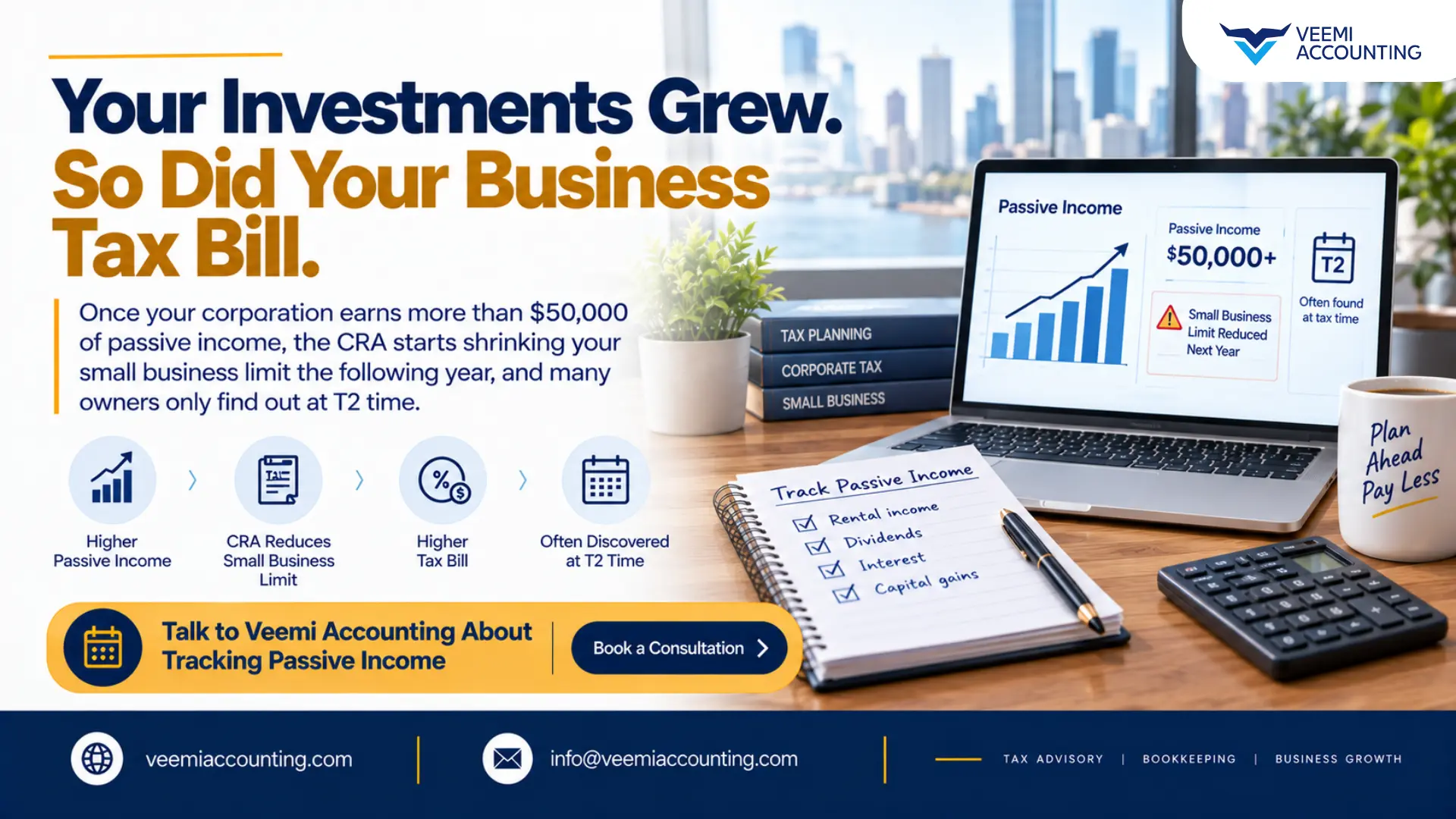
Since 2019, the $500,000 limit shrinks when your corporation earns too much passive investment income. The CRA calls this adjusted aggregate investment income (AAII).
The rule is simple to state:
👉 For every $1 of AAII above $50,000, your business limit drops by $5.
👉 At $150,000 of AAII, the business limit reaches zero.
👉 The reduction is based on AAII from the tax year that ended in the previous calendar year.
That last point is the one that catches owners off guard. The investment income you earn this year reduces next year’s small business limit. By the time your accountant sees the numbers, this year’s limit is already set.
Note: The $500,000 limit and the $50,000 threshold are shared among associated corporations. Investment income in a holding company counts if it’s associated with your operating company.
What Counts as Passive Income, and What Doesn’t
AAII is broadly the investment income your corporation earns. It generally includes:
✅ Interest from GICs, bonds, and high-interest savings accounts
✅ Portfolio dividends from public companies
✅ Rental income, unless the corporation employs more than five full-time employees in the rental business
✅ The taxable half of capital gains on investments
It generally doesn’t include capital gains on assets used in your active business, or your personal RRSP and TFSA. Those are yours, not the corporation’s.
Note: Only half of a capital gain is included in income. The proposed increase to the inclusion rate was cancelled in March 2025, so the inclusion rate remains 50%.
A Worked Example: What the Grind Costs a BC Consulting Firm
Say your BC consulting corporation earns $400,000 of active business income this year. It also holds a $1.5 million investment portfolio.
Last year, that portfolio produced:
👉 $60,000 of interest and rental income
👉 A $60,000 capital gain, of which $30,000 is taxable
Last year’s AAII was $90,000.
Here’s the grind:
Step | Amount |
AII above $50,000 | $40,000 |
Reduction ($40,000 × 5) | $200,000 |
This year’s business limit ($500,000 − $200,000) | $300,000 |
Active income taxed above the limit ($400,000 − $300,000) | $100,000 |
In BC, the combined corporate rate is about 11% on income eligible for the small business deduction and about 27% at the general rate. That 16-point gap on $100,000 is about $16,000 in extra corporate tax this year.
Part of that comes back later. Income taxed at the general rate can usually be paid out as eligible dividends, which are taxed at a lower personal rate. But the corporation loses the cash today, and that’s money you can’t reinvest.
Note: These are illustrative figures. Your accountant will calculate the exact cost using current provincial rates and your full tax picture.
If You’re in Ontario or New Brunswick, the Math Changes
Ontario and New Brunswick chose not to apply the passive income grind to their provincial small business rates.
So an Ontario corporation in the same situation loses the federal SBD on the $100,000, but keeps the Ontario small business rate. The extra cost is the 6-point federal gap, about $6,000 instead of $16,000.
That’s smaller, but it isn’t zero. And it can grow fast once AAII heads toward $150,000.
Why Most Owners Don’t See This Coming
The rule isn’t the hard part. The bookkeeping is.
We often see corporate investments recorded in ways that make AAII impossible to track during the year:
⚠️ Brokerage accounts never entered in the books, so only transfers in and out appear
⚠️ Interest, dividends, and capital gains combined in one “Investment Income” or “Other Income” account
⚠️ Sale proceeds booked as income, with no adjusted cost base, so the gain can’t be calculated
⚠️ Rental income from a corporate property mixed with operating revenue
⚠️ A holding company’s investment income left out of the picture entirely
When that happens, nobody can estimate AAII until the T2 is being prepared. By then, the grind for the following year is locked in.
We also see owners sell a large position in December to “clean up” a portfolio. One sale like that can add tens of thousands to AAII and cut next year’s limit, with no warning.
How to Track AAII Before It Costs You
You don’t need to stop investing through your corporation. You need to see the number in time to plan around it.
Separate every type of investment income in your books. Use distinct accounts for interest, portfolio dividends, rental income, and realized capital gains. Each one is treated differently.
Reconcile brokerage statements every month. Record the transactions inside the account, not just transfers in and out. Keep a running adjusted cost base for each holding.
Build a running AAII estimate each quarter. Add interest, rent, portfolio dividends, and half of realized gains. If it’s heading past $50,000 by the third quarter, your accountant still has time to act.
Include associated corporations. If you have a holding company, its AAII counts toward the same $50,000 threshold.
Ask your accountant about your options. Depending on your situation, options might include timing when gains are realized, realizing losses to offset gains, choosing investments that grow rather than pay interest, or other strategies such as an individual pension plan. These are decisions to make with your accountant, not from a blog post.
Note: A second grind applies when your associated group’s taxable capital in Canada passes $10 million, and the business limit reaches zero at $50 million. Larger groups should ask their accountant to check both.
When the CRA reviews a T2 and finds AAII was understated, the SBD claim is reduced and the extra tax comes with interest. That’s how a clean year ends in a reassessment notice that nobody planned for.
This Is Where Veemi Accounting Helps
This is where Veemi Accounting helps. Our dedicated team works from India, directly inside your own accounting software, using a named login you set up for us. Each month we:
👉 Record and reconcile your corporate brokerage and rental activity, with interest, dividends, rent, and capital gains in separate accounts
👉 Track the adjusted cost base of each holding so realized gains are calculated correctly
👉 Prepare a quarterly AAII estimate for your accountant, so they can see the grind coming while there’s still time to plan
Every file goes through a self-check and a team lead review before it reaches you. Your accountant then reviews it and files with the CRA. Access is through named logins with multi-factor authentication, client files stay in secure cloud systems, and our team works in a phone-free area under ISO 27001 certified information security controls.
Note: Your accountant stays responsible for tax advice and for filing your returns with the CRA. Our role is to keep the numbers they work from complete, accurate, and up to date.
A Strong Year Shouldn’t Come With a Surprise Tax Bill
The investments built up a cushion for your business. They shouldn’t quietly raise the tax rate on the business itself.
Where to start depends on your situation:
👉 If your corporation earned over $40,000 of investment income last year, ask your accountant for a projection of this year’s AAII now, not in March.
👉 If you have a holding company, check that its investment income is in the same projection.
👉 If you’re planning a large sale of investments, talk to your accountant before you sell, not after.
The grind works one year ahead, so your books need to as well. If your corporate investments are buried in one account and you want to see your AAII before your accountant does, Schedule a Consultation Call and we’ll show you what clear, current investment records look like.
Questions CCPC Owners Ask About Passive Income and the SBD
No. The grind only looks at investment income earned inside your corporation and any associated corporations. Your personal RRSP, TFSA, and non-registered accounts don’t count.
Next year. The business limit for a tax year is reduced based on AAII from the tax year that ended in the previous calendar year. At $70,000, next year’s limit would drop by $100,000, to $400,000.
Yes, but less. Ontario doesn’t apply the grind to its provincial small business rate, so you keep the Ontario rate. You still lose the federal 9% rate on the affected income.
Usually, yes. Rental income is generally treated as investment income unless the corporation employs more than five full-time employees in the rental business throughout the year. Your accountant can confirm how it applies to you.
Usually not for that year. Once the tax year closes, the AAII is set and the following year’s limit is fixed. That’s why tracking it during the year matters.