- Published on
- Veemi Accounting
- Last Modified
Owner-Operator Trucking Business in Canada? Why Fuel and IFTA Costs Get Missed in Basic Bookkeeping
It’s October 28. Your third-quarter IFTA return is due in three days. You have a fuel card statement, a shoebox of pump receipts, and an ELD report showing kilometres by province.
Nothing lines up. This post explains why fuel is the hardest cost to keep straight in a trucking business, what it costs when it goes wrong, and how to set up your books so every quarter is easier than the last.
Why Fuel Is Different From Every Other Trucking Expense
For most businesses, fuel is just an expense. For an owner-operator running across provincial or state lines, every litre affects three separate things:
👉 Your income tax, as a deductible business expense
👉 Your GST/HST return, where the tax included in the fuel price can be claimed as an input tax credit
👉 Your IFTA return, which compares the fuel tax you paid at the pump in each jurisdiction against the fuel you actually used there
A bookkeeping system that just records “Fuel: $8,400” handles the first one. It doesn’t handle the other two.
How IFTA Actually Works
The International Fuel Tax Agreement (IFTA) lets carriers report fuel tax to one base jurisdiction, usually their home province, instead of to every province and state they drive through.
You need an IFTA licence if your vehicle is used for business, travels in your home province and at least one other jurisdiction, and has two axles with a gross vehicle weight over 11,797 kg (26,000 lb), or three or more axles.
Each quarter, you report:
👉 Total kilometres driven, and kilometres in each province or state
👉 Total litres of fuel bought, and litres bought in each jurisdiction
Your fuel efficiency is total kilometres divided by total litres. That tells IFTA how much fuel you used in each jurisdiction. You owe tax where you used more fuel than you bought, and get a credit where you bought more than you used.
IFTA returns are due April 30, July 31, October 31, and January 31. You file even in a quarter when the truck didn’t move.
A Worked Example: One Quarter, Three Provinces
Say you’re an Ontario-based owner-operator. In the third quarter, you drove 36,000 km and bought 14,400 litres of diesel. That’s 2.5 km per litre.
Jurisdiction | Km driven | Litres used (km ÷ 2.5) | Litres bought | Result |
Ontario | 20,000 | 8,000 | 9,000 | Credit on 1,000 L |
Quebec | 8,000 | 3,200 | 1,400 | Tax owed on 1,800 L |
Manitoba | 8,000 | 3,200 | 4,000 | Credit on 800 L |
Each line is then multiplied by that jurisdiction’s rate from the IFTA tax rate matrix, and the totals are netted.
Now say 2,000 of the litres you bought in Manitoba went on a personal card and never made it into your books. On paper, you bought less fuel in Manitoba than you really did. You lose the credit for fuel tax you already paid at the pump, and you can end up paying that tax a second time.
There’s a GST/HST cost too. If $4,000 of Ontario fuel receipts go missing in a quarter, the HST included in them is about 460(4,000 × 13/113). Across a year, that’s roughly $1,840 of input tax credits gone.
Where Owner-Operator Bookkeeping Usually Goes Wrong
These are the patterns we see most in trucking books:
⚠️ Fuel card statements entered as one monthly lump, with no breakdown by province or state
⚠️ Fuel bought on personal cards or with cash never recorded
⚠️ Reefer fuel, DEF, and the personal pickup’s gas mixed in with tractor diesel
⚠️ US fuel purchases recorded in USD as if they were CAD
⚠️ ELD kilometres never reconciled against trip records and fuel purchases
⚠️ IFTA payments booked as fuel a second time, or IFTA refunds never recorded
⚠️ Meals recorded at the standard 50% instead of the 80% deduction available to long-haul truck drivers
Each mistake is small on its own. Together, they turn a quarterly return into a weekend of guesswork.
How to Set Up Fuel Records That Make IFTA Simple
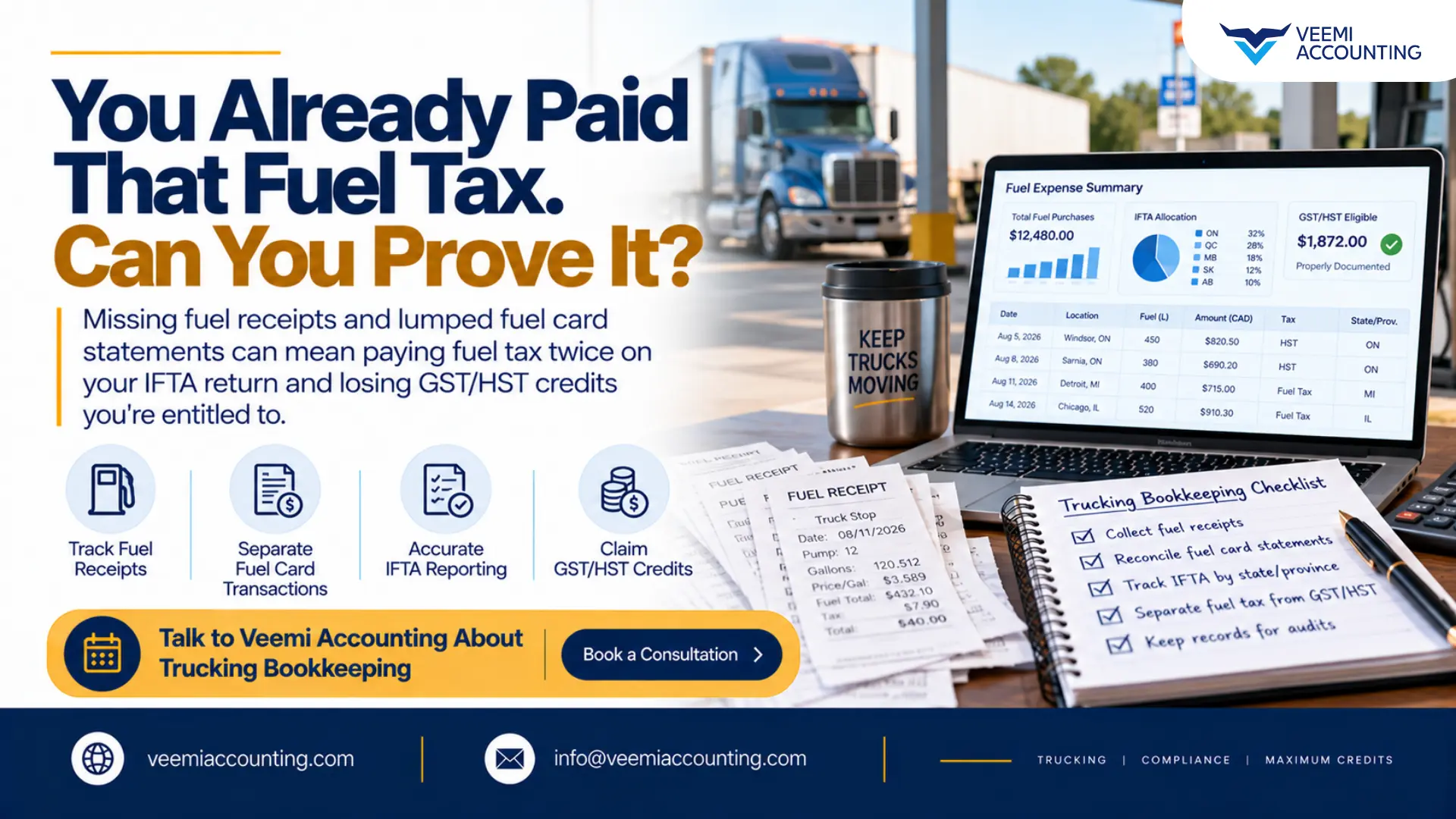
Record every fuel purchase separately. Each entry needs the date, location, jurisdiction, litres, fuel type, total cost, and the GST/HST or sales tax included. Fuel card data can usually be imported line by line.
Split fuel by type. Keep separate accounts for tractor diesel, reefer fuel, DEF, and any personal vehicle. Only the fuel used to drive the qualified vehicle belongs in IFTA.
Put every fuel purchase through a business card. If a personal card is used in an emergency, record the receipt that week.
Reconcile kilometres monthly. Match ELD or GPS distance by jurisdiction to your trip records, so the quarter-end report isn’t the first time anyone looks.
Convert US purchases properly. Record US fuel in USD and convert using a consistent exchange rate method.
Keep IFTA separate from fuel cost. Record IFTA payments and refunds in their own account, so fuel isn’t counted twice.
Keep records long enough. IFTA generally requires records for four years. The CRA generally requires six. Keeping everything for six years covers both.
GST/HST on fuel is one of the largest input tax credits an owner-operator has, so a messy fuel account often turns into a GST/HST return filed late while someone hunts for receipts.
Note: IFTA is administered by your base jurisdiction. In Ontario, that’s the Ministry of Finance. Rules on records, penalties, and audits are set through IFTA and your base jurisdiction, not the CRA.
This Is Where Veemi Accounting Helps
This is where Veemi Accounting helps. Our dedicated team works from India, directly inside your own accounting software, using a named login you set up for us. Each month we:
👉 Import and categorize your fuel card transactions line by line, separating tractor diesel, reefer fuel, DEF, and personal use
👉 Record fuel by jurisdiction, with GST/HST tracked separately for your input tax credits
👉 Reconcile litres and kilometres by province and state, and prepare a quarterly IFTA summary for you or your accountant to review and file
Every file goes through a self-check and a team lead review before it reaches you. You or your accountant then review the IFTA summary and file it with your base jurisdiction, and your accountant files your GST/HST and income tax returns with the CRA. Access is through named logins with multi-factor authentication, client files stay in secure cloud systems, and our team works in a phone-free area.
Note: You and your accountant stay responsible for filing your IFTA, GST/HST, and income tax returns. Our role is to keep the numbers they work from complete, accurate, and up to date.
Every Litre Should Count Once, Not Twice
You pay fuel tax at the pump in every province and state you drive through. Good records make sure you only pay it once.
Where to start depends on your situation:
👉 If your next IFTA return is due this month, reconcile your fuel card statement against your ELD kilometres this week, before the deadline.
👉 If you’ve been putting fuel on a personal card, gather those receipts for the current quarter and record them now.
👉 If your fuel is recorded as one monthly lump, ask your bookkeeper to split it by jurisdiction and fuel type from the start of next quarter.
Your truck already tracks every kilometre, so your books should track every litre. If fuel and IFTA are eating your weekends every quarter, Schedule a Consultation Call and we’ll show you what quarter-end looks like when the records are already done.
FAQs
No. IFTA covers qualified vehicles that travel in more than one jurisdiction. If you stay within one province, you pay that province’s fuel tax at the pump and don’t file IFTA returns.
Yes. IFTA licensees file every quarter, even with no kilometres or fuel purchases. A missing return is treated as late, not as zero.
Generally yes, if you’re a GST/HST registrant and the fuel is for your business. Keep receipts that show the GST/HST paid. US fuel purchases don’t include Canadian GST/HST, so there’s nothing to claim on them.
If your main business is driving a long-haul truck that transports goods, you can generally deduct 80% of eligible meal costs instead of the usual 50%. As a self-employed owner-operator, you can’t use the CRA’s simplified per-meal rate, so keep your actual meal receipts. Your accountant can confirm whether your trips qualify.
You may lose the IFTA credit for the fuel tax you paid in that jurisdiction, and the GST/HST input tax credit on those purchases. Fuel card statements can help, so ask your base jurisdiction what it accepts as a record.