- Published on
- Veemi Accounting
Importing From the US Into Canada? Why Multi-Currency Bookkeeping Gets Complicated
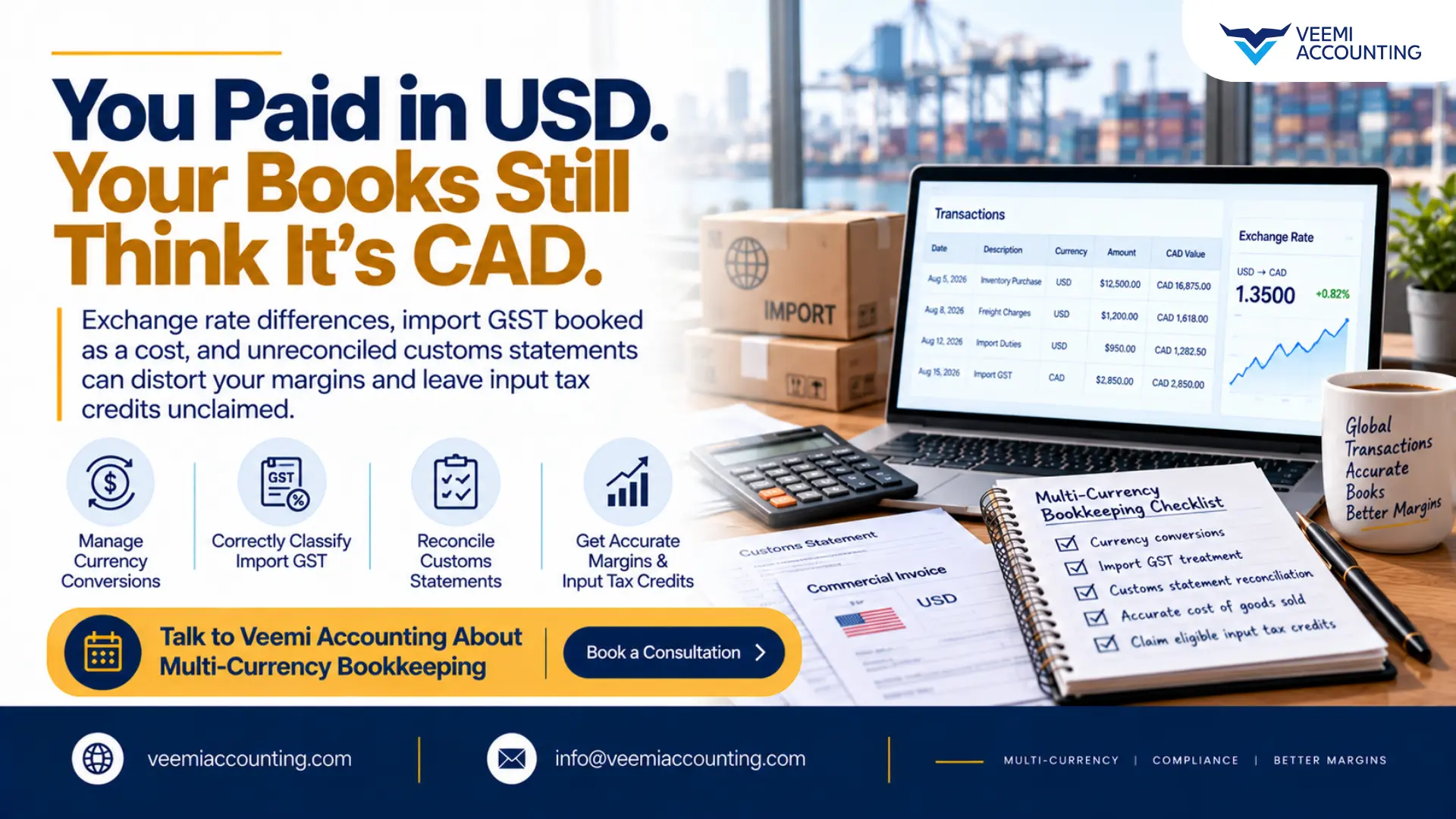
Your supplier invoice says US$40,000. Your bank statement says something different. Your customs broker’s bill adds GST, duty, and a brokerage fee, and your CBSA statement shows yet another number.
Four documents, one shipment, and none of them match. This post explains why US imports make Canadian bookkeeping complicated, what goes wrong, and how to keep your costs and GST/HST claims accurate.
Why One US Purchase Creates Four Different Numbers
A domestic purchase has one invoice and one payment. A US import has several moving parts, each at a different date and exchange rate:
👉 The supplier invoice in USD, dated when the goods ship
👉 The payment in USD, converted at your bank’s rate on the day you pay
👉 The customs entry, where the CBSA converts the value of the goods into CAD to calculate duty and GST
👉 Freight and brokerage, often billed separately, sometimes in USD and sometimes in CAD
Your books need to tie all four together. If they don’t, your inventory cost, gross margin, and GST/HST return will all be off.
Note: For tax purposes, the CRA generally expects foreign currency amounts to be converted using the Bank of Canada exchange rate for the day of the transaction, or another reasonable rate that you use consistently.
A Worked Example: One US Shipment Into Ontario
Say your Ontario home goods business orders US$40,000 of inventory. These exchange rates are for illustration only.
Item | Amount |
Invoice recorded at 1.37 | $54,800 (CAD) |
Paid 30 days later at 1.39 | $55,600 |
Foreign exchange loss | $800 |
Freight (US$1,200 at 1.38) | $1,656 |
Customs brokerage fee | $185 + $24.05 HST |
Duty (goods qualify under CUSMA) | $0 |
GST paid at the border (5% of the value for tax: CBSA value plus duty plus any surtax, say $54,900) | $2,745 |
Here’s how it should land in your books:
✅ Inventory (landed cost): $54,800 + $1,656 + $185 = $56,641
✅ Foreign exchange loss: $800, recorded separately when the invoice is paid
✅ GST/HST receivable (input tax credits): $2,745 + $24.05 = $2,769.05
Now here’s what we often see instead. The whole $58,345 that left the bank account is booked to “Cost of Goods Sold.” The $2,745 of import GST is buried in costs and never claimed, your margin looks worse than it is, and the exchange loss disappears into inventory.
Across 12 shipments a year, that’s more than $30,000 of unclaimed input tax credits.
Where Multi-Currency Bookkeeping Breaks Down
These are the mistakes we find most often in importers’ books:
⚠️ USD invoices entered as if they were CAD, so a US$40,000 bill shows as $40,000
⚠️ Import GST lumped into inventory or cost of goods sold instead of claimed as an input tax credit
⚠️ Freight, duty, and brokerage expensed separately instead of added to landed cost, which distorts margins by product
⚠️ USD bank accounts and credit cards never revalued, so the CAD balance in the books doesn’t match reality
⚠️ The CBSA statement of account never reconciled against customs payments
⚠️ Card and payment-platform currency conversion fees hidden inside purchase amounts
None of these stop the business from running. They just mean your numbers can’t be trusted when you need them for pricing, a bank loan, or your GST/HST return.
The Customs Side Changed in 2025
The Customs Rules Have Changed Twice Since 2025
Three changes since 2025 affect how importers keep their books.
CARM is now mandatory. Since May 20, 2025, the CBSA has required importers to have an account in the CARM Client Portal and to post their own financial security for Release Prior to Payment. Duties, surtaxes, and GST now appear on a monthly CBSA statement of account. Reconcile that statement every month, just like a bank statement.
Most 2025 counter-tariffs were removed. Canada lifted its retaliatory surtaxes on most US goods on September 1, 2025, but kept them on US steel, aluminum, and motor vehicles.
New counter-tariffs started on September 8, 2026. Canada now charges a surtax of 15%, 25%, or 50% of the value for duty on a list of US-origin goods. The surtax on many US steel and aluminum goods also rose from 25% to 50%.
That changes your landed cost. A surtax is part of the cost of the goods, not a recoverable tax, so it belongs in inventory. GST is also charged on top of it, because the CBSA adds the surtax to the value before calculating GST.
Say a shipment has a value for duty of $10,000 and falls under a 25% surtax:
👉 Surtax: $2,500, added to inventory cost
👉 GST: 5% of $12,500 = $625, claimable as an input tax credit if you’re the importer
Note: The surtax list is set by tariff item, not by broad product type. Check every product against the Department of Finance list with your customs broker before ordering.
Note: If you’re registered for GST/HST and you’re the importer, meaning the business that caused the goods to be imported, you can claim the GST paid at the border as an input tax credit. Keep the customs accounting documents for every entry. If your US supplier ships “delivered duty paid,” who can claim depends on how the sale is structured, so check with your accountant.
How to Set Up Your Books for US Imports
Turn on multi-currency in your accounting software. QuickBooks Online and Xero both support it. Set your home currency to CAD and record USD suppliers in USD, so the software tracks exchange gains and losses for you.
Keep a separate USD bank account in your books. If you hold US dollars, record that account in USD and revalue it at each month-end.
Build landed cost into inventory. Add freight, duty, brokerage, and any surtax to the cost of each shipment. Keep GST and HST out of it.
Track import GST as its own line. Record border GST from each customs entry in a GST/HST receivable account, so it flows into your return.
Reconcile the CBSA statement monthly. Match each entry to its shipment, and each payment to your bank.
Use one exchange rate policy consistently. Choose a method, such as the Bank of Canada daily rate, and use it the same way every month.
When the GST/HST from imports isn’t tracked properly, the return often gets left until the last minute, and that’s how importers end up dealing with a late GST/HST filing on top of the claim they missed.
This Is Where Veemi Accounting Helps
This is where Veemi Accounting helps. Our dedicated team works from India, directly inside your own accounting software, using a named login you set up for us. Each month we:
👉 Record USD supplier invoices and payments in their original currency and track exchange gains and losses
👉 Build landed cost for each shipment and record import GST as an input tax credit, not a cost
👉 Reconcile your CBSA statement of account, USD bank accounts, and payment platforms, and revalue USD balances at month-end
Every file goes through a self-check and a team lead review before it reaches you. Your accountant then reviews it and files with the CRA. Access is through named logins with multi-factor authentication, client files stay in secure cloud systems, and our team works in a phone-free area under ISO 27001 certified information security controls.
Note: Your accountant stays responsible for tax advice and for filing your returns with the CRA, and your customs broker stays responsible for customs entries. Our role is to keep the numbers they work from complete, accurate, and up to date.
Buying in USD Shouldn’t Mean Guessing in CAD
Your supplier invoices in one currency. Your margins, taxes, and lenders all work in another. Your books are where the two have to meet.
Where to start depends on your situation:
👉 If you’ve never claimed import GST, ask your accountant to review last year’s customs entries. Unclaimed input tax credits can generally be claimed within four years.
👉 If your USD invoices are entered in CAD, switch on multi-currency before your next shipment, not at year-end.
👉 If you also sell into the US, keep your cross-border sales records separate from your import costs, so each side reconciles on its own.
A clean shipment record turns four mismatched numbers into one landed cost you can price from. If your US imports are making your books harder to trust each month, Schedule a Consultation Call and we’ll show you what accurate multi-currency books look like.
Questions Canadian Importers Ask About Multi-Currency Books
The CRA generally accepts the Bank of Canada rate for the day of the transaction, or another reasonable rate used consistently. Your software’s built-in rate feed is usually fine as long as you don’t switch methods from month to month.
Generally yes, if you’re registered for GST/HST and you’re the importer, meaning the business that caused the goods to be imported for its commercial activities. Keep the customs accounting documents for each entry. If your supplier handled the import, ask your accountant who is entitled to the credit.
Exchange gains and losses on business transactions, such as paying a supplier, generally count as business income or expenses. Your accountant will confirm the treatment, especially for larger USD balances.
A USD account held at a Canadian bank isn’t specified foreign property. An account held in the US can be, unless it’s used to carry on your active business. If your total specified foreign property costs more than $100,000 at any time in the year, Form T1135 is generally required. Ask your accountant how this applies to your accounts.
It depends on the product. Since September 8, 2026, Canada has charged a surtax of 15%, 25%, or 50% on a list of US-origin goods, and up to 50% on many US steel and aluminum goods. Check each product’s tariff item with your customs broker before you order.