- Published on
- Veemi Accounting
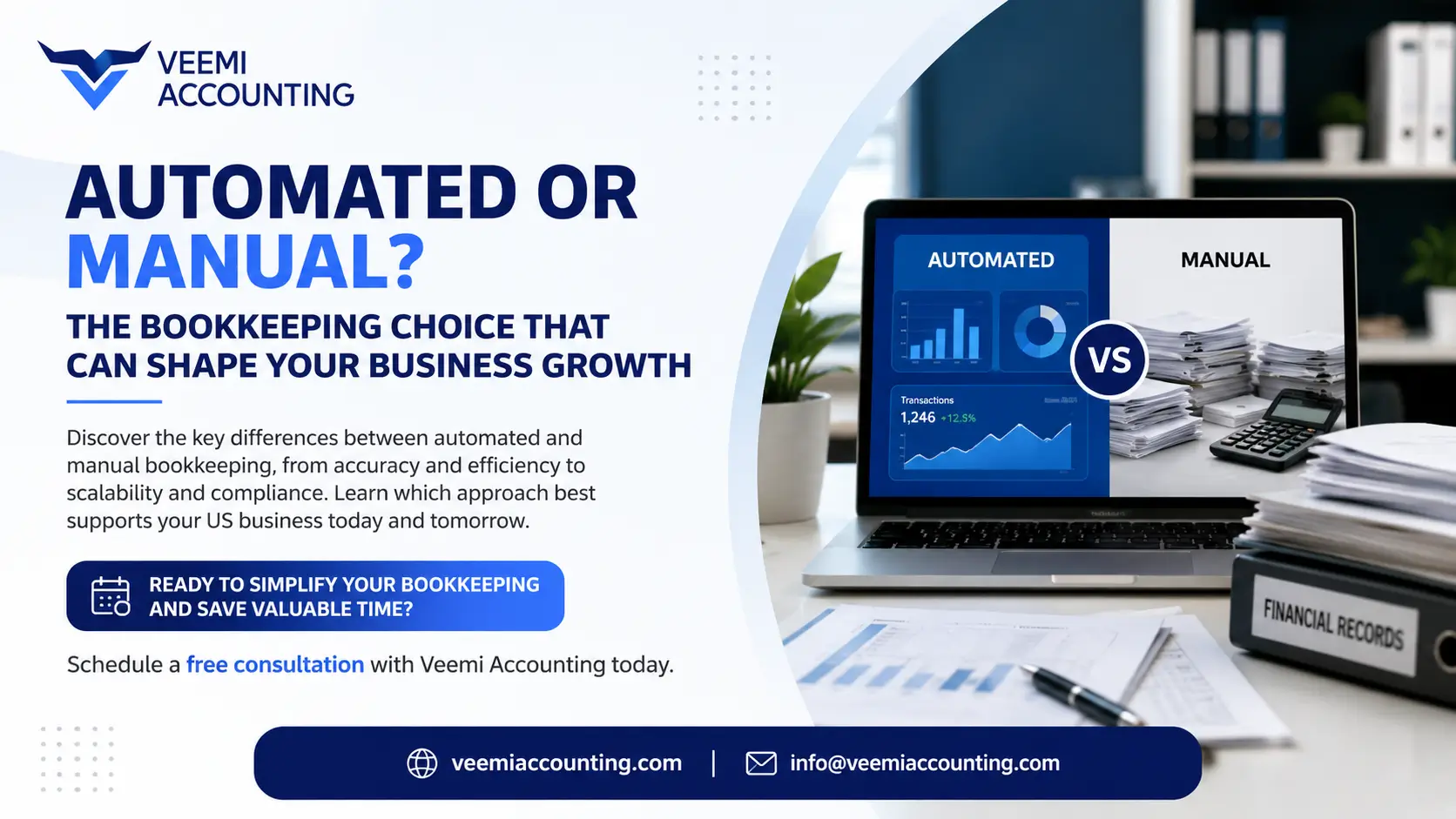
Automated Bookkeeping vs Manual Bookkeeping: Which Is Right for Your US Business?
For many US business owners, bookkeeping is one of the most important yet time-consuming responsibilities. Accurate financial records are essential for managing cash flow, making informed business decisions, preparing tax filings, and maintaining compliance. However, as transaction volumes increase, keeping books updated can quickly become overwhelming.
This is why the debate between automated bookkeeping solutions and traditional manual bookkeeping methods has become increasingly relevant. While some businesses still rely on spreadsheets and manual data entry, others are adopting cloud-based software that automates much of the bookkeeping process.
The right choice depends on your business size, transaction volume, growth plans, and operational needs. Understanding the strengths and limitations of each approach can help you determine which bookkeeping system best supports your business objectives.
In this guide, we will compare manual and automated bookkeeping, explore their advantages and disadvantages, and explain why many growing US businesses are turning to outsourced bookkeeping solutions that combine technology with expert financial oversight. Companies like Veemi Accounting help businesses leverage modern bookkeeping tools while ensuring accuracy, compliance, and financial clarity.
What Is Manual Bookkeeping?
Manual bookkeeping is the traditional method of recording, organizing, and managing financial transactions. Businesses using this approach typically maintain records through physical ledgers, spreadsheets, or manually updated accounting files.
Transactions such as sales, expenses, payroll entries, and bank reconciliations are entered and reviewed by business owners, bookkeepers, or accounting staff without significant automation.
For decades, manual bookkeeping was the standard approach for businesses of all sizes. While modern accounting software has become increasingly popular, some small businesses continue to rely on manual methods due to familiarity or perceived cost savings.
Pros of Manual Bookkeeping
Full Control Over Financial Records
Business owners can personally oversee every transaction and maintain direct control over their financial data.
No Software Dependency or Subscription Costs
Manual bookkeeping can often be managed using spreadsheets or paper-based systems without recurring software expenses.
Suitable for Very Small Businesses
Businesses with only a handful of monthly transactions may find manual bookkeeping manageable during their earliest stages.
Cons of Manual Bookkeeping
High Risk of Human Error
Manual data entry increases the likelihood of mistakes, duplicate entries, missing transactions, and reconciliation issues.
Time-Consuming
Recording transactions, reconciling accounts, and preparing reports manually requires substantial time and effort that could be spent on business growth.
Difficult to Scale
As transaction volumes increase, manual processes become harder to manage efficiently.
Limited Real-Time Compliance Visibility
Manual bookkeeping often creates delays in identifying tax liabilities, reporting obligations, and compliance issues, making IRS readiness more challenging.
What Is Automated Bookkeeping?
Automated bookkeeping uses cloud-based accounting software and digital tools to streamline financial recordkeeping. Instead of manually entering every transaction, software automatically imports, categorizes, and reconciles financial data.
Popular platforms such as QuickBooks Online, Xero, and FreshBooks connect directly to business bank accounts, credit cards, payment processors, and payroll systems. This integration allows transactions to flow into accounting records automatically.
The rise of automated bookkeeping USA solutions has transformed how businesses manage their finances by reducing administrative workload and improving reporting accuracy.
Automation can handle:
👉 Bank feed synchronization
👉 Transaction categorization
👉 Invoice creation
👉 Expense tracking
👉 Bank reconciliations
👉 Financial reporting
👉 Audit trail maintenance
While automation significantly reduces manual work, professional oversight remains essential to ensure data accuracy and proper financial interpretation.
Pros of Automated Bookkeeping
Faster Processing
Transactions are recorded automatically, reducing administrative burden and improving efficiency.
Improved Accuracy
Automation minimizes common data entry errors and helps maintain consistent records.
Real-Time Financial Visibility
Business owners can access updated financial reports and cash flow insights at any time.
Better Tax Compliance
Automated systems generate organized records, making tax preparation and audits more efficient.
Highly Scalable
As businesses grow, automated systems can accommodate increasing transaction volumes without significant increases in workload.
Cons of Automated Bookkeeping
Learning Curve
New users may require training to effectively utilize accounting software.
Initial Setup Requirements
System configuration and account integration can take time during implementation.
Subscription Costs
Most bookkeeping software requires monthly or annual subscription fees.
Human Oversight Still Needed
Automation can process transactions, but financial review and judgment remain important.
Key Differences: Side-by-Side Comparison
Factor | Manual Bookkeeping | Automated Bookkeeping |
Speed & Efficiency | Time-intensive data entry | Automated transaction processing |
Accuracy | Higher risk of human error | Reduced errors through automation |
Cost | Lower technology costs but higher labor costs | Software subscription plus setup costs |
Scalability | Difficult to manage growth | Easily adapts to higher transaction volumes |
Financial Visibility | Delayed reporting | Real-time dashboards and reports |
IRS Compliance | More manual effort is required | Better recordkeeping and audit trails |
Reporting | Often prepared manually | Generated automatically |
Best For | Very small or early-stage businesses | Growing businesses seeking efficiency |
While manual bookkeeping may initially appear less expensive, the hidden costs of time, inefficiency, and potential errors can become significant as a business expands.
Automated bookkeeping often provides stronger long-term value by improving accuracy, reducing administrative workload, and supporting better decision-making through real-time financial data.
Which Is Right for Your US Business?
The best bookkeeping method depends on your business’s current stage and future growth plans.
When Manual Bookkeeping May Still Work
Manual bookkeeping can remain practical if:
👉 You are a solo freelancer with limited monthly transactions.
👉 Your business is in a pre-revenue stage.
👉 Financial activity is minimal and straightforward.
👉 You have sufficient time to manage records yourself.
In these situations, a spreadsheet-based system may provide adequate functionality temporarily.
When to Switch to Automated Bookkeeping USA
Automation becomes increasingly valuable when:
👉 Transaction volumes are growing.
👉 You employ staff or contractors.
👉 You manage multiple revenue streams.
👉 Tax preparation is becoming more complex.
👉 Investors or lenders require financial reporting.
👉 Bookkeeping tasks consume excessive management time.
A growing business requires timely and accurate financial information. Delays caused by manual bookkeeping can impact decision-making, cash flow management, and compliance.
For most established businesses, automation provides greater efficiency and operational visibility than manual methods.
As businesses grow, accurate bookkeeping becomes the foundation for stronger financial decision-making. However, maintaining records is only the first step. Learn Why Bookkeeping Alone Is Not Enough for Business Growth and how financial insights can help drive profitability, cash flow management, and long-term planning.
The Best of Both: Outsourced Automated Bookkeeping
Many businesses discover that the most effective solution is not choosing between automation and manual bookkeeping; it is combining automation with professional oversight.
This hybrid model leverages modern accounting technology while ensuring experienced bookkeepers review financial records, identify discrepancies, and maintain compliance standards.
As a result, many organizations are adopting outsourced bookkeeping services in the USA instead of maintaining fully in-house bookkeeping operations.
Benefits include:
👉 Lower costs compared to hiring full-time accounting staff
👉 Greater accuracy and consistency
👉 Improved compliance support
👉 Access to experienced professionals
👉 Scalable bookkeeping processes
👉 Enhanced financial reporting
At Veemi Accounting, businesses benefit from cloud-based bookkeeping systems supported by a dedicated accounting team. Our professionals help maintain accurate records, ensure US GAAP alignment, and provide timely financial reporting that supports informed business decisions.
The result is a bookkeeping process that is efficient, accurate, and capable of supporting long-term business growth.
Many growing businesses find that combining automation with professional support delivers the best results. If you are evaluating whether to manage bookkeeping internally or work with an external provider, our guide on In-House vs Outsourced Bookkeeping in the USA: What is the Smarter Choice in 2026? explores the costs, scalability, and operational considerations of both approaches.
Top Automated Bookkeeping Tools Used in the USA
Several bookkeeping platforms dominate the US market.
QuickBooks Online
QuickBooks Online remains one of the most widely used accounting platforms among US small businesses. It offers comprehensive bookkeeping, invoicing, payroll integration, and reporting capabilities.
Xero
Xero is popular among growing businesses and accounting professionals due to its user-friendly interface, strong integrations, and scalable features.
FreshBooks
FreshBooks is particularly well-suited for freelancers, consultants, and service-based businesses that prioritize invoicing and project-based billing.
Wave
Wave provides a cost-effective bookkeeping solution for startups and micro-businesses, offering free accounting functionality for businesses with basic requirements.
Veemi Accounting works across these leading platforms, helping clients implement and optimize bookkeeping systems that align with their operational needs.
Transform Your Bookkeeping from a Business Burden into a Growth Advantage
The choice between manual and automated bookkeeping ultimately comes down to your business goals, transaction complexity, and growth trajectory. While manual bookkeeping may still be suitable for businesses with minimal financial activity, automated bookkeeping USA solutions offer clear advantages in efficiency, accuracy, scalability, and real-time financial visibility.
For most growing US businesses, the ideal approach is not simply adopting software, it is combining powerful automation with expert financial oversight. This ensures your books remain accurate, compliant, and actionable while freeing up valuable time to focus on running and growing your business.
Ready to simplify your bookkeeping and gain complete confidence in your numbers?
Schedule a free 30-minute consultation with Veemi Accounting today and discover how our outsourced bookkeeping solutions can support your business growth, improve accuracy, and save valuable time.
Veemi Accounting – Helping US businesses build stronger financial foundations through modern bookkeeping solutions.
FAQs
Yes. Modern accounting software can maintain detailed records, audit trails, and financial reports that support IRS compliance. However, a professional review is still recommended to ensure accuracy and proper classification.
Costs vary depending on the software and service level. Basic software subscriptions may start around $20–$50 per month, while comprehensive bookkeeping support may involve additional service fees.
Yes. Many bookkeeping platforms integrate with payroll software, CRM systems, payment processors, inventory management tools, e-commerce platforms, and banking institutions. These integrations reduce manual data entry and create a more connected financial ecosystem that improves operational efficiency.
Businesses should consider automation when they experience increasing transaction volumes, spend several hours each week updating financial records, struggle to reconcile accounts accurately, manage multiple revenue streams, or require more frequent financial reporting for lenders, investors, or management teams