How US CPA Firms Scale Faster Using White Label Accounting Partners
CPA firms across the United States are under increasing pressure to grow, but scaling has never been more difficult. Hiring qualified accountants is becoming harder, salaries are rising, and seasonal workload spikes (especially during tax season) often push teams to their limits.
This creates a frustrating paradox: firms have demand, but not the capacity to fulfill it.
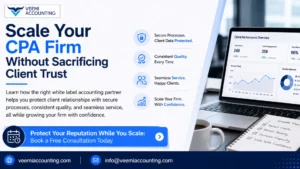
That’s where white-label accounting for CPA firms in the USA is quietly transforming how modern firms scale. Instead of expanding headcount, forward-thinking CPA firms are partnering with specialized accounting providers who work behind the scenes, enabling them to grow faster, serve more clients, and improve profitability without operational chaos.
In this blog, you will learn:
- What white-label accounting really means
- Why traditional scaling models are failing CPA firms
- How white-label partners unlock faster growth
- What to look for in the right partner
- How firms are already using this strategy to stay competitive
What Is White Label Accounting for CPA Firms?
White-label accounting is a business model where a third-party accounting team performs services that are delivered under your CPA firm’s brand name.
In simple terms:
- The work is outsourced
- The client-facing identity remains yours
- The client never knows a third party is involved
This is very different from traditional outsourcing. In standard outsourcing, clients may be aware that work is being handled externally. In white-label accounting, everything is seamlessly integrated into your firm’s operations, from communication to deliverables.
Common White Label Services:
- Bookkeeping
- Tax preparation support
- Financial statement preparation
- Write-ups and reconciliations
- Year-end closing
The goal is simple: expand your service capacity without expanding your internal team.
The Scaling Problem Most CPA Firms Face
Before understanding the solution, it’s important to recognize the core challenges limiting CPA firm growth.
1. Hiring Is Slower and More Expensive
The US accounting talent pool is shrinking, while demand is rising. Recruiting skilled accountants takes time and comes with high salary expectations.
2. High Overhead Costs
Full-time employees come with:
- Salaries
- Benefits
- Office space
- Software licenses
- Training costs
These fixed costs reduce flexibility and profitability.
3. Seasonal Workload Imbalance
CPA firms experience:
- Overload during tax season
- Underutilization during the off-season
This imbalance leads to inefficiencies and burnout.
4. Lost Revenue Opportunities
Many firms:
- Turn away clients
- Delay onboarding
- Avoid offering new services simply because they lack capacity.
This is where urgency builds; traditional scaling methods are no longer sustainable.
As CPA firms struggle with rising hiring costs and capacity issues, many are re-evaluating traditional staffing models. If you are still weighing your options, this detailed comparison of in-house vs outsourced bookkeeping in the USA can help clarify which approach aligns best with your growth strategy.
How White Label Partners Help CPA Firms Scale Faster
White-label accounting solves these problems by fundamentally changing how capacity is managed.
Instant Capacity Without Hiring
Instead of spending months recruiting, firms can immediately access trained accounting professionals ready to handle the workload.
Significant Cost Savings
Offshore or remote delivery models often cost significantly less than hiring in-house US staff, without compromising on output quality.
Faster Turnaround Times
Dedicated teams working exclusively on accounting tasks can process work faster and more efficiently, especially during peak periods.
Flexibility to Scale Up or Down
- Scale up during tax season
- Scale down during slower months
This eliminates the burden of fixed staffing costs.
This flexibility becomes especially critical during peak periods, which is why CPA firms are increasingly outsourcing during tax season has become a major trend across the US accounting industry.
Focus on High-Value Work
With backend tasks handled, CPA firm owners can focus on:
- Advisory services
- Client relationships
- Business development
A Practical Example (Non-Pushy)
Firms working with partners like Veemi Accounting often use white-label services to handle routine and high-volume tasks, allowing their in-house team to focus on strategic roles. The result is improved client satisfaction and better margins, without operational strain.
What to Look for in a White Label Accounting Partner (USA)
Not all white-label providers are equal. Choosing the right partner is critical.
1. US Compliance Expertise
Ensure the partner understands:
- US GAAP
- Federal and state tax regulations
- Industry-specific requirements
2. Data Security & Confidentiality
Look for:
- NDAs and confidentiality agreements
- Secure file-sharing systems
- Encryption protocols
- Controlled data access
3. Experience with CPA Firms
A provider experienced with US CPA firms will:
- Understand workflows
- Align with deadlines
- Maintain expected quality standards
4. Technology Compatibility
Your partner should be proficient in tools like:
- QuickBooks
- Xero
- Drake, UltraTax, or similar tax software
5. Communication & Turnaround
Reliable partners offer:
- Clear communication channels
- Defined turnaround times
- Consistent updates
A good white-label partner feels like an extension of your internal team.
Common Concerns CPA Firms Have, And the Reality
Adopting a white-label model often raises valid concerns. Let’s address them directly.
“Will my clients find out?”
No. White-label services are designed to be invisible. All deliverables are branded under your firm, and communication is controlled by you.
“Is the quality reliable?”
Yes, when working with experienced providers. Most white-label firms have:
- Multi-level review processes
- Standardized workflows
- Quality control checks
“What about data security?”
Reputable providers use:
- Encrypted systems
- Secure servers
- Restricted access protocols
Data protection is a top priority.
“Is it expensive to set up?”
Compared to hiring full-time staff, white-label accounting is significantly more cost-effective. There are no long-term employment commitments, and you pay based on workload.
The Reality:
White-label accounting reduces risk; it doesn’t increase it when implemented correctly.
Real-World Use Cases: When White Label Makes the Most Sense
White-label accounting is not just for large firms. It’s useful across different growth stages.
Small CPA Firms
- Offer full-service accounting without hiring multiple specialists
- Compete with larger firms
Mid-Sized Firms
- Handle tax season overload efficiently
- Avoid employee burnout
Firms Expanding Services
- Add advisory services like FP&A or CFO support
- Test new offerings without internal investment
Firms Expanding Geographically
- Serve clients across multiple US states
- Handle varied compliance requirements
In all cases, white-label accounting enables growth without operational bottlenecks.
Scale Smarter, Not Harder: Your Next Step Forward
White-label accounting has evolved from a behind-the-scenes workaround into a powerful growth strategy for modern CPA firms. It enables you to expand capacity, improve efficiency, and increase profitability, all without the stress of constant hiring or operational strain.
The reality is simple: the firms that are scaling fastest today are not doing it alone. They are leveraging strategic partnerships to stay agile, competitive, and client-focused.
If you are ready to unlock growth without adding overhead, now is the right time to explore what white-label accounting can do for your firm.
Take the next step toward scalable growth
Schedule your free 30-minute consultation here.
Let’s discuss how you can streamline operations, serve more clients, and grow your CPA firm with confidence.