What Happens If a US Business Files Taxes with Incomplete Records
It’s March. Deadlines are approaching. Your inbox is full of reminders. You sit down to finalize your business taxes, only to realize key receipts are missing, payroll reports don’t match, and several bank statements are missing.
For many small business owners, this scenario is all too familiar.
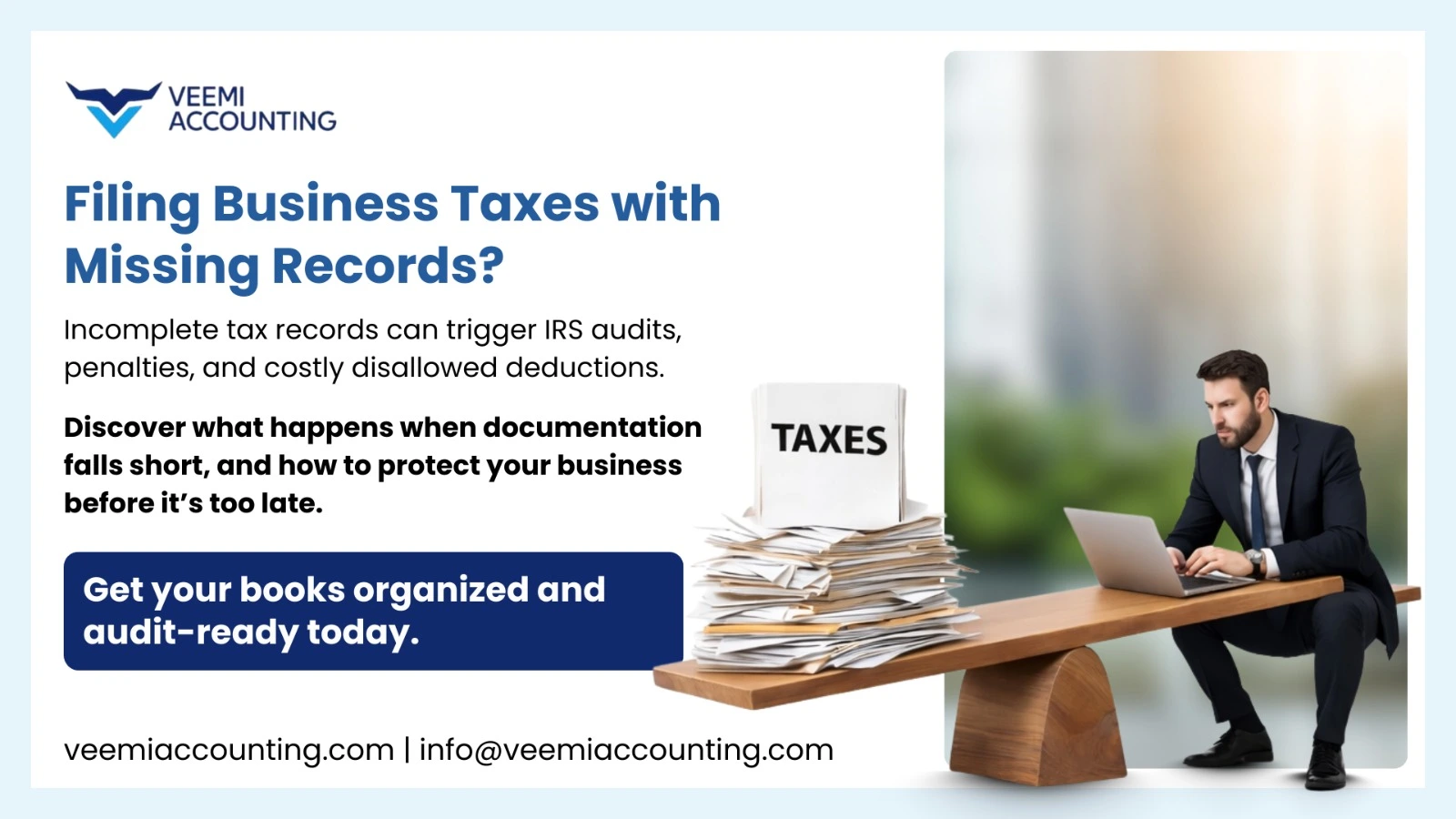
Complete and accurate records are the backbone of a successful tax filing. Without them, even an honest mistake can lead to serious consequences. Filing with incomplete records is not just stressful; it can trigger IRS audits, penalties, delayed refunds, disallowed deductions, and even legal exposure.
Understanding the risks and how to avoid them is critical to protecting your business.
Why Businesses End Up with Incomplete Records
Incomplete tax records rarely happen overnight. They usually result from small gaps throughout the year.
1. Poor Bookkeeping Habits
When bookkeeping is delayed or inconsistent, transactions pile up. Small errors compound over time, leading to missing or inaccurate data by year-end.
Many small businesses underestimate how much inconsistent bookkeeping impacts their bottom line. In fact, here is a detailed look at how poor bookkeeping is costing US small businesses thousands every year in penalties, missed deductions, and cash flow errors.
2. Informal Tracking Methods
Relying on:
- Spreadsheets
- Paper receipts
- Manual notes
- Memory
Often leads to lost documentation and reporting discrepancies.
3. Rapid Business Growth
As revenue increases, financial complexity increases. More clients, more vendors, more payroll, but without upgraded systems, recordkeeping suffers.
4. No Dedicated Accounting Support
Many small businesses operate without:
- A bookkeeper
- An accountant
- A structured financial review process
This creates blind spots in tax compliance.
Common Missing Records Include:
- Bank statements
- Payroll reports
- Expense receipts
- Vendor invoices
- Asset purchase documentation
Even a few missing items can significantly impact your return.
What the IRS Expects from US Businesses
The Internal Revenue Service (IRS) requires businesses to maintain accurate and complete financial records to support income, deductions, and credits claimed on tax returns.
1. Record Retention Rules (3–7 Year Standard)
In general:
- Keep records for at least 3 years from the date you file
- Keep records for 6–7 years if income is underreported by more than 25%
- Keep payroll tax records for at least 4 years
2. Required Documentation Includes:
- Gross income records
- Expense receipts and invoices
- Payroll documentation
- Asset purchase and depreciation schedules
- Bank and credit card statements
While small businesses are not legally required to follow strict GAAP standards in all cases, maintaining Generally Accepted Accounting Principles (GAAP)-aligned records improves compliance and credibility.
Failure to meet IRS documentation standards can raise red flags quickly.
Consequences of Filing Taxes with Incomplete Records
This is where the risks become serious.
1. IRS Audits & Increased Scrutiny
Incomplete or inconsistent tax returns often trigger automated IRS review systems.
Red flags include:
- Large deductions without supporting documentation
- Income inconsistencies compared to prior years
- Mismatched payroll filings
If audited, the burden of proof is on the business owner.
No documentation = no defense.
2. Penalties & Interest
There are multiple penalty categories businesses face:
Failure-to-File Penalty
- Typically, 5% of unpaid taxes per month (up to 25%)
Failure-to-Pay Penalty
- 0.5% per month on unpaid taxes
Accuracy-Related Penalty
- Up to 20% of the underpaid amount
Interest accrues daily.
Even unintentional mistakes can be costly.
Filing with incomplete records is one of the most common tax filing mistakes US businesses make when rushing in March, often resulting in avoidable IRS scrutiny and penalties.
3. Disallowed Deductions
One of the most overlooked risks:
If you cannot provide documentation for:
- Travel expenses
- Business meals
- Equipment purchases
- Contractor payments
The IRS can disallow those deductions.
Result?
You pay taxes on income you didn’t actually keep.
This often costs businesses far more than expected.
4. Delayed Refunds or Processing
Incomplete filings may:
- Trigger review requests
- Require additional documentation
- Delay refund processing
For businesses relying on refunds for cash flow, this can create operational strain.
5. Legal Liability
In severe cases, incomplete records combined with misreporting can escalate to allegations of:
- Negligence
- Substantial understatement
- Tax fraud
Sole proprietors and certain S-Corp owners may face personal liability for unpaid taxes.
The financial and reputational damage can be long-term.
6. Damaged Business Credit & Reputation
Unresolved tax issues can impact:
- Loan approvals
- Investor confidence
- Vendor relationships
- Government contract eligibility
Tax compliance directly affects your business’s credibility.
What to Do If You Are Missing Records
If you discover gaps before filing, act immediately.
1. Contact Financial Institutions
Request duplicate:
- Bank statements
- Credit card statements
- Loan records
Most institutions provide digital archives.
2. Reconstruct Records
Use:
- Email confirmations
- Vendor invoices
- Accounting software exports
- Payroll provider reports
You can often rebuild missing data with careful review.
3. Use Accounting Software to Fill Gaps
Cloud-based tools help centralize records and reconcile discrepancies.
4. File for an Extension
Businesses can file:
- Form 4868 (for sole proprietors filing with personal return)
- Form 7004 (for corporations/partnerships)
Important:
An extension gives more time to file, not more time to pay.
Estimated taxes must still be paid by the original deadline.
5. Consult a Professional Accountant
A tax professional can:
- Assess risk exposure
- Identify reconstructable deductions
- Reduce audit risk
- Develop a correction strategy
Early intervention often limits penalties.
How to Prevent Incomplete Records in the Future
Prevention is far less expensive than correction.
1. Implement Monthly Bookkeeping
Reconcile:
- Bank accounts
- Credit cards
- Payroll reports
Every month, not annually.
2. Use Cloud-Based Accounting Software
Popular tools include:
These systems:
- Automate transaction imports
- Store receipts digitally
- Generate real-time financial reports
3. Separate Business & Personal Finances
Maintain:
- Dedicated business bank accounts
- Separate credit cards
- Clear expense categorization
Commingling funds creates documentation issues.
4. Conduct Quarterly Reviews
Quarterly financial reviews help:
- Catch errors early
- Prepare for estimated tax payments
- Adjust deductions proactively
5. Partner with an Outsourced Accounting Firm
Year-round support ensures:
- Consistent recordkeeping
- Compliance monitoring
- Tax-ready books at all times
This eliminates last-minute chaos.
Stay Audit-Ready: How Veemi Accounting Prevents Incomplete Tax Records
At Veemi Accounting, we specialize in:
- Small business bookkeeping
- Tax preparation & compliance
- Financial cleanup & reconstruction
- Ongoing advisory support
We don’t just prepare taxes; we manage your records year-round so you are always audit-ready.
Don’t Let Incomplete Records Put Your Business at Risk
Incomplete tax records are not just a filing inconvenience; they can expose your business to audits, penalties, disallowed deductions, cash flow disruption, and even legal consequences.
The longer recordkeeping issues go unaddressed, the more expensive they become.
The good news? These risks are entirely preventable with structured bookkeeping, proactive tax planning, and professional oversight. Whether you are currently facing missing documentation or simply want to avoid future compliance problems, taking action now protects your revenue, reputation, and peace of mind.
If your books feel disorganized, or you are unsure whether your records would withstand IRS scrutiny, now is the time to fix it.
Schedule a free 30-minute consultation with Veemi Accounting today.
Let’s ensure your business stays compliant, audit-ready, and financially strong year-round.