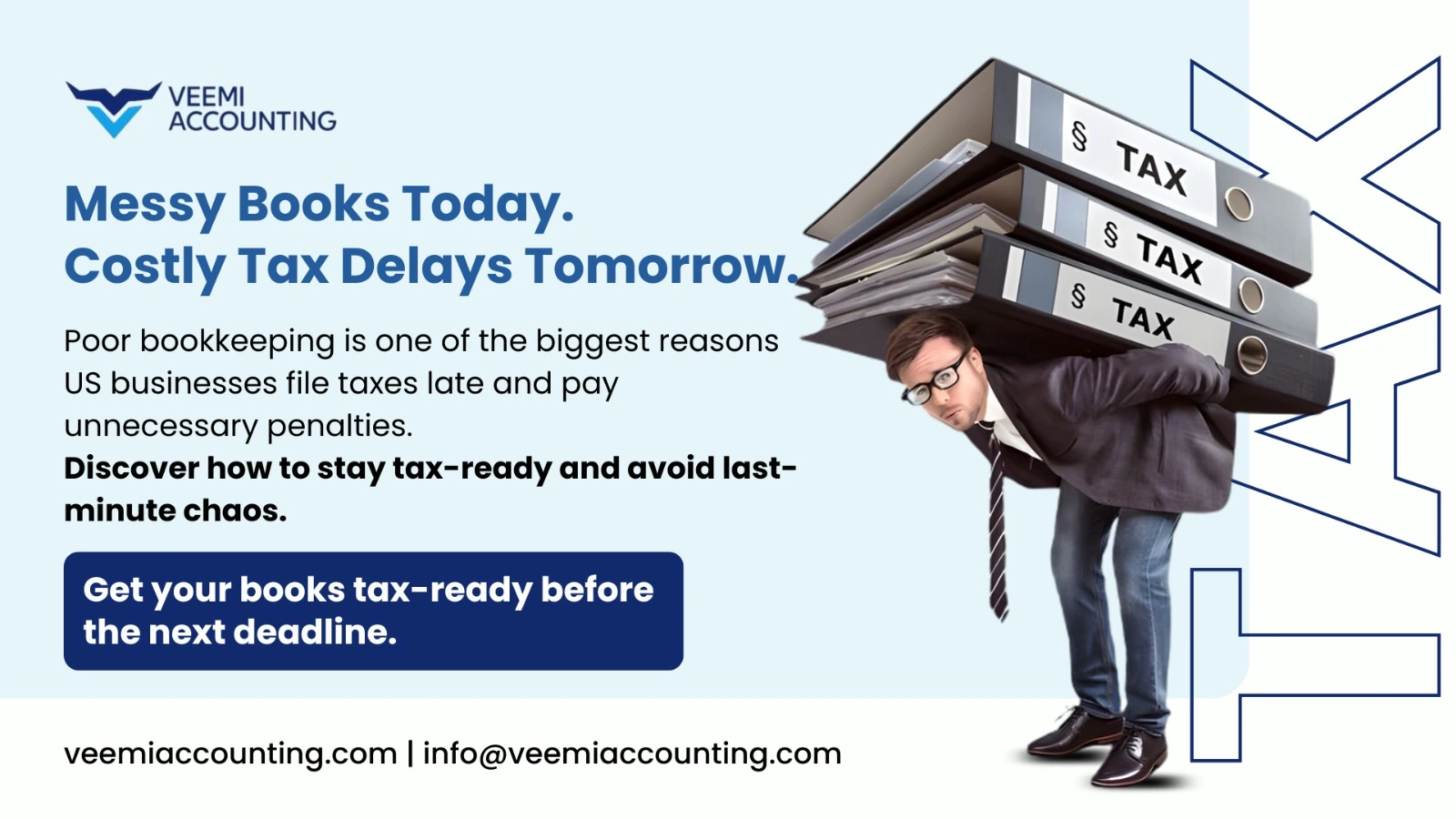
How Poor Bookkeeping Delays Tax Filing for US Businesses
The Costly Domino Effect of Disorganized Books During Tax Season
Every year, thousands of US businesses enter tax season unprepared. What starts as a few missing receipts or unreconciled bank statements quickly turns into missed deadlines, mounting penalties, and unnecessary stress.
According to the Internal Revenue Service, failure-to-file penalties can reach 5% of unpaid taxes per month, up to 25%. Yet most delays are not caused by complicated tax laws; they stem from poor bookkeeping.
Thesis: Poor bookkeeping is the hidden culprit behind most tax filing delays for US businesses.
In this article, you will learn:
- How bookkeeping directly impacts tax preparation
- The most common bookkeeping mistakes that cause delays
- The real financial and operational consequences
- Industry-specific challenges
- How proper bookkeeping eliminates tax-season chaos
The Direct Connection Between Bookkeeping and Tax Filing
Bookkeeping is the foundation of tax preparation. Tax returns are built from:
- Profit & Loss statements
- Balance Sheets
- General ledgers
- Payroll reports
- Expense documentation
If bookkeeping is incomplete or inaccurate, tax filing cannot proceed.
The Timeline Problem
Tax preparation begins in January or February.
Good bookkeeping should happen daily, weekly, and monthly, year-round.
When businesses attempt to “catch up” 12 months of financial data in a few weeks, errors multiply, and deadlines slip.
“Catching up” rarely works because:
- Transactions must be categorized
- Accounts must be reconciled
- Missing documents must be retrieved
- Adjustments must be reviewed
By the time books are cleaned up, filing deadlines are dangerously close.
If you are unsure what financial reports should be ready before filing, our guide Tax Season 2026: A Step-by-Step Checklist for US Business Owners outlines exactly what to prepare before handing documents to your tax professional.
Common Bookkeeping Mistakes That Cause Tax Delays
Missing or Incomplete Records
Examples:
- Lost receipts
- Missing vendor invoices
- Unrecorded transactions
- Forgotten subscriptions
Without documentation, legitimate deductions cannot be claimed. Accountants either pause filing or exclude deductions altogether.
Mixing Personal and Business Finances
Using one account for both personal and business expenses creates a cleanup nightmare.
Untangling commingled funds requires:
- Reviewing every transaction
- Separating personal from business
- Reclassifying expenses
This process can take hours, even days, and raises red flags with the Internal Revenue Service.
Inconsistent Record Updates
The “shoeboxing” problem, updating books once a year, creates massive backlogs.
Quarterly bookkeeping is better than annual.
Monthly bookkeeping is better than quarterly.
Real-time bookkeeping is ideal.
Delays compound quickly, making year-end cleanup overwhelming.
Improper Expense Categorization
Common errors include:
- Recording assets as expenses
- Misclassifying contractor payments
- Mixing Cost of Goods Sold with operating expenses
Incorrect categorization affects:
- Tax form accuracy
- Deduction calculations
- Financial statements
One wrong classification can ripple through the entire return.
Unreconciled Bank Accounts
Reconciliation means matching your books with bank and credit card statements.
If accounts aren’t reconciled:
- Income may be missing
- Expenses may be duplicated
- Balances may not match
Tax filing cannot move forward with discrepancies. Fixing reconciliation issues during tax season significantly delays the preparation process.
Poor Documentation of Deductions
The IRS requires substantiation for deductions.
Common gaps:
- No mileage logs
- Missing home office calculations
- No proof of business meals
- Unverified charitable donations
Without documentation, businesses either lose deductions or increase audit exposure.
The Cascading Consequences of Tax Filing Delays
Financial Penalties
Failure-to-file penalty:
Failure-to-pay penalty:
Plus interest.
Example: If a business owes $20,000 and files five months late, penalties alone could reach $5,000, excluding interest.
Poor bookkeeping becomes expensive quickly.
Cash Flow Disruption
Delayed filing may mean:
- Delayed refunds
- Uncertainty about tax liability
- Postponed financial decisions
Without finalized numbers, confident planning becomes impossible.
Operational Stress
Tax chaos leads to:
- Overtime costs
- Burnout
- Distraction from revenue-generating activities
Instead of growing the business, leaders spend time repairing records.
Increased Audit Risk
Late filings and rushed returns increase error rates.
Errors increase audit exposure.
Patterns of late filing may also attract scrutiny.
Missed Strategic Opportunities
Tax-saving strategies must be implemented before year-end:
- Timing income
- Accelerating expenses
- Retirement contributions
- Depreciation planning
Without accurate books, proactive tax planning is impossible.
Industry-Specific Bookkeeping Challenges
E-commerce Businesses
Challenges include:
- Multi-platform sales tracking
- Payment processor reconciliation
- Multi-state sales tax
Disorganized data can halt tax preparation entirely.
Service-Based Businesses
Complications include:
- Retainer vs. earned revenue tracking
- Deposit management
- Project-based accounting
Improper revenue recognition leads to reporting delays.
Retail & Inventory Businesses
Key issues:
- Cost of Goods Sold calculations
- Inventory valuation methods
- Physical vs. recorded discrepancies
Inventory errors significantly distort taxable income.
Contractors & Freelancers
Pain points include:
- 1099 contractor tracking
- Vehicle expense logs
- Home office deductions
- Estimated tax payments
Missing quarterly payments can trigger additional penalties.
The True Cost of Poor Bookkeeping
Time Cost
Fixing one year of messy books may take 20 to 60+ hours.
Maintaining clean books monthly may require only 2–4 hours.
Prevention is cheaper than repair.
Financial Cost
Poor bookkeeping leads to:
- IRS penalties
- Rush accounting fees
- Lost deductions
- Increased audit risk
Opportunity Cost
Time spent fixing books could be spent on:
- Sales
- Marketing
- Expansion
- Process improvement
Disorganized books don’t just delay tax filing; they directly reduce profitability through penalties, missed deductions, and higher accounting costs. If you want to understand the full financial impact of poor bookkeeping on US small businesses, read our detailed guide: Poor Bookkeeping Is Costing US Small Businesses Thousands.
How Proper Bookkeeping Streamlines Tax Filing
Real-Time Financial Clarity
When books are current:
- You always know where you stand
- There are no tax-time surprises
- Decisions are data-driven
Simplified Tax Preparation
Clean books mean:
- Faster return preparation
- Lower accounting fees
- Greater accuracy
Tax season becomes procedural, not stressful.
Proactive Tax Planning
Year-round bookkeeping enables:
- Strategic expense timing
- Deduction optimization
- Tax forecasting
- Retirement planning
Audit Protection
Organized documentation provides:
- Faster responses
- Reduced risk
- Peace of mind
Best Practices to Prevent Tax Delays
Implement Consistent Systems
- Use reliable accounting software
- Set up a proper chart of accounts
- Document procedures
Maintain Regular Schedules
- Record transactions daily
- Reconcile weekly
- Review financials monthly
Separate Business and Personal Finances
- Dedicated business accounts
- Business credit cards
- Clear owner draw tracking
Work with Professionals
DIY bookkeeping may work initially. But as businesses grow, complexity increases, and errors become costly.
Professional bookkeeping ensures tax readiness year-round.
From Tax Chaos to Tax Confidence: Take Control Before the Next Deadline
Poor bookkeeping doesn’t just delay tax filing; it silently drains your business through penalties, missed deductions, and unnecessary stress.
The good news? Most tax delays are preventable.
When your books are clean and current:
- Tax season becomes predictable
- Accounting costs decrease
- Strategic planning improves
- Confidence increases
The difference between chaos and confidence is preparation.
Ready to stay Tax Ready Year Round?
If you are tired of scrambling every tax season, fix the root cause.
Schedule a free 30-minute consultation with Veemi Accounting to discover how organized bookkeeping can eliminate tax delays for good.
Don’t wait until the next deadline is near.
Invest in better bookkeeping today, and make tax season the easiest part of your financial year.