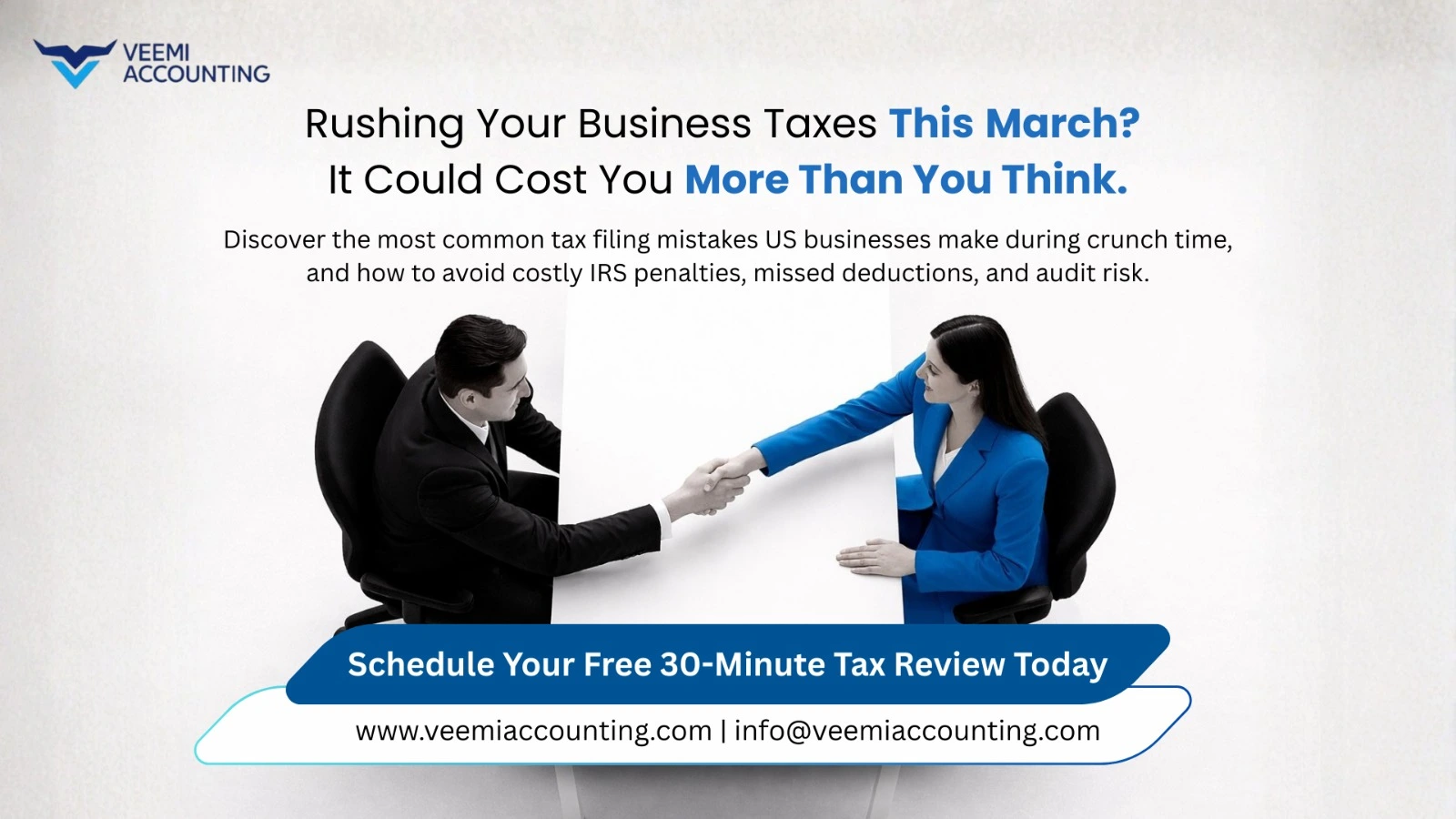
Common Tax Filing Mistakes US Businesses Make When Rushing in March
March is crunch time for US businesses.
As the US business tax deadline approaches, inboxes fill with reminders, accountants get overwhelmed, and business owners scramble to gather receipts, statements, and financial reports. Unfortunately, when taxes are rushed, mistakes happen, and those mistakes can cost thousands in IRS penalties, missed deductions, and even audits.
Many businesses delay tax preparation due to cash flow concerns, understaffing, operational demands, or simple procrastination. But waiting until March to “deal with taxes” often leads to preventable business tax errors that create long-term financial consequences.
At Veemi Accounting, we see the same common tax filing mistakes every year. The good news? Nearly all of them are avoidable with proper planning and professional guidance.
Below are the 10 most common tax filing mistakes small businesses make when rushing in March, and how to avoid them.
1. Misclassifying Workers (Independent Contractors vs. Employees)
The Mistake
Treating employees as independent contractors (issuing 1099s instead of W-2s) to avoid payroll taxes.
Why It Happens
Many business owners misunderstand IRS classification rules. Some believe that simply signing a contractor agreement makes someone a 1099 worker.
The Cost
Misclassification can result in:
- Back payroll taxes
- Interest and penalties
- Unpaid overtime claims
- Potential lawsuits
The IRS uses three main criteria:
- Behavioral control
- Financial control
- Nature of the relationship
If you control how and when someone works, they may legally be an employee.
2. Missing or Incorrect 1099 Forms
The Mistake
Failing to issue 1099-NEC or 1099-MISC forms to contractors or vendors paid over $600.
Why It Happens
Poor bookkeeping and failure to collect W-9 forms upfront.
The Cost
IRS penalties range from $50 to $280 per missing or incorrect form, and higher if intentionally ignored.
How to Avoid It
- Collect W-9 forms before payment
- Track vendor payments throughout the year
- Use accounting software to flag $600+ payments.
3. Overlooking Deductible Business Expenses
One of the most common tax filing mistakes is simply failing to claim legitimate deductions.
Frequently Missed Deductions:
- Home office expenses
- Vehicle mileage
- Software subscriptions
- Professional development
- Business insurance
- Marketing expenses
The result? Paying more tax than necessary.
Prevention:
- Keep organized records
- Use expense tracking tools
- Conduct year-end deduction reviews
4. Failing to Separate Personal and Business Expenses
Using one bank account for everything creates chaos.
When personal and business transactions are mixed, tax preparation becomes unnecessarily complicated, especially during the March rush. What seems convenient throughout the year often turns into hours of sorting receipts, reconciling transactions, and justifying deductions.
The Risk:
- IRS audit red flags
- Disallowed deductions
- Hours of sorting transactions
- Increased likelihood of reporting errors
Commingling expenses is also one of the biggest signs of weak financial systems. In fact, as we explain in our article on how poor bookkeeping is costing US small businesses thousands, messy books don’t just create stress; they can directly increase your tax liability and compliance risk.
The Solution:
- Maintain separate bank accounts
- Use business credit cards exclusively
- Reconcile accounts monthly
- Implement structured bookkeeping processes
Clean books reduce March stress dramatically, and make your tax return faster, safer, and more accurate.
5. Incorrect Calculation of Cost of Goods Sold (COGS)
For product-based businesses, COGS directly impacts taxable income.
The Mistake:
- Not accounting for beginning inventory.
- Failing to count the ending inventory.
- Guessing inventory values.
The Cost:
- Overstated income (higher taxes)
- Understated income (audit risk)
Best Practice:
- Conduct physical inventory counts
- Reconcile monthly
- Use inventory management systems
6. Neglecting Quarterly Estimated Tax Payments
Businesses that skip quarterly tax payments often face underpayment penalties.
Deadlines:
- April 15
- June 15
- September 15
- January 15
Failing to pay quarterly estimates leads to IRS penalties and interest, even if you pay in full in April.
7. Math Errors and Data Entry Mistakes
Simple number transpositions can trigger IRS notices.
Common examples:
- Incorrect EIN
- Misreported income totals
- Wrong Social Security numbers
- Duplicate entries
Manual entry increases risk.
8. Missing Section 179 & Bonus Depreciation Opportunities
Many businesses fail to maximize deductions on equipment purchases.
Section 179:
Allows immediate expensing of qualifying equipment instead of depreciating over years.
Bonus Depreciation:
Additional first-year deduction benefits.
Rushing in March often means these opportunities were never strategically planned before year-end.
9. Incomplete or Missing Documentation
Filing without receipts or bank statements is risky.
If Audited:
- Deductions can be disallowed
- Penalties applied
- Stress levels skyrocket
Best Practices:
- Scan receipts immediately
- Use cloud storage
- Maintain digital files
Proper documentation protects your business.
10. Choosing the Wrong Business Entity or Tax Election
As businesses grow, their tax structure may no longer be optimal.
For example:
- An LLC might benefit from an S-Corp election
- A C-Corp may not be tax-efficient for certain profit levels
Failure to review entity structure can lead to excessive self-employment taxes.
11. BONUS: Waiting Until the Last Week to Hire an Accountant
Calling an accountant in late March significantly limits your options.
By the final weeks before the US business tax deadline, most strategic opportunities are already gone. At that stage:
- Tax strategy is minimal
- Extensions may be required
- Rush fees can apply
- Stress levels increase
- Review time is compressed, increasing the risk of business tax errors
Tax preparation is most effective when done proactively and not reactively.
If you are unsure what should already be completed before filing, reviewing a structured guide on what US businesses should prepare before April 15 can help you quickly identify gaps and avoid last-minute surprises. Having your financial reports, reconciliations, payroll summaries, and documentation organized in advance dramatically reduces the risk of IRS penalties and missed deductions.
The businesses that experience smooth tax seasons aren’t scrambling in March; they are planning throughout the year.
How Veemi Accounting Helps You Avoid These Mistakes
At Veemi Accounting, we go beyond basic tax preparation.
Year-Round Bookkeeping
Clean books mean stress-free tax season.
Proactive Tax Planning
We identify savings opportunities before December 31.
Compliance Expertise
Stay current with changing IRS regulations.
Multi-Level Review
Errors are caught before submission.
Technology Integration
Cloud-based tracking and automated systems.
Dedicated Support
We are available when you need guidance, not just in March.
Our outsourced accounting tax preparation services are designed to eliminate tax filing mistakes that small businesses commonly face.
Don’t Let March Decide Your Financial Future
Tax season stress isn’t caused by complexity; it is caused by last-minute preparation.
The most common tax filing mistakes US businesses make are not about intelligence or effort. They happen because business owners are stretched thin, juggling operations, payroll, growth, compliance, and taxes become a reactive task instead of a proactive strategy.
But it doesn’t have to be this way.
With proper bookkeeping, quarterly planning, documentation systems, and entity reviews, tax season can become predictable, strategic, and even advantageous. The businesses that save the most in taxes aren’t scrambling in March; they are planning in January.
If this year felt rushed or overwhelming, consider it a wake-up call, not a setback. The right accounting partner can help you avoid IRS penalties, capture every eligible deduction, and build a smarter tax strategy for the future.
Your business deserves proactive planning, not last-minute panic.
Ready for a Stress-Free Tax Season?
Schedule a free 30-minute consultation with Veemi Accounting today.
Let’s review your current setup and identify opportunities to improve your tax position before the next deadline.
Book your call here.